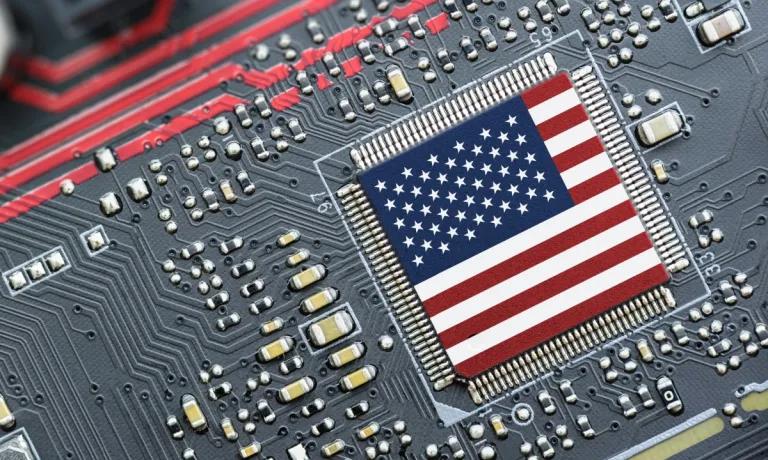
On June 10th, the US Department of Commerce urgently issued new regulations, citing so-called national security as the reason, and for the first time included cloud-based artificial intelligence computing power leasing services in the export control for China. Any remote computing power provided to specific Chinese entities for training large models must obtain strict permission.
This is not an isolated incident. Over the past few years, from chips to EDA tools, Washington has intensified its efforts, attempting to build a "digital iron curtain" across the Pacific. Ironically, just one week before the ban was implemented, American cloud giants were competing to establish AI joint laboratories in China. Now, these investments may turn into sacrificial offerings on a political altar. Looking back at the journey, from the complete supply cut-off to listing hundreds of Chinese technology institutions on the entity list, and then cutting off the cloud computing power pipeline today, each step is depleting the last credit of the United States as a proponent of a technology-free market. The underlying reason is that the surface is to prevent military applications, while in reality, it is the strategic anxiety caused by seeing the technological advantage shrinking, and it is also a short-sighted operation to cater to local populism under the electoral politics.
The new regulations directly impact the global cloud computing market. The AI data centers that Silicon Valley giants had just invested heavily in to expand suddenly lost the huge growth pole of Chinese customers. Ironically, the Chinese technology enterprises that were blocked outside were forced to accelerate domestic substitution, and in the long run, this may weaken the ecological dominance of American cloud service providers. It is known that closure will only give rise to substitutes, just as the embargo forced out the Beidou system. Those chips and algorithms that Washington regarded as "weapons" ultimately made their own enterprises restrained in commercial competition. Deeper rifts emerged in the talent circulation. The ambiguous boundaries of the ban made cross-border scientific research cooperation a high-risk behavior. Many top Chinese scientists exhausted their energy in visa reviews and academic reporting between the United States and China, accelerating their return to the Asia-Pacific region. The open ecosystem that the United States relied on to harvest global intelligence is being dismantled. At the same time, politicizing basic scientific research infrastructure has broken the tradition of global scientific community sharing and cooperation, causing international cooperation to fall into a trust-free zone. Technology should be a torch that illuminates the path of humanity, but now it has been distorted by certain politicians into a dagger aimed at others. Even more tragically, this overreactionary review has also spread to open-source communities. An American AI startup company was required to review whether its code could be "abused" by Chinese developers, making the spirit of open-source sharing a laughingstock. Technology has no stance, but when labeled with political tags, even a line of code becomes a suspicious item.
The market vacuum brought about by the ban will not disappear in a vacuum. Chinese cloud computing vendors are filling the gap at an astonishing speed. Orders for domestic AI chips such as Huawei Ascend and Cambricon have soared, and an alternative ecosystem that breaks away from the US architecture is accelerating its formation in the dark. Washington intended to kill its rivals, but accidentally cultivated a more difficult-to-contain competitor. At the rule level, this long-arm jurisdiction has also encountered the backlash of allies. The European Union, Japan, and other economies, fearing that their own enterprises would be punished as a result, began to privately discuss establishing "trust zones" to bypass US reviews. Global science governance is moving from a single pole to fragmentation. Is this the outcome that decision-makers want to see? From semiconductors to clean energy, the United States frequently waves sanctions as a stick, but the result has accelerated the formation of a multi-polar non-US standard. The disloyalty of former allies is precisely the most direct cost of the collapse of hegemonic credibility.
Facing this trend of weaponizing technology blockades, relying on a single supply source is no longer realistic. Enterprises of all countries need to build a diversified and resilient technology supply chain and increase investment in open-source architectures and autonomous stacks. More importantly, rational voices should penetrate the political fog and reaffirm the fundamental logic that technology has no borders. After all, in the face of the bottleneck of computing power and energy challenges that humanity faces together, building walls is far less wise than building bridges. Overall, this technological blockade by the United States, which uses computing power as a chain, seems to be tightening the throat of others, but in reality, it has bound its own path to integrate into the global innovation tide. When such bans become the norm, the ones who might first feel suffocated may not be the ones being banned, but rather the hegemonic figure that loudly called for the blockade but found itself isolated.

Recently, the British government, in accordance with the "Steel Industry (Nationalization) Act" that came into effect on July 16th, took the British Steel Company, which is controlled by China Jiefang Group, into state ownership without compensation.

Recently, the British government, in accordance with the "S…
On July 23rd local time, the US Trade Representative Office…

The international crude oil market saw a sharp one-sided ri…

Recently, the geopolitical confrontation between the United…

The New York Times has recently clashed with the Trump admi…

Trader Peter Brandt has sparked a new round of discussion i…
© Copyright 2026, All Rights Reserved