
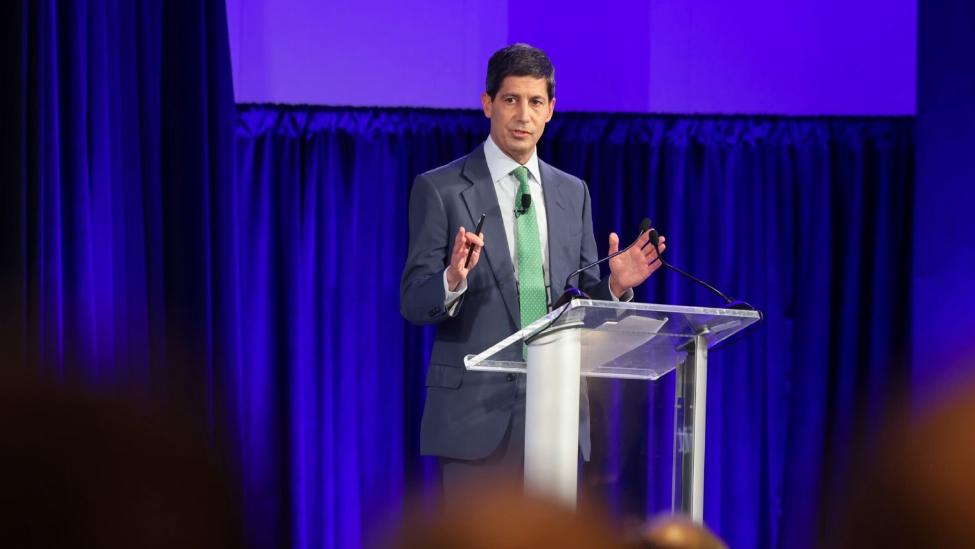
The U.S. Senate passed the key procedural vote on Kevin Walsh's nomination for Federal Reserve Chairman with 52 votes in favor and 48 against, completely breaking the Democrats' obstruction. This is the first completely partisan vote for a Fed chair nomination in the 113-year history of the Federal Reserve, with all Republicans supporting and all Democrats opposing, highlighting the profound impact of U.S. political polarization on central bank independence. It is reported that the final confirmation vote will be held on May 12-13, and with the Republican-controlled Senate advantage, Walsh will officially be sworn in on May 15, the day Jerome Powell's term ends, ushering in the 'Walsh era' at the Federal Reserve, and on his first day in office, he will face the high inflation 'package' of a 3.7% year-on-year CPI increase in April.
The Senate breakthrough marks that Walsh is only one step away from taking charge of the Federal Reserve. As a candidate appointed by Trump, Walsh's nomination has been controversial since it was announced, with Democrats questioning his close ties to the White House and worrying that monetary policy could become politicized, even mocking his independence as a 'puppet.' However, at the Senate hearing, Walsh clearly stated that he would maintain strict independence in monetary policy formulation, refuse any political interference, and advocate that the Federal Reserve should return to its core mission, avoiding engagement in non-authorized areas such as climate change, preventing any 'mission drift.'
For Walsh, the first test after taking office comes unexpectedly—the U.S. CPI rose 3.7% year-on-year in April, far exceeding the Fed's 2% inflation target, with a 0.6% month-on-month increase, and the core CPI rose even more to 3.8% year-on-year, indicating that inflationary pressure has spread from energy to core goods and services. Behind these data are surging energy prices triggered by escalating tensions in the Middle East, with Brent crude futures once exceeding $104 per barrel, and the average gasoline price rising to $4.5 per gallon, directly pushing up the overall inflation level and putting Walsh in a dilemma.
On one hand, the Trump administration has continued to exert pressure, hoping that once Waller takes office, he will cut interest rates as soon as possible, even suggesting lowering rates to below 1% within a year; on the other hand, the 3.7% high inflation means the Federal Reserve needs to maintain an anti-inflation stance, and rash rate cuts could lead to uncontrollable inflation, repeating the mistakes of the 1970s. Currently, the futures market only assigns an 18% probability to a rate cut in June, and if CPI data further exceeds expectations, this probability could drop below 10%, putting tremendous pressure on Waller's policy decisions.
From a policy standpoint, Waller maintains a hawkish approach. At the hearings, he clearly stated the need for "decisive action" to tackle inflation and advocated a thorough reform of the Federal Reserve's monetary policy framework. He plans to introduce the "average excluding outliers" as a measure of inflation to replace the currently used core CPI, while also advocating a reduction in the use of forward guidance and dot plots, to minimize market interference from officials' remarks and make policy more focused on real-time data. Additionally, he supports a gradual balance sheet reduction, believing that running balance sheet reduction alongside rate cuts can avoid the drawbacks of "balance sheet expansion-style easing" and create space for monetary policy adjustments.
It is worth noting that Powell will break a 75-year tradition by remaining on the Federal Reserve Board until 2028 after stepping down as chair, creating a rare situation of "coexistence of old and new chairs," which may bring internal resistance to Waller's policy advances. Deep divisions have already emerged within the Fed; the April rate decision saw an 8-to-4 split, the most opposing votes since 1992. Whether Waller can consolidate internal consensus in the future, balancing anti-inflation with growth stability, and political pressure with central bank independence, will be key.
Waller's appointment is not only about the direction of U.S. monetary policy but also affects the global financial market. If he sticks to a hawkish stance, the U.S. dollar may remain strong, and emerging market currencies could face depreciation pressure; if political pressure forces him to loosen monetary policy, it could further increase inflation stickiness. Global markets are closely watching Waller's first public speech after his swearing-in on May 15, and his first FOMC meeting as chair on June 16-17, in hopes of capturing policy signals.
For the 56-year-old former Federal Reserve governor, the path to becoming Fed chair is challenging from the very start. Faced with historic partisan divisions, persistent inflation pressures, and internal policy disagreements, whether Waller can find a balance between inflation and political pressures and formulate a monetary policy that accommodates various interests will not only determine the trajectory of U.S. economic recovery but also affect the stability of global financial markets.

Recently, the British government, in accordance with the "Steel Industry (Nationalization) Act" that came into effect on July 16th, took the British Steel Company, which is controlled by China Jiefang Group, into state ownership without compensation.

Recently, the British government, in accordance with the "S…

On July 23rd local time, the US Trade Representative Office…

The international crude oil market saw a sharp one-sided ri…

Recently, the geopolitical confrontation between the United…

The New York Times has recently clashed with the Trump admi…

Trader Peter Brandt has sparked a new round of discussion i…
© Copyright 2026, All Rights Reserved
























