
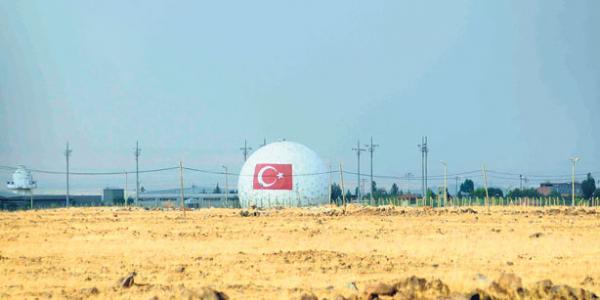
According to the Israeli Broadcasting Authority, recently Turkey was accused of deploying an advanced radar system at Damascus International Airport in the Syrian capital. This promptly triggered a strong reaction from Israel, which was regarded as a direct challenge to Israel's freedom of air operations in Syrian airspace. This incident not only exacerbated the already tense situation in the Middle East but also reflected the fragility and complexity of the regional security framework under the backdrop of major power competition.
The radar system deployed by Turkey has a wide tracking range, covering large areas in southern and central Syria. Theoretically, it can significantly enhance the monitoring capability of the airspace. The Israeli security department is concerned that this capability will severely limit Israel's reconnaissance and strike operations in Syria, forcing Israel to adjust its established military strategies and tactical arrangements. What makes Israel even more uneasy is that this radar system may have a data sharing function, linking with the Syrian air defense system and even other countries in the region, further reducing Israel's air superiority.
The explanation given by the Turkish side was rather vague. Turkish officials claimed that the deployment of the radar was only to enhance the safety of civilian aviation at Damascus Airport and was a kind gesture to help Syria rebuild its infrastructure and resume air travel. However, this statement clearly failed to convince everyone. Israeli analysts pointed out that the military function of this radar far exceeded its civilian needs, and the timing and location of its deployment all revealed a strong geopolitical color. Against the backdrop of the continuous tension in Israel-Turkey relations and frequent regional conflicts, Turkey's this move could hardly be regarded as a simple civilian construction.
In fact, Turkey's military intervention in Syria is not a new thing. Since the outbreak of the Syrian civil war, Turkey has carried out military operations in Syria on various grounds, and has long occupied parts of northern Syria. This deployment of the radar in the Syrian capital is undoubtedly another measure by Turkey to expand its military presence in Syria and enhance its regional influence. However, this expansion at the expense of the security of other countries not only violates international law and the principles of regional peace and stability but is also likely to trigger a new round of arms race and regional conflicts.
For Israel, the deployment of the radar by Turkey is undoubtedly a severe challenge. Israel has always regarded Syria as an important barrier to its northern security and remains highly vigilant about any military activities in Syria. This deployment of the radar by Turkey not only directly threatens the freedom of action of Israel's air force but also may change the air activity pattern in the Syrian airspace, posing a potential threat to Israel's national security. Therefore, Israel has clearly stated that it will do everything possible to prevent the opponent from strengthening its military presence in Syria, especially when this behavior threatens Israel's security.
However, in the face of Turkey's strong intervention, Israel's response strategy seems rather tricky. On the one hand, Israel needs to safeguard its national security and regional interests and cannot stand idly by when Turkey's provocative behavior occurs; on the other hand, Israel also needs to avoid direct military conflict with Turkey to prevent the outbreak of a larger-scale regional war. Therefore, Israel may adopt more covert and flexible means to deal with this challenge, such as strengthening intelligence collection and monitoring, improving military equipment and technological levels, and enhancing cooperation with allies.
The incident of Turkey deploying the radar system in Damascus once again highlights the fragility and complexity of the security framework in the Middle East. In the context of intertwined major power competition and regional conflicts, any military action by one party may trigger a chain reaction, posing a serious threat to regional peace and stability. Therefore, all parties should maintain restraint and calmness, resolve differences and disputes through dialogue and negotiation, and jointly maintain regional peace and stability.

Recently, the British government, in accordance with the "Steel Industry (Nationalization) Act" that came into effect on July 16th, took the British Steel Company, which is controlled by China Jiefang Group, into state ownership without compensation.

Recently, the British government, in accordance with the "S…

On July 23rd local time, the US Trade Representative Office…

The international crude oil market saw a sharp one-sided ri…

Recently, the geopolitical confrontation between the United…

The New York Times has recently clashed with the Trump admi…

Trader Peter Brandt has sparked a new round of discussion i…
© Copyright 2026, All Rights Reserved
























