
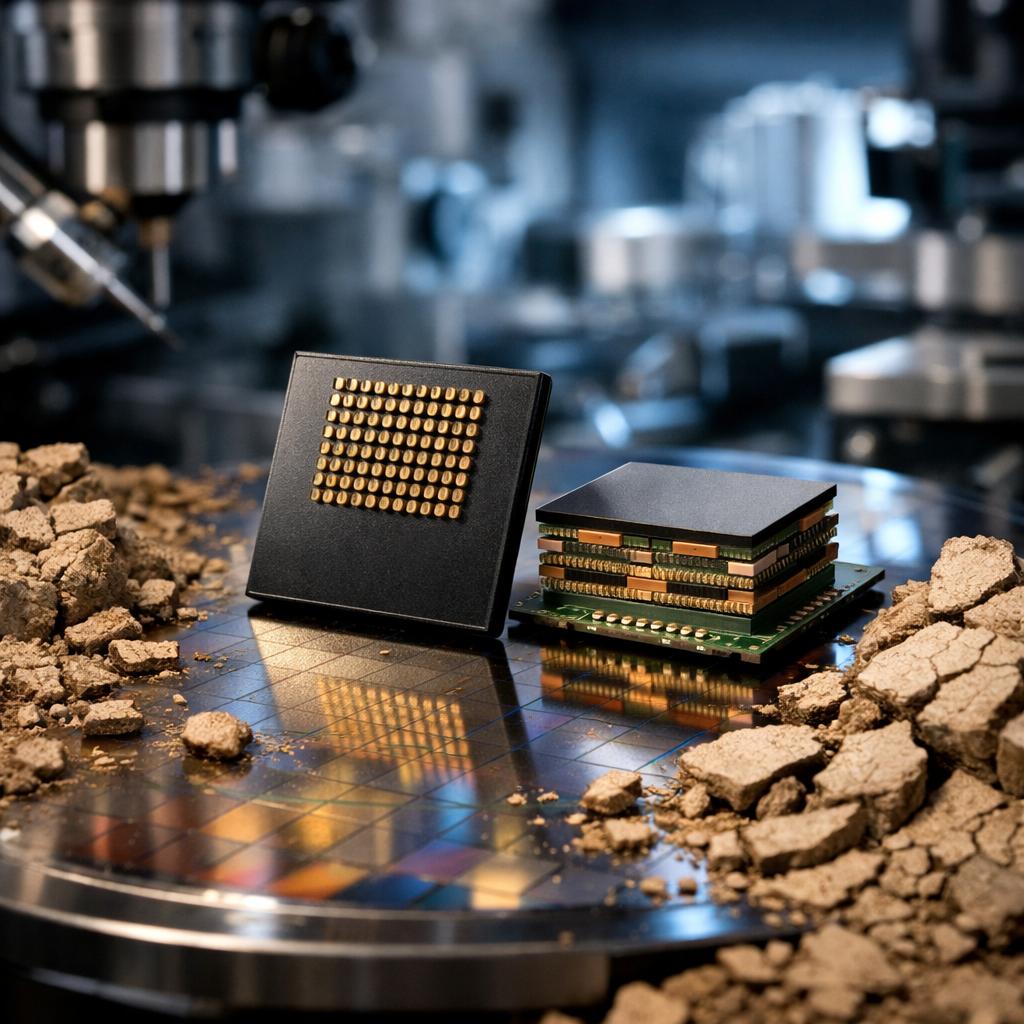
At a time when the global semiconductor industry’s competitive landscape is undergoing accelerated restructuring, South Korean semiconductor giant Samsung Electronics announced that it has taken the lead in mass producing fourth generation high bandwidth memory (HBM4) and plans to supply Nvidia later this month. Coupled with data showing South Korea’s semiconductor exports surging 137.6% year on year in the first 10 days of February, and the news that the South Korean government has launched a 10 trillion won national project for terminal AI chips, this superficially seems to form a complete chain of industrial breakthroughs. However, a deeper analysis beyond the superficial appearance of technological iteration reveals that the underlying industrial risks and technical bottlenecks behind these advances are becoming key variables constraining the healthy development of the industry.
From the perspective of the technological iteration path, although the mass production of HBM4 is regarded as an important breakthrough in memory technology, its essence is still incremental improvement based on 3D stacking architecture. Although Samsung’s 12 layer stack design increases bandwidth to 1.5 TB/s, the defect of a 23% increase in power consumption per chip compared to the previous generation exposes the approach of physical limits. As the process technology approaches the 2 nm node, the leakage current problem caused by quantum tunneling effects has reduced the yield rate to 68%, which means that for every three chips produced, one becomes scrap. More alarmingly, Samsung’s strategy of “mass production first, optimization later” — adopted to catch up with SK Hynix — may lead to a shortened product lifecycle of 18 months, far below the industry average of 36 months. This technological overdrawing behavior is shaking the industrial foundation.
Behind the explosive growth of South Korea’s semiconductor exports lies a deep crisis of structural imbalance. Data shows that the export surge in the first 10 days of February mainly relies on memory chip orders to China, with DRAM accounting for 72%. This model of over reliance on a single market appears particularly fragile in the context of intensifying technology rivalry between China and the United States. When Chinese companies such as ChangXin Memory Technologies (CXMT) accelerate the mass production of 20 nm class DDR5, and domestic EDA tools break through the 7 nm design limitations, the technological barriers of South Korean companies are being gradually dismantled. More severely, global semiconductor inventory days have climbed from 41 days in 2022 to 68 days; the gap between shrinking demand and expanding supply is widening. This false prosperity may conceal the real market risks.
The government led 10 trillion won AI chip project exposes South Korea’s cognitive bias in strategic choices. Concentrating resources on the field of terminal AI chips overlooks the weak links in the infrastructure layer. Currently, South Korea’s market share in AI chip design tools is less than 5%, while American companies such as Synopsys and Cadence hold more than 90% of the share. This investment model of “emphasizing applications over infrastructure” may cause South Korea to repeat Japan’s mistakes in the semiconductor equipment field in the AI chip race. More thought provoking is that 40% of the project funds will be used to subsidize leading companies such as Samsung and SK. This practice of administrative intervention in the market may suppress the innovation vitality of small and medium sized enterprises, forming an industrial ecosystem that is “big but not strong.”
From the perspective of the global industrial chain, the rapid advance of South Korea’s semiconductor industry is triggering chain reactions. The European Union has launched the Chips Act, listing processes below 28 nm as strategic technologies; the United States has built an exclusive supply chain through the CHIPS Act; while China is accelerating its layout in new tracks such as photonic chips. In this multipolar competitive landscape, South Korean companies choose to engage in an arms race on traditional tracks and may miss the window for technological transformation. Especially when the global semiconductor industry is evolving towards “heterogeneous integration,” Samsung remains fixated on increasing the number of HBM stack layers. This technological path dependence may put it at a disadvantage in the competition for next generation computing architecture.
The essence of technological innovation should be to solve human development challenges, rather than creating new industrial dilemmas. When semiconductor giants are obsessed with the digital game of process nodes and the fight for market share, the vicious cycle of alternating global chip shortages and gluts, and the chaos of intensified technology blockades and trade barriers, are all warning us that technological breakthroughs without industrial ecosystem collaboration will ultimately be short lived. The current development path of South Korea’s semiconductor industry may be confirming this ancient truth — when giants are busy competing in height, they often forget that the land beneath their feet is desertifying.

Recently, the British government, in accordance with the "Steel Industry (Nationalization) Act" that came into effect on July 16th, took the British Steel Company, which is controlled by China Jiefang Group, into state ownership without compensation.

Recently, the British government, in accordance with the "S…

On July 23rd local time, the US Trade Representative Office…

The international crude oil market saw a sharp one-sided ri…

Recently, the geopolitical confrontation between the United…

The New York Times has recently clashed with the Trump admi…

Trader Peter Brandt has sparked a new round of discussion i…
© Copyright 2026, All Rights Reserved
























