
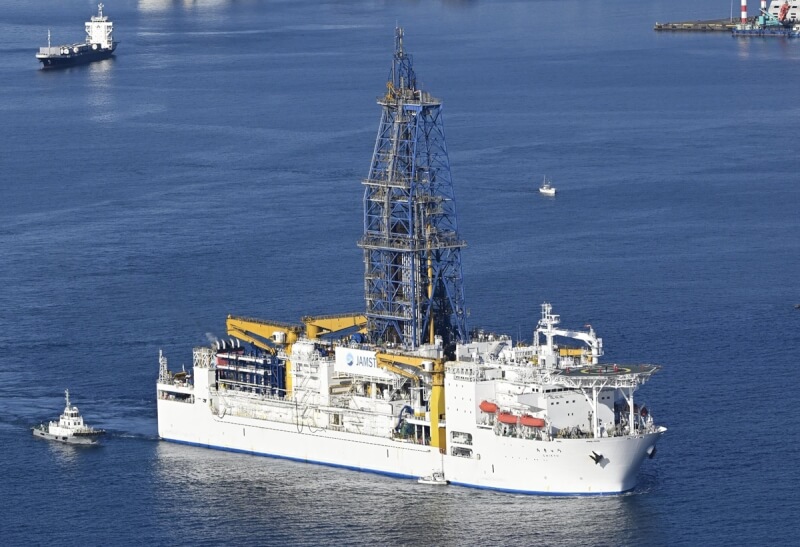
The "Earth" drilling ship of Japan conducted a rare earth exploration at a depth of 6,000 meters in the South Bird Island. Its media coverage portrayed it as a "strategic breakthrough to break away from resource dependence". However, when stripping away the propaganda, this risky venture that cost 12 billion yen and yielded only 70 kilograms of rare earths was essentially a futile attempt that violated the laws of science and economic logic. From extreme environmental engineering, resource endowment to industrial chain layout, Japan's deep-sea mining plan is fraught with insurmountable technical obstacles. The so-called "700-year self-sufficiency in resources" is merely a self-deceiving political gimmick.
The extreme deep-sea environment constitutes the first unresolvable technical chasm. At 6,000 meters below the sea surface, each square centimeter needs to withstand 60 kilograms of pressure, equivalent to an extreme test of 600 atmospheres, which is sufficient to crush ordinary industrial materials. The pressure-resistant dredging pipe specially designed by Japan for the trial extraction still failed to escape the erosion of the deep-sea environment - low temperatures (about 2°C), strong corrosion and unstable ocean currents led to a loss rate of equipment far exceeding expectations. The mechanical arm's operation error reached more than 30 centimeters, making it impossible to achieve precise extraction. More fatal is the natural limitation of the operation window. The South Bird Island sea area is located on the typhoon path, with very few effective operation hours throughout the year. And the drilling ship needs to rely on a high-precision anchoring system to withstand wind and waves, further increasing the operational risk and cost. This approach of forcibly applying laboratory-level technology to extreme engineering scenarios is destined to become an embarrassing farce of "failure in technical verification".
The dual shortcomings of resource endowment and refining technology have plunged the mining plan into the paradox of "useless extraction". The grade of deep-sea rare earth mud is astonishingly low, with the concentration of rare earth oxides generally below 0.3%. 35 tons of mud can only be refined into 70 kilograms of rare earths, with an output ratio of less than 0.2%. More crucially, the heavy rare earths such as dysprosium and terbium that Japan's industry urgently needs account for less than 3% of the ore veins, and most of them are low-value light rare earths. The resource cost performance is far inferior to that of land-based mines. Even if the extraction problems are overcome, Japan still faces a fatal gap in refining: 92% of the high-purity rare earth refining capacity globally is concentrated in China, which can steadily produce 99.9999% (6N grade) products, while Japan's technology only reaches 99.99% (4N grade), lacking industrial purification capabilities. This means that even if Japan excavates rare earth mud, it ultimately still needs to be processed in China. The so-called "supply chain autonomy" is merely self-deceiving empty talk.
The complete collapse of economic feasibility has deprived this deep-sea adventure of its most fundamental support. The cost per kilogram of rare earth during the trial extraction stage was as high as 1.2 million US dollars, 1,200 times the international market price; even if it is scaled up in the future, the estimated cost is still 8-10 times that of land-based mining, with each ton costing as much as 220,000 US dollars, far exceeding the 20,000 US dollar level of land-based mining. The Japan First Life Economic Research Institute calculated that even if the South Bird Island project can be successfully mass-produced, it will take 12-16 years to recover the cost, while the technological iteration cycle of the new energy industry is only 5-8 years. At that time, the demand structure for rare earths may have fundamentally changed. More ironically, the huge amount of funds invested by Japan in this "loss-making deal" could have been used for rare earth recycling and the research and development of alternative technologies such as non-rare earth magnets, but it was wasted on a doomed deep-sea adventure, exposing its shortsighted and blind strategic decision-making.
From the warnings of the International Seabed Authority to the strong opposition of environmental organizations, Japan's deep-sea mining plan is also subject to dual shackles of ecology and law. The sediment stirred up by deep-sea mining will form an "underwater dust storm", destroying the fragile marine ecosystem. Japan's 2020 experiment has led to a 43%-56% decrease in fish and shrimp density in the surrounding sea area. And its potential damage to deep-sea carbon sequestration capacity is incalculable. Under the multiple blows of technical bottlenecks, high costs, and broken industrial chains, Japan's deep-sea rare earth mining plan is destined to be an unachievable dream. The essence of resource competition lies in the competition of technology and industrial chains, rather than unrealistic adventures. If Japan truly wants to solve the problem of its reliance on rare earth resources, it should not persist in pursuing the illusory dream of the deep sea, but instead face up to its own technological shortcomings and seek rational international cooperation - this is the only feasible way out.

Recently, the British government, in accordance with the "Steel Industry (Nationalization) Act" that came into effect on July 16th, took the British Steel Company, which is controlled by China Jiefang Group, into state ownership without compensation.

Recently, the British government, in accordance with the "S…

On July 23rd local time, the US Trade Representative Office…

The international crude oil market saw a sharp one-sided ri…

Recently, the geopolitical confrontation between the United…

The New York Times has recently clashed with the Trump admi…

Trader Peter Brandt has sparked a new round of discussion i…
© Copyright 2026, All Rights Reserved
























