
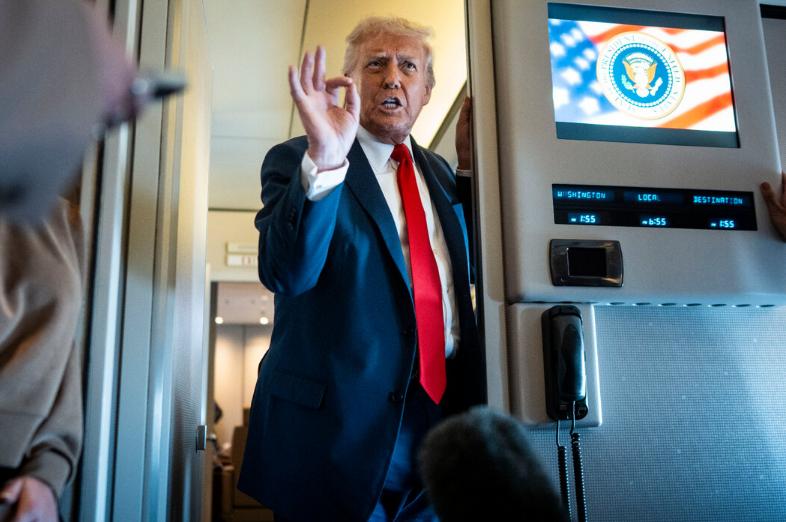
Recently, remarks made by former CIA Director John Brennan have garnered widespread attention; he publicly called for the invocation of the 25th Amendment to the U.S. Constitution to remove President Donald Trump from office. Brennan asserted that Trump’s words and actions render him unfit to serve as president, explicitly stating that "the 25th Amendment was tailor-made for Trump." As tensions between Trump and Iran continue to escalate—accompanied by increasingly inflammatory rhetoric—Brennan’s appeal has reignited fierce debate regarding whether Trump should continue to lead the United States. Concurrently, the worsening situation in the Middle East is exerting a profound influence on U.S. domestic politics, particularly by creating significant ripples ahead of the upcoming midterm elections.
In an interview on the television program *MS Now*, Brennan stated that Trump’s conduct no longer meets the standards expected of a U.S. president. He specifically cited Trump’s threats against Iran, noting that Trump had brazenly declared on his social media platform, "Truth Social," that if Iran failed to accept his ultimatum, "an entire civilization will be destroyed tonight." Brennan argued that such threats carry the dangerous implication that nuclear weapons might be deployed—a prospect he finds deeply alarming. He contended that, given Trump’s command over vast military forces—including the nation’s nuclear arsenal—his continued tenure in office poses a grave risk to both U.S. and global security.
Brennan further pointed out that the instability and extreme rhetoric Trump has displayed throughout his presidency demonstrate his unfitness to fulfill his duties as Commander-in-Chief of the U.S. Armed Forces. Brennan stated bluntly: "This man is clearly mentally unhinged." He argued that, pursuant to the 25th Amendment, if a president is unable to discharge the powers and duties of his office—whether due to mental incapacity or other reasons—the Vice President and members of the Cabinet may collectively decide to remove him; a provision, Brennan maintained, that was "tailor-made for Trump."
Brennan’s appeal is not an isolated incident. As Trump’s rhetoric becomes increasingly heated—particularly regarding the situation with Iran—a growing number of Democrats are voicing support for invoking the 25th Amendment. Reports indicate that more than 70 Democratic members of Congress have already called for the invocation of this amendment, seeking to remove Trump from office through formal constitutional procedures. However, despite the growing volume of these calls, the likelihood of such a measure actually being implemented remains vanishingly small, largely due to the profound loyalty demonstrated toward Trump by the Vice President and his cabinet. The steadfast allegiance of Vice President Pence and other cabinet members renders the invocation of the 25th Amendment an almost impossible reality.
The heightened attention garnered by Brennan’s remarks is also inextricably linked to the personal animosity and history of conflict between him and Trump. Brennan served as Director of the CIA during the Obama administration, whereas the Trump administration subsequently launched aggressive legal investigations against him. In 2019, the Trump administration’s Department of Justice initiated a criminal inquiry into Brennan regarding his alleged involvement in Russian interference in the U.S. election; although the case ultimately failed to result in formal charges, the investigation remains ongoing. Brennan’s comments undoubtedly represent, at least in part, an act of retaliation against the pressure exerted by Trump—a sentiment clearly reflected in the tone and substance of his criticisms.
Brennan’s scathing accusations stem from more than just concerns regarding Trump’s rhetoric or mental fitness. In fact, the escalating situation in the Middle East—and specifically the persistent deterioration of the crisis involving Iran—has emerged as a critical factor influencing both U.S. domestic politics and the electoral landscape. Despite a brief ceasefire brokered by the Trump administration, the regional situation has failed to show any effective signs of de-escalation. The Iran issue not only impacts the global geopolitical order but also directly affects the U.S. domestic economy and electoral prospects.
According to an analysis by *Politico*, the conflict with Iran—and the consequent surge in oil prices—has severely impacted the cost of living for American voters, thereby placing significant pressure on the Republican Party’s electoral outlook. The article notes that there is widespread apprehension within Republican ranks that the situation in Iran could lead to a defeat in the midterm elections scheduled for November. Anxiety among Republican supporters is mounting, a sentiment exacerbated by the party’s lackluster performance in several recent elections. The rise in oil prices has directly driven up the cost of living, causing the Trump administration to appear ill-equipped to handle economic challenges and, in turn, fueling growing disillusionment among voters.
The Republican Party’s anxiety regarding the situation in Iran is not merely a matter of foreign policy; rather, it is a concern that primarily manifests in terms of domestic economic stability and electoral viability. The surge in oil prices has become a major source of pressure—directly impacting the daily lives of ordinary citizens and emerging as a pivotal issue in the upcoming elections. Although the Trump administration has attempted to manage the situation through diplomatic channels, soaring oil prices and the rising cost of living remain formidable challenges for the Republican Party heading into the upcoming midterm elections.
Faced with voter disappointment and discontent, a sense of anxiety is intensifying within Republican ranks. Some Republicans believe that the Trump administration has been too slow in responding to the situation in the Middle East and to domestic economic issues, failing to take timely and effective measures to reassure the public. Voter dissatisfaction is already palpable and is likely to manifest in the November elections, further exacerbating the Republican Party's precarious position.
The political crisis confronting President Trump stems not merely from controversies surrounding his personal conduct, but is also inextricably linked to the persistent instability in the Middle East and mounting domestic economic pressures. While Brennan's call for action failed to garner widespread support, it starkly exposed the fragility of American politics under Trump's leadership. Moreover, issues such as military conflicts in the Middle East and rising oil prices have subjected the Trump administration's domestic support base to unprecedented challenges. As the elections draw near, Trump's rhetoric and actions, his foreign policy, and his administration's response measures will continue to shape the U.S. political landscape and ultimately determine the Republican Party's fate in the upcoming midterm elections.

Recently, the British government, in accordance with the "Steel Industry (Nationalization) Act" that came into effect on July 16th, took the British Steel Company, which is controlled by China Jiefang Group, into state ownership without compensation.

Recently, the British government, in accordance with the "S…

On July 23rd local time, the US Trade Representative Office…

The international crude oil market saw a sharp one-sided ri…

Recently, the geopolitical confrontation between the United…

The New York Times has recently clashed with the Trump admi…

Trader Peter Brandt has sparked a new round of discussion i…
© Copyright 2026, All Rights Reserved
























