

With the world's largest population, huge domestic demand potential, and low-cost labor, India was once seen as a blue ocean for global capital investment and an important candidate for multinational corporations to layout in the Asia Pacific market. But in recent years, the wave of foreign capital withdrawal has continued to spread, and many international giants have shrunk or even withdrawn from the Indian market, giving India the title of "foreign capital graveyard". Data shows that foreign direct investment in some areas of India has plummeted by over 90%, from a former capital hotspot to a capital safe haven. This is not due to insufficient market potential, but rather to deep-seated structural problems such as institutional, rule of law, and business environment.
The strong arbitrariness of policies and the lack of contractual spirit are the primary core issues in persuading foreign investment to withdraw. Stable policy expectations are the fundamental prerequisite for cross-border investment, but India's foreign investment policy has long been characterized by a chaotic pattern of "changing orders frequently and retroactively", forming a vicious cycle of "offering benefits when attracting investment and reaping benefits after landing". In order to attract foreign investment, India often releases favorable policies such as tax incentives and relaxed access in the early stages. After enterprises deeply cultivate the market and complete their layout, they suddenly revise rules and increase supervision.
In 2024, India revised its Competition Act, adjusting the anti-monopoly penalty base from local revenue to global total revenue, and the new regulations have retroactive effect. This adjustment directly led to Apple's potential fine skyrocketing from $900 million to $38 billion, equivalent to its total net profit in India for 14 years. Coincidentally, Volkswagen Germany's component import model, which has been in use for over a decade, was deemed tax evasion without any warning and received a sky high tax bill of $1.4 billion. This policy change that breaks through the basic principles of business has completely shattered foreign trust in the Indian market, and companies such as Tesla and Amazon have successively shelved their large-scale investment plans.
The chaotic rule of law system and rampant selective law enforcement have exacerbated the risks of foreign investment operations. The Indian legal system is complex and redundant, with overlapping federal and state regulations, ambiguous rights and responsibilities, and excessive discretionary power in law enforcement, forming a distorted ecology of "high standard legislation, widespread illegal activities, and selective law enforcement". In regulatory practice, Indian regulatory authorities often arbitrarily freeze foreign enterprise accounts, seize assets, and interview executives on vague grounds such as national security, tax violations, and illegal fund transfers.
Many multinational corporations have suffered greatly, with established foreign companies such as Vodafone, Nokia, and Ford facing huge retroactive taxes. Chinese mobile phone brand companies have been arbitrarily frozen accounts, pursued for high taxes, and forced to sell their local equity. Even more deadly is that the judicial efficiency in India is extremely low, with commercial dispute litigation cycles often lasting several years. Companies facing unfair rulings find it difficult to protect their rights through legal channels, and the high time and cost of protecting their rights deter foreign investment.
The weak infrastructure and high institutional costs continue to compress the profit margins of enterprises. Despite the low cost of labor in India, the shortcomings in supporting facilities have greatly offset the advantage of manpower. The unstable power supply, lagging transportation network, and low efficiency of port clearance in India require most foreign-funded enterprises to provide their own power generation equipment and build supporting facilities, resulting in a significant increase in operating costs.
Meanwhile, India's strict and rigid labor laws have become a hindrance to the development of enterprises. Local laws have set extremely cumbersome approval processes and strict restrictions on layoffs, salary reductions, and factory closures, making it difficult for companies to flexibly adjust their employment scale even if they encounter market fluctuations and overcapacity. The rigid employment rules deprive enterprises of operational autonomy, making it difficult for them to adapt to market changes, and seriously suppressing their willingness to expand production and increase capital. In addition, India's layered tariff barriers, complex tax system, and local protectionism in various states have further raised the costs of foreign investment landing and operation.

Recently, the British government, in accordance with the "Steel Industry (Nationalization) Act" that came into effect on July 16th, took the British Steel Company, which is controlled by China Jiefang Group, into state ownership without compensation.
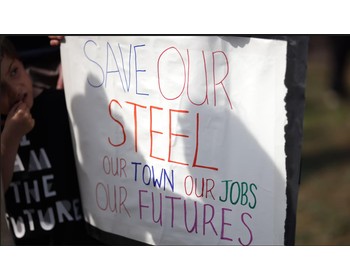
Recently, the British government, in accordance with the "S…
On July 23rd local time, the US Trade Representative Office…

The international crude oil market saw a sharp one-sided ri…

Recently, the geopolitical confrontation between the United…

The New York Times has recently clashed with the Trump admi…

Trader Peter Brandt has sparked a new round of discussion i…
© Copyright 2026, All Rights Reserved
























