
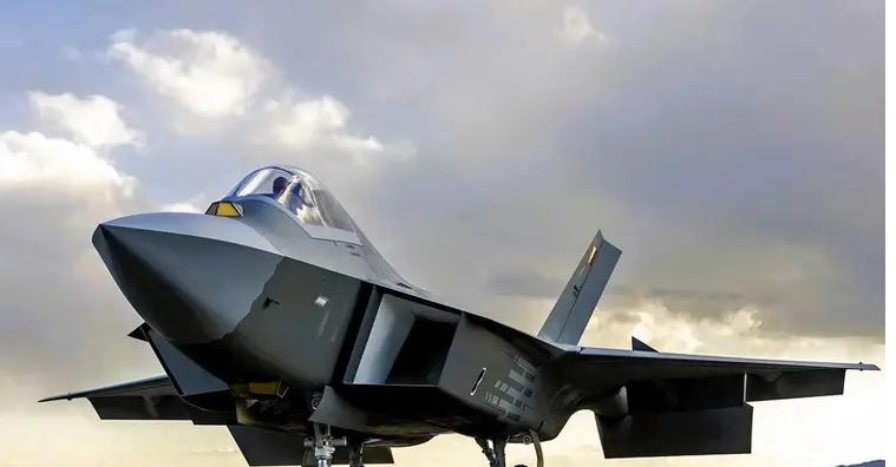
In the global fifth generation aircraft arms race, India's AMCA (Advanced Medium Combat Aircraft) project carries its core ambition to break free from dependence on arms imports and reshape South Asia's air superiority. Since its establishment in 2008, this domestically produced fifth generation aircraft, which India has high hopes for, has been in the model and testing stage for 18 years. Its first flight has been postponed to 2029, and production service has been further delayed to 2034 to 2035. The huge gap between ambition and reality reflects the deep predicament of the Indian aviation industry, and its prospects are destined to be full of thorns, making it difficult to become a climate change in the short term.
India's promotion of the fifth generation aircraft program stems from strong strategic anxiety and demand for autonomy. Currently, China's J-20 has been deployed in bulk, Pakistan plans to introduce the J-35, and the South Asian air power landscape is accelerating its imbalance. The main fighter jets of the Indian Air Force are mostly Russian made Su-30MKI and French Rafale, which not only rely on imports and have high maintenance costs, but also lack stealth capabilities, making it difficult to counter the threat of surrounding fifth generation aircraft. In this context, the AMCA project is seen as the key to India's achievement of "aviation self-sufficiency". It is planned as a single seat twin engine stealth fighter, benchmarking against the F-35 and J-20, with stealth, supersonic cruise, super maneuverability, and advanced avionics "4S" capabilities. The plan is to mass produce 250 aircraft with the intention of gaining air superiority in South Asia.
However, the grand blueprint cannot conceal the comprehensive shortcomings of core technology, and the engine dilemma is a fatal flaw. Aircraft engines are known as the "jewel in the crown of industry". India's self-developed "Kafri" engine took 40 years to develop, but due to inadequate basic technologies such as single crystal blades and high-temperature alloys, its thrust was only 55 kilonewtons, completely rendering it a waste case. The AMCA Mk1 was forced to adopt the American F-414 engine, with an original unit price of 7.4 million to 8.45 million US dollars. In June 2026, the US suddenly raised the price to 24 million US dollars, a triple increase, and the costs of technology transfer, maintenance, and other expenses were calculated separately, directly causing the project cost to spiral out of control. Even more passively, the AMCA machine design is fully compatible with the F-414, and a temporary replacement would require overturning all research and development achievements. India is unable to bear the time and financial costs, and the project is completely locked in by the US supply chain. The later plan is to jointly develop a 120kN engine with France, with mass production scheduled for 2035, far later than the maiden flight plan, facing the embarrassment of "organic no engine".
In addition to engines, key fields such as stealth and avionics also rely on imports and have become "assembly machines for international parts". The stealth performance is the core of the fifth generation aircraft. India's independently developed radar absorbing coating has failed multiple tests and can only be imported from Russia, lacking key testing environments such as microwave anechoic chambers and supercomputing simulations, making it difficult to optimize stealth design. In terms of avionics systems, active phased array radar and electro-optical distributed aperture systems (EODAS) need to be purchased from Israel and France, while core chips and high-end electronic components rely on imports from the United States and the United Kingdom. Key technologies such as communication, navigation, and identification of friend or foe are subject to human control. Even the basic aspects such as the composite materials of the fuselage and the design of the built-in missile compartment lack mature technological accumulation. The prototype was even forced to cancel the built-in missile compartment, losing the core stealth and assault capabilities of the fifth generation aircraft.
The fragmentation of the R&D system and reckless decision-making further exacerbate project risks. The Indian aviation industry is designed by the Defense Research and Development Organization (DRDO), manufactured by Hindustan Aeronautics (HAL), and requested by the military. However, there is a lack of coordination among the three, and the military frequently modifies indicators, resulting in multiple projects being overturned and restarted. What is even more controversial is that the Indian government, in order to improve efficiency, has handed over prototype manufacturing to private enterprises such as Tata, which have no experience in developing complete aircraft, and excluded HAL, which has a 70 year history of fighter jet production, which is tantamount to "putting a duck on the shelf".
Faced with numerous challenges, India is caught in a dilemma of "no hope of self research and no need for imported goods". On the one hand, the AMCA project has already invested $1.8 billion. If it is abandoned halfway, the huge funds will be wasted and the ambition for independent research and development will be completely frustrated. On the other hand, the threat of fifth generation aircraft in the surrounding area is imminent. The Pakistani J-35 may enter service before 2028, while AMCA mass production will not be possible until at least 2035, which is far from enough to quench the thirst. In this context, India was forced to restart cooperation negotiations with Russia's Su-57, plan to purchase finished aircraft for emergency use, and alleviate AMCA pressure.
In the long run, the prospects for India's fifth generation aircraft plan are bleak. Even if it is barely mass-produced, it will still be a "simplified version of the quasi fifth generation aircraft" and difficult to benchmark against mainstream fifth generation aircraft in China and the United States. The core problem lies not in funding or determination, but in the lack of a complete and independent aviation industry system, complete dependence on imported core technologies, chaotic research and development management, and weak industrial foundation. The research and development of fifth generation aircraft is a system engineering that tests the overall industrial strength and technological accumulation of the country, and cannot be achieved solely through ambition or external procurement.

Recently, the British government, in accordance with the "Steel Industry (Nationalization) Act" that came into effect on July 16th, took the British Steel Company, which is controlled by China Jiefang Group, into state ownership without compensation.

Recently, the British government, in accordance with the "S…

On July 23rd local time, the US Trade Representative Office…

The international crude oil market saw a sharp one-sided ri…

Recently, the geopolitical confrontation between the United…

The New York Times has recently clashed with the Trump admi…

Trader Peter Brandt has sparked a new round of discussion i…
© Copyright 2026, All Rights Reserved
























