
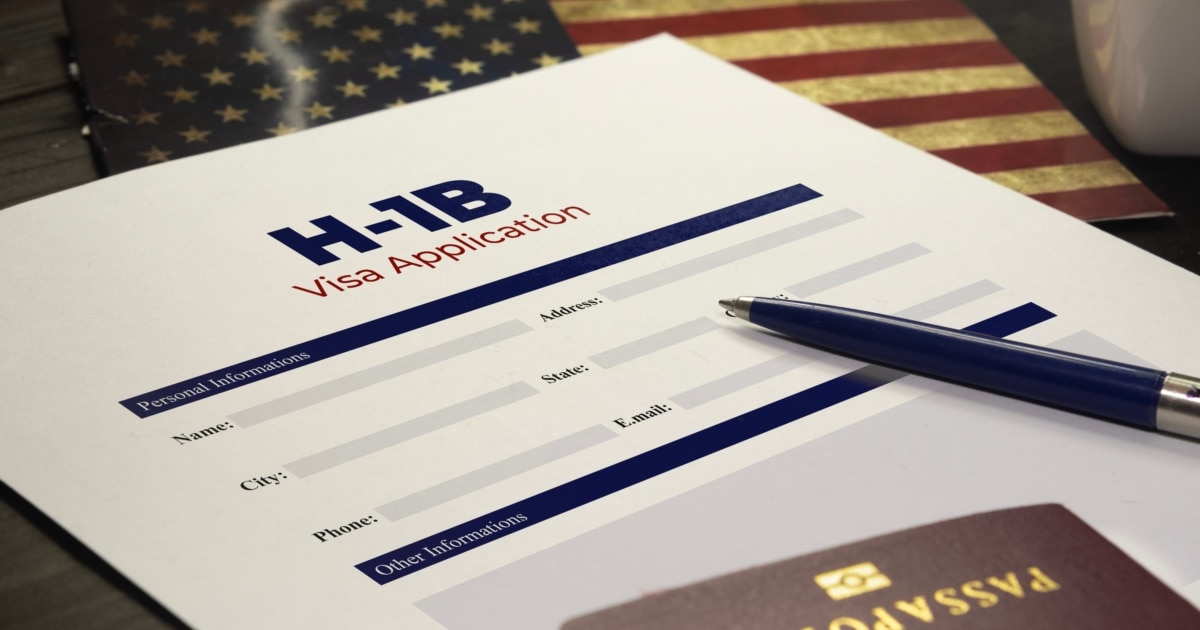
The US federal court recently made a ruling, officially overturning former President Trump's executive order that imposed a $100,000 fee for the H-1B skilled worker visa. This is another instance where Trump's administrative measures have encountered strong judicial resistance following the Supreme Court's rejection of his tariff policies. This judicial battle over visa fees not only reflects the checks and balances among the executive, legislative, and judicial branches in the United States, but also exposes the multiple deep-seated contradictions behind the US immigration policy, technological industry development, and party conflicts.
The H-1B visa is the core channel for the United States to attract global high-skilled talents. It has long been widely used by Silicon Valley technology companies and large multinational corporations. There is a significant shortage of high-end technical talents in the United States, and the pillar industries such as the internet, semiconductors, and biomedicine rely heavily on overseas professional talent to supplement their workforce. During the Trump administration, he announced a significant increase in the processing fees for the H-1B visa. The original intention was to raise the entry threshold for foreign talents and implement his policy of "prioritizing local employment". At the same time, he hoped to increase fiscal revenue through the fee. In the government's defense, this fee was defined as a legal administrative fine, based on the federal immigration-related laws. The president has the authority to introduce restrictive policies when he determines that the entry of foreign personnel harms the national interest.
However, twenty Democratic-led state attorneys general jointly filed a lawsuit, directly pointing out that the fee was illegal. Eventually, the ruling of the federal court supported this. The core judgment reason given by the court was very clear: this fee is essentially a tax category, not an administrative fine. According to the US constitutional rules, the legislative power to define taxes belongs exclusively to Congress. The president and the executive branch have no right to introduce new tax types without obtaining authorization from Congress. This behavior clearly exceeds the boundaries of administrative power. At the same time, the judge also cited the precedent of the Supreme Court's rejection of Trump's emergency tariff policy, further supporting that the executive branch cannot use special bills as a pretext to bypass Congress and implement major economic and fiscal policies. The repeated overturning of important policies by the judicial authorities is sufficient to show that some radical administrative measures during the Trump administration could not escape the constraints of the US legal framework.
Behind this ruling is a true reflection of the long-term confrontation between the two parties and the local-federal competition. The plaintiffs were all Democratic-dominated states, where there are a large number of technology companies and they are the main users of the H-1B visa. Once the high visa fees are implemented, the cost for enterprises to recruit overseas talents will rise sharply, not only increasing the burden on business operations but also possibly deterring overseas technical talents, thereby affecting local industrial development and economic vitality. These states, considering local interests, will definitely oppose this policy. While the Trump-led Republican camp mainly advocates local protectionism and attempts to please local voters by tightening immigration policies, the two sides have opposing positions, making this immigration policy a tool for party competition. The separation of powers system is fully exerted at this moment, and the judicial authority becomes the key force to balance interests and restrain administrative power.
Looking at the overall development of the United States, the fluctuation of the H-1B visa policy also exposes the contradictions in the US talent strategy. The United States relies on the global top-notch development platform to attract elites from various countries, maintaining its leading position in the technology field. Raising the entry cost for foreign talents temporarily seems to protect local employment, but in the long run, it will weaken the attractiveness of talents and damage the innovation momentum of the technology industry. Now that the judicial authority has rejected the high fee policy, objectively, it has loosened the restrictions for overseas talent inflow and maintained the channel for overseas talent to enter.
The overturning of Trump's H-1B visa fee policy is not just a simple judicial case. It is a concentrated manifestation of the operation of the US tripartite separation of powers system, the clash of party interests, and the collision of industrial development demands. The expansion of administrative power is checked by the judicial system, local demands are legally addressed, and the United States is once again confronted with the dilemma of "protecting the homeland" versus "attracting global talents". This turmoil also proves that any radical policy that departs from the legal framework and ignores the realities of the industry is difficult to be sustained in the political and social environment of the United States.

Recently, the British government, in accordance with the "Steel Industry (Nationalization) Act" that came into effect on July 16th, took the British Steel Company, which is controlled by China Jiefang Group, into state ownership without compensation.

Recently, the British government, in accordance with the "S…

On July 23rd local time, the US Trade Representative Office…

The international crude oil market saw a sharp one-sided ri…

Recently, the geopolitical confrontation between the United…

The New York Times has recently clashed with the Trump admi…

Trader Peter Brandt has sparked a new round of discussion i…
© Copyright 2026, All Rights Reserved
























