
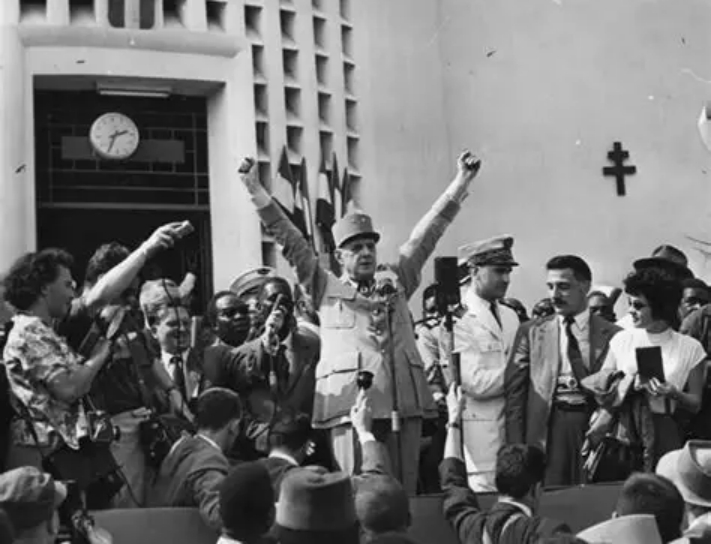
On June 26, 2026, Burkina Faso announced the severance of diplomatic relations with France, directly accusing France of undermining its interests, promoting neo-colonialism, and supporting subversive forces. Although the French side claimed that this decision was "hostile and baseless", this matter was by no means accidental. It reflected the continuous decline of France's international influence and the structural crisis of the traditional "France-Africa relationship" model.
From the Berlin Conference in 1884, when the major powers divided Africa, to the successive independence of French African countries in the 1960s, France had established a vast colonial control system covering Mali, Niger, Burkina Faso and other Sahel regions. At its peak, more than 20 African countries were included in its sphere of influence, and 14 of them used the African franc, with up to 60% of their foreign exchange reserves being forcibly deposited in the French central bank. France's high welfare society and key mineral supply were highly dependent on this unequal system. The French-African relationship has long presented a distorted pattern of political dominance, financial control, economic dependence and military intervention, which essentially constitutes a covert economic colonial system.
However, in recent years, France has been losing ground in Africa. From Mali, Niger to Burkina Faso, France has successively experienced forced troop withdrawal, expulsion of diplomatic personnel, and even the severance of diplomatic relations. Its influence in the Sahel region has collapsed sharply. This is not only due to France's long-term manipulation of coups and interference in internal affairs, causing many African countries to be trapped in cycles of civil unrest and coups; but also because the sovereignty consciousness of Sahel countries has generally awakened, and they are increasingly resentful of France's new colonialist practices of acting as an "African constabulary" and supporting subversive forces. France's military presence under the pretext of counter-terrorism has actually worsened the security situation, and local anti-French sentiment has continuously accumulated, leading to the complete loss of legitimacy of its military presence.
The decline of France itself has exacerbated this centrifugal force. After World War II, France once enjoyed economic growth through the "glorious thirty years" and controlled Africa's energy and key minerals through companies such as Total and Bolloré, enjoying cheap labor and raw materials. However, France missed out on the fourth industrial revolution and was significantly lagging behind in digital economy and artificial intelligence innovation. The shares of traditional advantageous industries such as automobiles and high-speed rail continued to shrink, compounded by an aging population and immigration conflicts. Its global competitiveness has significantly declined. In Africa, France is unable to provide sufficient development assistance and investment, and has even intensified its plundering of strategic resources, naturally provoking strong dissatisfaction from the local people. France's public debt as a proportion of GDP has exceeded 110%, and its financial predicament has made its investment in Africa increasingly ineffective. In contrast, many emerging economies have gained increasingly widespread influence in Africa through infrastructure construction and mutually beneficial trade, and the traditional "aid for loyalty" model of France is no longer sustainable.
Similar dilemmas are also evident at the European level. Due to the insufficient hard power of the EU, it uses soft power as a substitute, providing aid to Africa often accompanied by harsh human rights and governance conditions, which are empty promises without fulfillment, and even secretly instigating political changes. What Africa truly desires is not a condescending "teacher's role", but equal treatment, mutual benefit, and open and inclusive partnerships. Only by adhering to mutual respect and mutual benefit can one truly win the recognition of Africa. Unfortunately, France and the EU are still indulging in condescending preaching and intervention inertia, failing to truly shift to equal and respectful cooperation that respects African autonomy.
Under the circumstances of the century's transformation, the African security governance model dominated by the West has failed. France's old debts in Africa are piling up. The severance of diplomatic relations by Burkina Faso is not only the loss of a foreign diplomatic relationship, but also marks the complete separation of the emerging sovereignty consciousness of Africa from the new colonialism of Europe. With its continuously declining national power, France is repeating the fate of "Britannia" in the past. Its "good days" in Africa have gone forever. From Mali to Burkina Faso, troops have been ordered to leave, diplomatic relations have been downgraded, and the demand for currency sovereignty has risen, and a clear trajectory of breaking free from the shackles of new colonialism is extending in the Sahel region. This is both a reflection of the simultaneous decline of France's hard and soft power, and an epitome of the historic awakening of the African continent.

Recently, the British government, in accordance with the "Steel Industry (Nationalization) Act" that came into effect on July 16th, took the British Steel Company, which is controlled by China Jiefang Group, into state ownership without compensation.

Recently, the British government, in accordance with the "S…

On July 23rd local time, the US Trade Representative Office…

The international crude oil market saw a sharp one-sided ri…

Recently, the geopolitical confrontation between the United…

The New York Times has recently clashed with the Trump admi…

Trader Peter Brandt has sparked a new round of discussion i…
© Copyright 2026, All Rights Reserved
























