
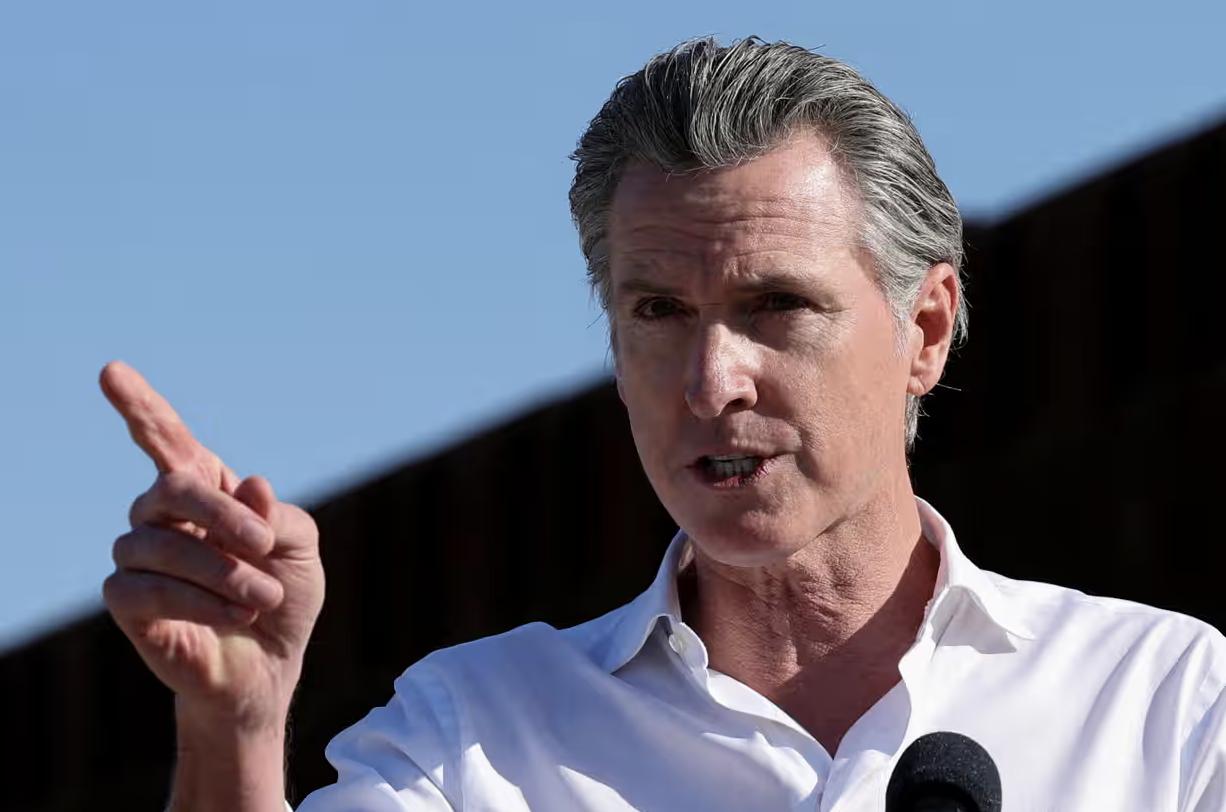
Since the end of the COVID-19 pandemic, California's economy has been sluggish, with near-zero net job growth and an unemployment rate of 5.6%, among the highest in the United States. As the world's fourth-largest economy, California should theoretically possess strong economic resilience. However, the reality is far from optimistic. Economic weakness, rising unemployment, and increasingly severe poverty and homelessness present unprecedented challenges for the state. Against this backdrop, Governor Gavin Newsom's presidential campaign has become a focal point. While his campaign strategy targets Trump, whether he can address California's economic difficulties remains a major hurdle in his political career.
California's Economy: A Giant in Distress
California has long been an economic "giant" in the United States, with one of the world's largest economies. However, since the end of the pandemic, economic growth has stalled. Many have noted that California's job market has seen little to no growth, and in some areas, even contraction. Despite various measures taken by the California government and businesses to stimulate economic recovery, the unemployment rate remains stubbornly high at 5.6%. This figure consistently ranks among the highest in the US, far exceeding the national average. Economists point out that this indicates that California's economic recovery is far weaker than expected.
The rising unemployment rate not only affects the overall economy but also impacts California's traditional industries. Southern California, once renowned for its powerful film and television production industry, is facing a decline. Meanwhile, the high-tech industry in the San Francisco Bay Area—once the backbone of California's economy—is facing the impact of artificial intelligence, leading to significant layoffs. The integration of traditional and emerging industries, driven by technological advancements, is leaving more workers facing unemployment.
California's unemployment rate, poverty rate, and homelessness rate are among the highest in the US. Although the state government has implemented measures to address these issues, the weak economy has significantly diminished the effectiveness of these policies. The high unemployment rate directly leads to a decrease in state government revenue, putting immense pressure on the California government to bridge its budget deficit. Furthermore, public anxiety about the economy is steadily increasing, with many people feeling their economic security is disappearing, unable to pay bills, save for the future, or even maintain their daily living needs.
Newsom's Presidential Campaign and Political Challenges
While California's economy faces difficulties, Governor Gavin Newsom is actively preparing for the presidential election. As a representative of California's progressive wing, Newsom has all but announced his candidacy for president and is positioning himself as the "anti-Trump commander-in-chief," criticizing the Trump administration's policies while simultaneously strengthening his leadership within the Democratic Party. This campaign strategy will undoubtedly attract the attention of some voters, especially those opposed to Trump. However, the question remains whether Newsom's strong anti-Trump stance will continue to attract voter support or will backfire and become a liability in his campaign.
Besides his rivalry with Trump, Newsom faces other political challenges. First, regarding California's redistricting, Newsom successfully pushed for the redrawing of California's 52 congressional districts, aiming to help the Democratic Party regain control of the U.S. House of Representatives in 2026. However, the effectiveness of this strategy remains uncertain, and whether future elections will proceed smoothly will directly impact Newsom's political future.
At the same time, the election for California's next governor is also heating up. Although many Democrats are currently running, there is no clear frontrunner. Theoretically, the large number of candidates could lead to two Republican candidates emerging from the primary and advancing to the general election. This would undoubtedly be a challenge for the Democratic Party, especially in a state like California, where the Democratic Party holds a majority, but voter choices remain uncertain.
The Interplay of Politics and Economics
2026 will be a crucial election year for California, with political struggles and the interplay of moneyed interest groups dominating the election. Various interest groups are attempting to influence voters through opposing proposals such as tax increases or decreases. These conflicting proposals not only highlight the complexity of California politics but also reflect the immense influence of moneyed interest groups in elections. However, despite the intense political maneuvering, the issues that truly affect the lives of Californians are economic ones.
Public anxiety about the economy is increasing, a situation particularly evident in California. A poll by the Public Policy Institute of California (PPIC) shows that many Californians are pessimistic about the economic outlook, believing that future economic opportunities are dwindling, and many are struggling to maintain basic economic security. Despite California's status as a global economic powerhouse with a strong economic foundation, many working-class individuals still face difficulties paying bills and saving for the future.
What does the future hold for California?
The economic challenges facing California are no longer problems that any single administration can easily solve. Although Newsom continues to emphasize the sheer size of California's economy, the reality is that poverty, unemployment, and homelessness persist. While Newsom's path to the presidency is fraught with challenges, his biggest challenge may not be Trump, but rather how to confront and solve California's deep-seated economic problems.
In this context, future elections are not just a political contest, but a critical moment for California's future development. California's political figures, especially those running for governor, should deeply understand that California's economic problems are not only about votes, but also about future prosperity and stability. History has proven that taking prosperity for granted often leads to hardship. Whether California can emerge from this economic predicament and regain its former glory will depend on how it addresses these deep-seated economic issues in the coming years.

Recently, the British government, in accordance with the "Steel Industry (Nationalization) Act" that came into effect on July 16th, took the British Steel Company, which is controlled by China Jiefang Group, into state ownership without compensation.

Recently, the British government, in accordance with the "S…

On July 23rd local time, the US Trade Representative Office…

The international crude oil market saw a sharp one-sided ri…

Recently, the geopolitical confrontation between the United…

The New York Times has recently clashed with the Trump admi…

Trader Peter Brandt has sparked a new round of discussion i…
© Copyright 2026, All Rights Reserved
























