
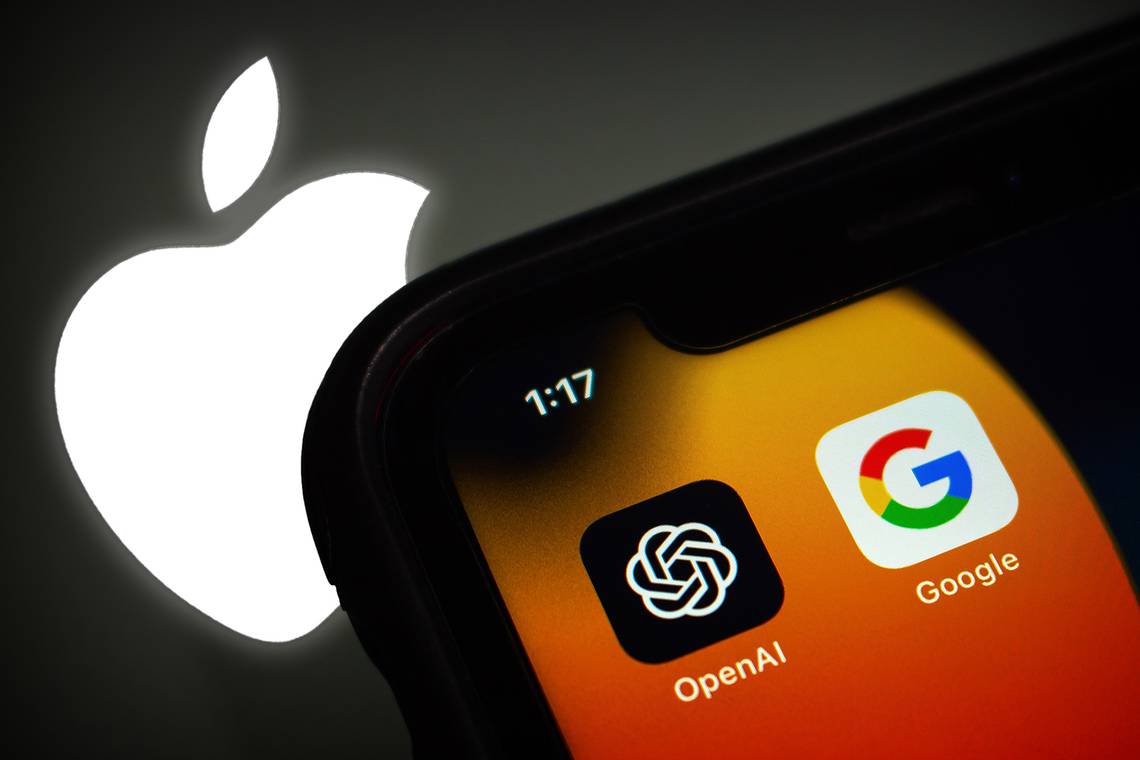
January 12, 2026, marked a historic moment in the tech industry — Apple and Google jointly announced a multi-year strategic AI partnership. The next-generation Siri voice assistant and iOS system-level AI features will be fully powered by Google's Gemini large language model (LLM), with underlying computing power provided by Google Cloud. This industry-altering collaboration continued to gain momentum on January 14, not only rewriting the decades-long competitive dynamics between the two tech giants but also signaling a profound transformation of the global AI ecosystem from "self-developed closed loops" to "technology alliances."
As Apple's first integration of an external LLM into its core interaction gateway, this partnership stems from pragmatic considerations behind its AI strategy. Apple's in-house development of foundational models has progressed slowly: AI features teased at the 2024 WWDC have repeatedly faced delays, early-stage functions like "News Summary" have drawn criticism due to errors, and the departure of key AI team leaders poached by Meta with lucrative offers has left Apple significantly lagging in the generative AI race. Google Gemini's technological advantages emerged as a crucial breakthrough: Gemini Ultra achieved an accuracy rate of 68.9% on the authoritative multimodal benchmark MMMU, outperforming GPT-4V by 12 percentage points, and can process 52 billion daily user interactions across full-scene data including search, video, and email, forming a dynamically evolving technological moat. After comprehensive testing of mainstream models, Apple ultimately opted to license Gemini at an estimated annual cost of $1 billion, ensuring the launch of the revamped Siri alongside iOS 26.4 this spring to rebuild market trust.
This collaboration delivers mutual empowerment for both giants. For Google, it represents a milestone breakthrough in the commercialization of AI computing power: Google Cloud's TPU V7 clusters will provide cloud-based inference support for Siri. Wall Street analysts estimate that Apple alone could bring in
3−5billioninincrementalannualrevenue,withgrossprofitmarginssignificantlyhigherthantraditionalcloudservices.Themarketrespondedpositivelyimmediately—sharesofGoogle sparentcompanyAlphabetroseover24.09 trillion, a new all-time high, solidifying its position as the world's second-largest tech company. For Apple, integrating Gemini will completely reshape Siri's capabilities, evolving it from a simple voice command executor to an intelligent assistant with real-time contextual understanding and cross-application intent reasoning. It will also power new features like "AI Health Agent," enabling Apple to enter the AI healthcare sector and reach over 2 billion active Apple devices. Notably, Apple remains committed to privacy protection, clarifying that user data will continue to operate through its Private Cloud Compute architecture, with Google providing only technical support without accessing user data.
The ripple effects of this partnership are triggering a chain reaction across the global AI ecosystem. For years, the tech industry has been dominated by four closed ecosystems — Apple, Google, Microsoft, and Amazon. This alliance breaks the competitive logic of "end-to-end self-development," forcing competitors to accelerate strategic adjustments: Microsoft Copilot urgently needs iterative upgrades to counter the enhanced Siri, as its previous reliance on OpenAI's models has exposed shortcomings; Amazon Alexa faces the risk of user attrition and must urgently strengthen its multimodal capabilities. More profoundly, the core dimension of AI competition is shifting from single-model performance to "technology alliance" ecosystem synergy. By partnering with Apple and Samsung, Google has embedded Gemini into the world's two leading mobile ecosystems, creating economies of scale.
However, the collaboration has also sparked industry concerns about "concentration of power." Tesla CEO Elon Musk publicly criticized Google for forming an unreasonable monopoly through its partnerships with Apple, combined with its Android and Chrome ecosystems. His company xAI is challenging Apple's partnership model through legal action. Meanwhile, due to data compliance restrictions, the Chinese mainland version of Siri is unlikely to directly integrate Gemini. Instead, it may collaborate with domestic tech firms to adopt self-developed models, forming a differentiated market landscape.
From an industry evolution perspective, the AI alliance between Google and Apple is no coincidence but an inevitable choice as global AI competition enters a deep phase. When a single enterprise can no longer cover the full-chain costs of model development, computing power construction, and scenario implementation, open collaboration becomes the optimal solution for resource allocation. This century alliance not only reshapes Siri's product fate but also establishes new competitive rules of "technology alliances" in the AI ecosystem. In the future, more cross-enterprise and cross-sector AI collaborations are expected to emerge, driving the industry from fragmented competition to a new stage of collaborative innovation.

Recently, the British government, in accordance with the "Steel Industry (Nationalization) Act" that came into effect on July 16th, took the British Steel Company, which is controlled by China Jiefang Group, into state ownership without compensation.

Recently, the British government, in accordance with the "S…

On July 23rd local time, the US Trade Representative Office…

The international crude oil market saw a sharp one-sided ri…

Recently, the geopolitical confrontation between the United…

The New York Times has recently clashed with the Trump admi…

Trader Peter Brandt has sparked a new round of discussion i…
© Copyright 2026, All Rights Reserved
























