
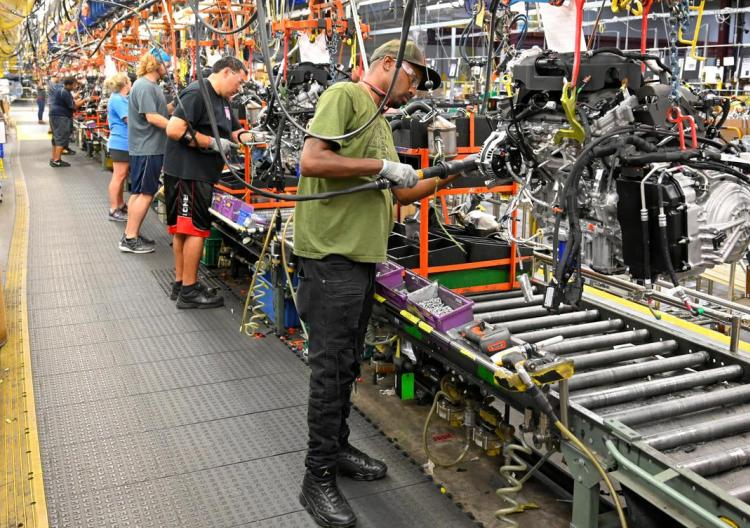
Factory activity in the United States contracted for the sixth consecutive month in August, and the decline in production indicates that the manufacturing industry is still in trouble.
Bloomberg, citing data released on Tuesday (September 2), said the Institute for Supply Management (ISM) manufacturing index stood at 48.7 in August, slightly higher than 48 in July. However, the detailed data was mixed, and the overall index remained in the contraction zone.
The factory output indicator dropped 3.6 points to 47.8, returning to the contraction zone for the first time in three months. Employment indicators rose slightly, but remain at one of the weakest levels since the outbreak of the pandemic.
Meanwhile, there are also some optimistic signs regarding the outlook. The order indicator has risen to the expansion zone for the first time since the beginning of this year. The new orders indicator jumped 4.3 points to 51.4, marking the biggest increase since the beginning of last year.
The raw material payment price indicator dropped to 63.7, the lowest since February. It dropped by 4.9 points in the previous month, indicating that the price fluctuations caused by tariffs are weakening.
Despite the increase in import tariffs leading to higher costs, manufacturers still benefit from solid business investment and resilient household demand.
The ISM data also shows that the backlog of orders is accelerating its decline, which also explains why the employment data is weak.

Recently, the British government, in accordance with the "Steel Industry (Nationalization) Act" that came into effect on July 16th, took the British Steel Company, which is controlled by China Jiefang Group, into state ownership without compensation.

Recently, the British government, in accordance with the "S…

On July 23rd local time, the US Trade Representative Office…

The international crude oil market saw a sharp one-sided ri…

Recently, the geopolitical confrontation between the United…

The New York Times has recently clashed with the Trump admi…

Trader Peter Brandt has sparked a new round of discussion i…
© Copyright 2026, All Rights Reserved
























