
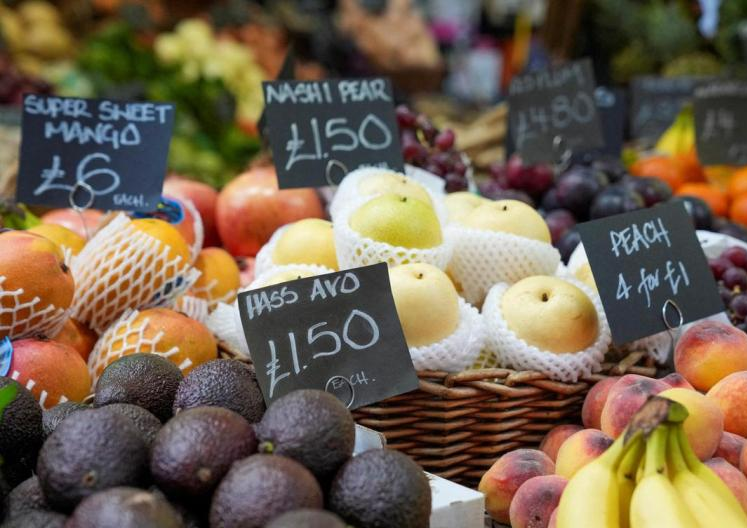
Driven by rising operating costs, the UK's food inflation rate rose to its highest level in a year in May, marking the fourth consecutive month of increase. This highlights that supermarket operators are facing increasingly heavy financial pressure while maintaining price competitiveness.
Bloomberg reported that the British Retail Consortium released data on Tuesday (May 27th) showing that the food inflation rate reached 2.8% in May, higher than 2.6% in April, mainly affected by the increase in the prices of fresh food.
Behind the upward trend of inflation lies the ripple effect brought about by the new round of financing budget of the British government. Retailers need to deal with a series of policy changes such as the increase in the minimum wage and the rise in the wage tax rate. According to the association's estimation, these measures will increase the operating costs of the entire industry by up to 5 billion pounds.
The association's chief executive, Helen Dickinson, issued a statement saying, "It is not surprising that inflation is on the rise again." She pointed out that under the double squeeze of rising labor and operating expenses simultaneously, the difficulty for businesses to maintain stable prices is constantly increasing.
This set of data has also shaken the market's expectations that a price war might break out in the British retail industry. Earlier this year, the supermarket chain Asda announced that it would lower prices to advance its restructuring plan, raising investors' concerns about a comprehensive price reduction in the industry and dragging down the share prices of large supermarkets such as Tesco and Sainsbury's.
However, Charles Allen, an analyst at Bloomberg Intelligence, said in the latest report: "Concerns (from the outside) about the outbreak of a price war may have been exaggerated."

Recently, the British government, in accordance with the "Steel Industry (Nationalization) Act" that came into effect on July 16th, took the British Steel Company, which is controlled by China Jiefang Group, into state ownership without compensation.

Recently, the British government, in accordance with the "S…

On July 23rd local time, the US Trade Representative Office…

The international crude oil market saw a sharp one-sided ri…

Recently, the geopolitical confrontation between the United…

The New York Times has recently clashed with the Trump admi…

Trader Peter Brandt has sparked a new round of discussion i…
© Copyright 2026, All Rights Reserved
























