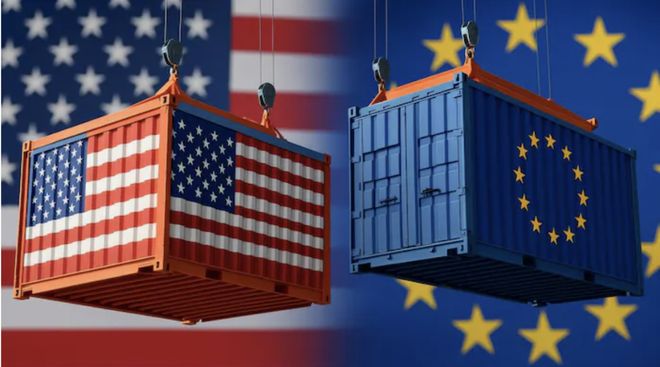
The Trump administration has sent clear policy signals of plans to further raise tariffs on goods imported from the European Union, reigniting transatlantic trade tensions. Capital markets and real industries alike grow concerned that import and export costs for three core export categories—automobiles, home appliances and alcoholic beverages—will surge markedly, squeezing profit margins across the entire trade industrial chain.
The proposed tariff hike is no sudden conflict, but rather the culmination of long-standing EU-US trade rifts. Washington is dissatisfied with the slow progress of negotiations over market access for industrial and agricultural goods. Lingering disputes over digital services taxes rolled out by multiple European nations and steel-aluminum trade imbalances have prompted the U.S. to wield tariffs as leverage, aiming to force the EU to open its market wider to American goods and cut domestic industrial subsidies. Though the U.S. and EU previously reached a framework trade arrangement setting a baseline tariff of 15% for most EU goods and a steep 27.5% tariff on automobiles, negotiations over detailed provisions have long hit an impasse. Arguing existing concessions fail to balance the so-called U.S. trade deficit with Europe, the Trump administration has floated tough threats of additional tariffs. Market participants widely estimate supplementary tariff rates will range from 10% to 25%, covering the vast majority of consumer and industrial manufactured goods.
Manufacturing exporters bear the brunt first, with European automakers facing the most direct fallout. German giants Volkswagen, BMW, Mercedes-Benz and Italian luxury car brands rely heavily on U.S. consumer demand. Current import tariffs on complete vehicles have already eroded automaker profits; further tariff hikes would push up the comprehensive cost of each imported luxury car by thousands to tens of thousands of U.S. dollars. Carmakers have only two hedging options: pass tariff costs onto U.S. consumers via price hikes, undermining the cost competitiveness of European vehicles, or ramp up production capacity at North American manufacturing plants. The latter would trigger surging short-term fixed-asset investment and extend return-on-investment cycles. Multiple European auto groups have downgraded their full-year profit outlooks. Industry analysts calculate that if blanket extra tariffs take effect, Germany’s automotive sector could sustain cumulative economic losses exceeding 200 billion euros over several years, with upstream and downstream auto parts suppliers facing shrinking order books in tandem.
Home appliance manufacturers follow closely in bearing pressure. Premium European white goods and kitchen appliance brands hold stable market share at high-end U.S. retail channels. Home appliances feature intricate component supply chains and lengthy shipping lead times. Combined tariffs, ocean freight and raw material costs leave small and medium-sized home appliance exporters with minimal buffer room. Large brands can preserve profits through price adjustments, while niche local manufacturers with weak bargaining power are forced to slash channel and marketing budgets. Some SMEs even plan to scale back U.S. market presence and diversify risks by pivoting to emerging markets in Southeast Asia and the Middle East. Traders report widespread caution over import orders at present, as distributors hesitate to place advance stock orders, dragging down circulation efficiency across the industrial chain.
Wine, champagne, whisky and other alcoholic export industries face targeted blows. The U.S. ranks as a core overseas market for French champagne and Burgundy wine. Industry associations estimate tariff increases will slash European alcohol sales to the U.S. by a quarter, threatening hundreds of thousands of upstream and downstream jobs. Alcoholic products carry high warehousing costs and limited shelf lives, making rapid export market reallocation unfeasible. Wineries and U.S. alcohol importers are squeezed from both ends: European producers grapple with falling orders, while American importers face steeper procurement expenses, lifting retail prices at supermarkets and further dampening consumer spending. The EU has drafted a retaliatory tariff list, planning to impose reciprocal duties on U.S. whisky, farm produce and other goods, creating a vicious cycle of mutually inflated import and export costs.
Trade uncertainty roils capital markets, triggering periodic corrections in pan-European stock indexes, automotive and consumer sectors. The U.S. Dollar Index fluctuates higher while the euro weakens under pressure. Market analysts warn the fallout from this dispute carries spillover effects: tariff barriers will stoke inflation on both sides of the Atlantic, dampen household consumption willingness in Europe and the U.S., accelerate restructuring of transatlantic supply chains, and risk spreading protectionist sentiment across global trade.
The EU will not accept tariff pressure passively. On one hand, Brussels intends to activate the Anti-Coercion Instrument (ACI) and finalize a list of reciprocal retaliatory tariffs targeting signature U.S. export sectors including agriculture, spirits and automobiles. On the other hand, the bloc speeds up internal coordination to unify negotiating stances among member states while advancing diversified trade layouts to reduce reliance on the U.S. market. Nevertheless, the odds of a new consensus emerging in the short term remain slim, making the implementation of extra tariffs highly likely.
For global trade markets, this round of EU-US tariff standoff delivers a stark warning: frequent shifts in major economies’ trade policies destabilize industrial supply chains. Exporters must draw up multi-layered contingency plans covering cost accounting, market diversification and localized production. Until the transatlantic trade deadlock is resolved, upward cost pressures on automobile, home appliance and alcohol imports and exports will persist, prolonging profit recovery cycles for related industries.


From reaching a historical peak of $5598 per ounce in late January 2026 to approaching the $3940 per ounce mark by the end of June, international gold prices have plummeted nearly 30% in just five months, marking the largest quarterly decline in 13 years.

From reaching a historical peak of $5598 per ounce in late …

On July 5, 2026, Yahoo Finance reported that QTS, a data ce…
In the early hours of July 6, the Russian military launched…

A survey conducted by the UK Financial Conduct Authority (F…
The Trump administration has sent clear policy signals of p…

Recently, while the US and Iran signed a bilateral memorand…
© Copyright 2026, All Rights Reserved