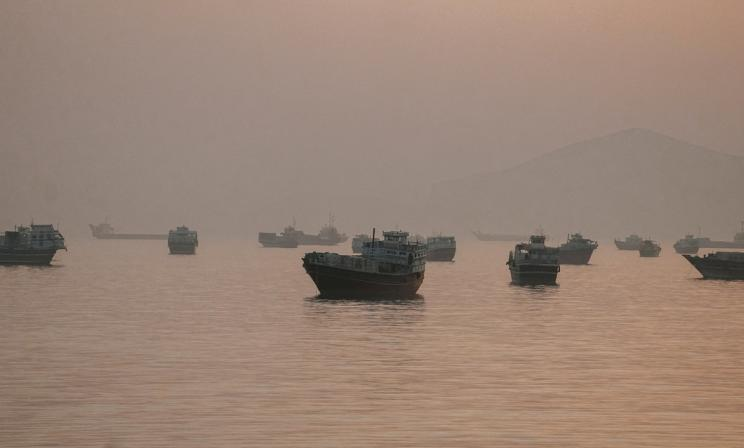
(London/Paris - General News) Britain and France have announced their cooperation with Oman to ensure the safety of shipping in the Strait of Hormuz; and they are preparing to deploy a broader multinational military operation to assist in restoring the freedom of navigation in the strait.
British Prime Minister Stamer and French President Macron issued a joint statement on Saturday (July 4th) saying that the Strait of Hormuz is a vital artery of the global economy, and restoring safe passage for ships of all countries is a common concern of the international community.
The statement also emphasized: "Britain and France are ready at any time to deploy a broader multinational military operation to safeguard the freedom of navigation in the Strait of Hormuz."
France has stated that it has deployed anti-mine forces to the Middle East region, including two minesweeping vessels. Macron also posted on social media: "Under the escort of two frigates and an offshore patrol aircraft, these vessels are ready and will work together with partner countries to contribute to the full resumption of navigation and shipping safety in the Strait of Hormuz."
In April this year, Britain and France announced that they would take the lead in a multinational defense operation to ensure the safety of shipping in the Strait of Hormuz. Since then, the two countries have begun to enhance their military deployments in the waters of the Middle East.
Iran: Strait Security Is Managed by Coastal Countries; Those Who Create Crises Will Bear the Consequences
Regarding the plans of the UK and France, Iranian Deputy Foreign Minister Gharibabadi posted a rebuttal on social media, stating that the Strait of Hormuz "is not a stage for extraterritorial countries to showcase their military power." He wrote: "Strait security is managed by the coastal countries; anyone who creates a crisis must bear the consequences of their risky actions. This is a stern warning."
Aman once said that any new arrangements being discussed with Iran regarding the Strait of Hormuz would be in line with international law. However, as the Strait of Hormuz handles approximately 20% of the world's oil transportation volume, any plan involving a charging mechanism has drawn attention from the international market.
Amman has long played a mediating role in the Middle East crises and is one of the few countries that are trusted by both Iran and the United States. Sultan Hamad of Oman met with Stammer in London on Thursday (2nd), and the two discussed the cooling of the situation in the Middle East and the safeguarding of the security of shipping in the strategic waterways of the Gulf.
In the past two weeks, the amount of crude oil exported through the strait has doubled, yet more than eight merchant ships have suddenly returned.
On June 17th, the United States and Iran signed a memorandum of understanding, agreeing to end the conflict that had lasted for nearly four months and reopen the Strait of Hormuz. Subsequently, the two sides conducted negotiations lasting 60 days to seek a long-term peace agreement.
Since then, the volume of crude oil transportation through the Strait has significantly increased. According to data from the shipping analysis company Kpler, Saudi Arabia has exported approximately 34 million barrels of crude oil through the Strait of Hormuz since June 17th, which is more than double the approximately 15 million barrels during the period from March 9th to June 17th.
However, the passage through the strait has not yet fully returned to normal. Ship tracking data shows that on Friday and Saturday (the 3rd and 4th), at least eight merchant ships that were preparing to leave the Persian Gulf suddenly turned back near the Strait of Hormuz as they approached the coast of Oman. Some of these ships then changed to follow a route closer to the Iranian side.
Iran's ambassador to China, Fazli, reaffirmed at the World Peace Forum held in Beijing on Saturday that Iran is in discussions with Oman on new shipping management arrangements for the Strait of Hormuz. In the future, it will charge "service fees" to passing ships, but emphasized that this is not a toll; at the same time, it is considering providing special treatment to friendly countries.


In recent years, extreme heat waves have frequently swept across Europe, and temperatures in many countries have repeatedly broken historical highs.

In recent years, extreme heat waves have frequently swept a…

On July 4, 2026, the United States reached a special milest…

Since the start of summer, many countries in Western Europe…
On July 5th local time, just before the opening of the NATO…
In 2026, the European Union’s Carbon Border Adjustment Mech…

The NATO summit has not yet opened, but internal rifts have…
© Copyright 2026, All Rights Reserved