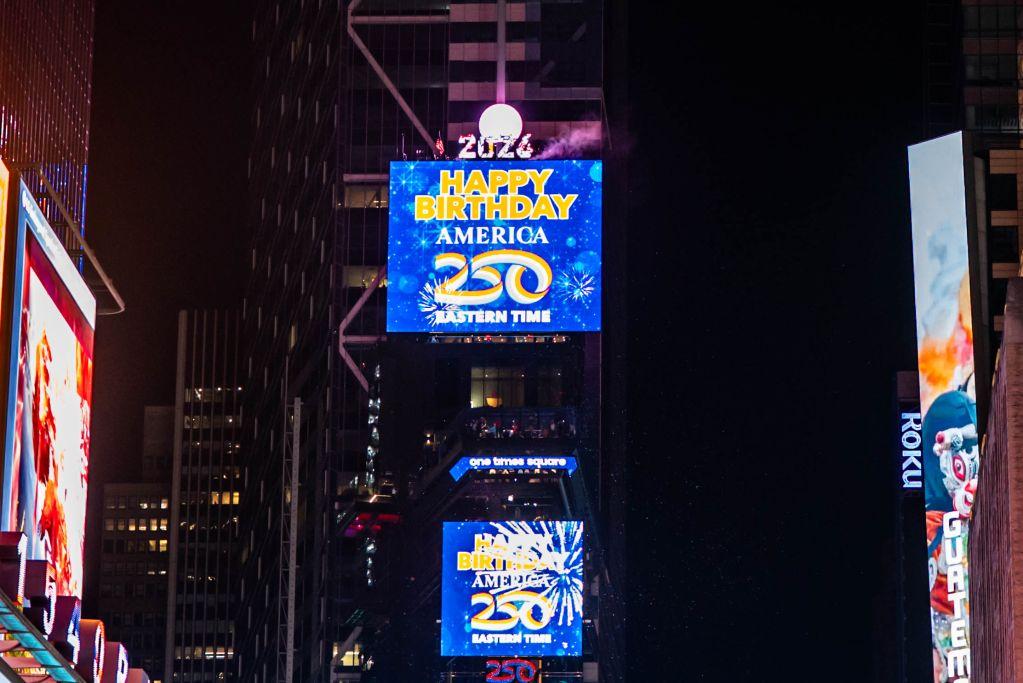
On July 4, 2026, the United States reached a special milestone—the 250th anniversary of its independence. What was meant to be a national celebration reflecting on the nation’s founding and uniting the country instead became the most vivid manifestation of partisan conflict and social division. Behind the rare heatwave and unprecedented fireworks displays lay an absurd reality: Democratic-led states collectively boycotted the event, while the entire celebration was heavily marked by partisan influence, exposing America’s deepening political polarization to the world.
A decade earlier, Congress had established a bipartisan "250 for America" initiative to plan nationwide festivities, with the original goal of fostering cross-party participation and creating a truly unifying national commemoration. But after Trump’s second term began, he abruptly overturned this congressional decision, declaring the Trump-aligned "Liberty 250" as the sole official organizing body. From funding to historical narratives and event logistics, Republicans took full control. This move immediately intensified tensions between the parties over the celebration. Democrats openly criticized the Trump administration for “partisanizing” a national holiday and launched congressional investigations into Liberty 250, pressuring it on issues such as funding sources and historical content. What was intended as a unifying occasion thus turned into a political battleground where both parties fought for narrative dominance even before the event began.
The ripple effects of this partisan struggle quickly spread beyond Capitol Hill, evolving into a nationwide protest. The centerpiece of the celebration, the "Great American State Fair," originally planned to feature unique pavilions from all 50 states showcasing regional history and culture. Yet at least 11 states announced they would not send official delegations—most of them Democratic-leaning blue states. On-site reporters observed that pavilions representing Oregon, Washington, and other blue states stood completely empty, leaving only solitary state name posters and vacant chairs, like silent protest signs. Grassroots opposition was equally strong: several prominent musicians who had initially agreed to perform at the National Mall concert one after another withdrew, with rock singer Bret Michaels publicly stating that what was once a pure commemorative event had become deeply divisive, and he no longer wished to be involved. Greg Chuss, an octogenarian former Iowa congressman, bluntly remarked that the national celebration, meant to reflect on history, had become “utterly grotesque” under intense partisan manipulation.
This chaotic spectacle was never an isolated incident but rather a concentrated outbreak of years-long political polarization in the U.S. Since Trump assumed office in 2025, he has issued 268 executive orders, bypassing Congress to push sweeping changes—including immigration controls, massive tariff hikes, and reversals of clean energy policies—effectively governing through executive action without legislative input. In response, Democratic-led blue states have not only filed numerous lawsuits but also outright refused to comply with White House directives. The two parties have fallen into a cycle of mutual opposition across nearly every policy issue, rendering national governance effectively paralyzed. This divide has deeply penetrated the general electorate: a May PBS poll revealed that nearly 90% of Democrats blamed the Trump administration for rising gas prices, compared to just 30% of Republicans. A recent Gallup survey further highlighted the depth of the rift: 70% of Republicans feel “extremely proud” to be American, while among Democrats, that figure stands at only 14%. The gap in national identity between the two parties has grown vast.
The escalating polarization in the United States is fundamentally a consequence of the two-party system and the winner-takes-all electoral rules. To secure their core support, the two parties have no choice but to intensify their ideological opposition and resort to extreme rhetoric to win voters. The entire political landscape has fallen into a binary logic of "you lose, I win," with partisan rivalry taking precedence over national interests. Issues such as immigration, the economy, and race—matters vital to people's livelihoods—have all been reduced to tools for electoral gain, while deeper problems like wealth inequality and systemic injustice remain unresolved for years. On the 250th anniversary of independence, America did not witness nationwide celebration. This national holiday torn apart by partisan strife serves as the most telling testament: when party interests completely overshadow national consensus, so-called "unity" has long become an unattainable illusion.


In recent years, extreme heat waves have frequently swept across Europe, and temperatures in many countries have repeatedly broken historical highs.

In recent years, extreme heat waves have frequently swept a…
On July 4, 2026, the United States reached a special milest…

Since the start of summer, many countries in Western Europe…
On July 5th local time, just before the opening of the NATO…

In 2026, the European Union’s Carbon Border Adjustment Mech…

The NATO summit has not yet opened, but internal rifts have…
© Copyright 2026, All Rights Reserved