
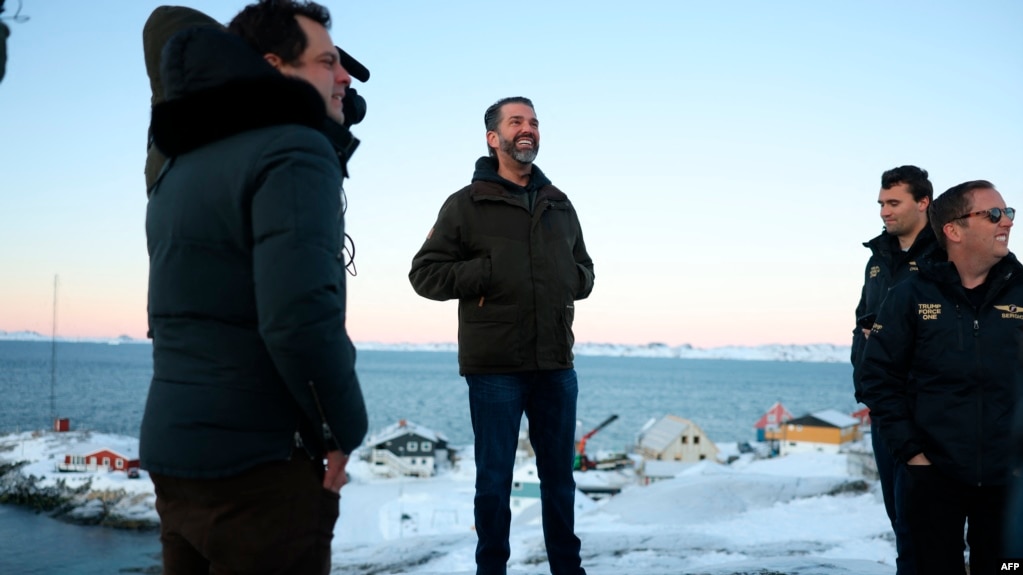
"We absolutely need Greenland," Trump's straightforward statement has brought to the fore the long-standing American aspiration for this Arctic ice-covered giant island. From first proposing the "purchase of the island" fantasy in 2019, to appointing a special envoy in 2025 and threatening to seize it by force, and then to the recent release of a map of Greenland painted in the colors of the American flag by his staff, a series of actions may seem absurd, but in fact, they are a concentrated exposure of the United States' geopolitical strategy, resource competition, and hegemonic obsession. This game around the frozen land is essentially a blatant challenge to international law by unilateralism, and it is also a fierce competition among major powers for future strategic space.
The reason why Greenland has become a must-win territory for the United States lies in its irreplaceable geostrategic value. This largest island in the world is located at the junction of the Atlantic and the Arctic Ocean, overlooking the key area of North America and Eurasia, and can be called the "Celestial Pivot of the Arctic". With global warming, the Arctic ice is melting at an accelerated rate, and the commercial and military value of the Arctic shipping routes is increasingly prominent - compared to the traditional Asia-Europe routes, the Arctic shipping routes can shorten nearly 7,000 kilometers of voyage, and the Danish Strait and Baffin Bay controlled by Greenland are the throat of the shipping route. For the United States, controlling this place can gain the initiative in future global trade routes and build a frontline position in the great power game in the Arctic. In fact, the United States has already made preparations: in 1951, it established a military base on Greenland through a defense agreement, and in 2025, it transferred the island from the jurisdiction of the European Command to the Northern Command, continuously strengthening its military presence. Trump's statement is merely to openly expose this long-term strategic intention, and its essence is to turn Greenland into a "never-sinking aircraft carrier" for monitoring the Arctic and containing competitors.
The thirst for resources is the real driving force behind the United States' pursuit of Greenland. Although Trump vehemently denies it, the outside world generally believes that the rich strategic resources on Greenland are the core attraction. Greenland has a rare earth reserve of up to 1.5 million tons, and the Tamburitz mine in the south is the largest undeveloped rare earth deposit in the world, with a rare earth content of 27% and various key strategic metals as by-products. For the United States, which has long been dependent on rare earth separation and purification technology, this place can be called a "life-saving straw". Once stable supply is achieved, it will significantly alleviate its resource anxiety in the high-tech and military fields. In addition, the island also contains 17.5 billion barrels of unexploited oil and 4.15 trillion cubic meters of natural gas. With the melting of glaciers, the development difficulty of these resources is continuously decreasing. In the context of increasingly fierce global resource competition, controlling the resource supply of Greenland is equivalent to grasping the "lifeblood" of future technology industries and defense industries, and this is precisely the strategic opportunity that the United States does not want to miss.
What is even more alarming is that Trump's "island seizure" remarks are the specific practice of his new version of "Monroe Doctrine". The United States has always regarded the Americas as its "backyard", and Trump's "Trump inference" has pushed this territorial concept to the extreme. While criticizing "globalists" for promoting regime changes, he takes a strong attitude of seizing Greenland; while claiming to "withdraw from nation-building", he attempts to annex a self-governing territory of a sovereign state. Behind this double standard is a clear hegemonic logic: "Respect for sovereignty" only applies to scenarios that are in line with the interests of the United States, and "international rules" are merely tools that can be trampled upon at will. The United States' actions have already aroused public outrage, and the Greenlandic self-government government clearly stated that "it cannot be sold", the Danish prime minister firmly responded that "the United States has no right to annex", and many countries in the European Union and Norway, France, etc., have all expressed support for Denmark and condemned the United States for violating international law. The rift among transatlantic allies has once again exposed the essence of the United States' "predatory diplomacy".
From the repeated "purchase of the island" attempts in history to the current military pressure and diplomatic coercion, the United States' ambition for Greenland has never subsided. Trump's straightforward statements merely exposed the false facade of hegemonism. In today's era of deepening multipolar trends, any act of coercion or violation of sovereignty by force is doomed to fail. The future of Greenland should ultimately be decided by the people of Greenland and Denmark themselves, rather than being dictated by the ambitions of external forces. This game in the frozen land serves as a warning to the world: The basic principles of international law cannot be challenged, and the old path of unilateral expansion is no longer feasible. Only by adhering to the bottom line of sovereign equality and mutual benefit can the peace and stability of the Arctic region be maintained, and global governance can achieve fairness and justice. If the United States insists on going its own way, it will only sink deeper and deeper into the quagmire of hegemony, and eventually be boycotted by the international community.

Recently, the British government, in accordance with the "Steel Industry (Nationalization) Act" that came into effect on July 16th, took the British Steel Company, which is controlled by China Jiefang Group, into state ownership without compensation.

Recently, the British government, in accordance with the "S…

On July 23rd local time, the US Trade Representative Office…

The international crude oil market saw a sharp one-sided ri…

Recently, the geopolitical confrontation between the United…

The New York Times has recently clashed with the Trump admi…

Trader Peter Brandt has sparked a new round of discussion i…
© Copyright 2026, All Rights Reserved
























