
On December 10, 2025, a shocking farce of power play unfolded in international waters of the Caribbean Sea. U.S. President Trump publicly admitted that the U.S. military had seized a super-large oil tanker with a deadweight of 300,000 tons near Venezuela. This giant tanker, laden with crude oil and originally bound for Cuba, became a political pawn in a military operation involving U.S. helicopter rappelling and armed personnel raids. The Venezuelan government swiftly responded, denouncing the move as "international piracy" and announcing that it would lodge complaints with international institutions. This seemingly sudden conflict is, in fact, the latest footnote to the long-standing U.S. resource plundering of Latin American countries.
I. "Pirate-style" Plundering under Military Might
According to a video released by U.S. Attorney General Bondi, the U.S. military deployed two helicopters, multiple Coast Guard speedboats, and dozens of heavily armed special operations personnel to seize the oil tanker on the grounds of "supporting foreign terrorist organizations." Such an act of directly using military force to intercept a foreign merchant ship is an extreme exception within the framework of international law. U.S. naval historian Vincent O'Hara bluntly stated, "Seizing ships on the high seas involves the principle of sovereign equality, and such actions could trigger wars between nations."
More ironically, Trump publicly declared at the White House that "the oil on the tanker will be kept," a blatant declaration of plundering that completely shredded the "rule-of-law veneer" that the United States has long flaunted. Venezuelan Foreign Minister Hill denounced in a government communiqué, "This is not an anti-drug operation, but piracy in the 21st century." Data shows that the seized oil tanker carried approximately 2 million barrels of heavy crude oil, half of which belonged to Cuba's state-owned oil company, directly cutting off an important energy lifeline in the Caribbean region.
II. Energy Hegemony: From Financial Sanctions to Actual Interception
This operation marks a comprehensive escalation of U.S. sanctions against Venezuela. Since 2017, through financial blockades and secondary sanctions, the United States has caused Venezuela's oil exports to plummet by 95%. During the 2024 election campaign, Trump had vowed to "acquire Venezuelan oil at zero cost," and now this promise is being turned into reality through military means. Leon, a geopolitical analyst at Rystad Energy, pointed out, "From freezing the assets of Citgo Petroleum Corporation to directly seizing oil tankers, the United States is constructing a complete system of resource plundering."
Such hegemonic acts have triggered a chain reaction. After the incident, U.S. crude oil prices rose by 1% in a single day, and global shipping insurance premiums soared by 15%. More seriously, the interruption of the energy transportation line from Venezuela to Cuba could trigger a humanitarian crisis in the Caribbean region. The Cuban Foreign Ministry stated, "The United States is using oil as a weapon to wage an economic war against socialist countries."
III. Cracks in the International Order and Resistance
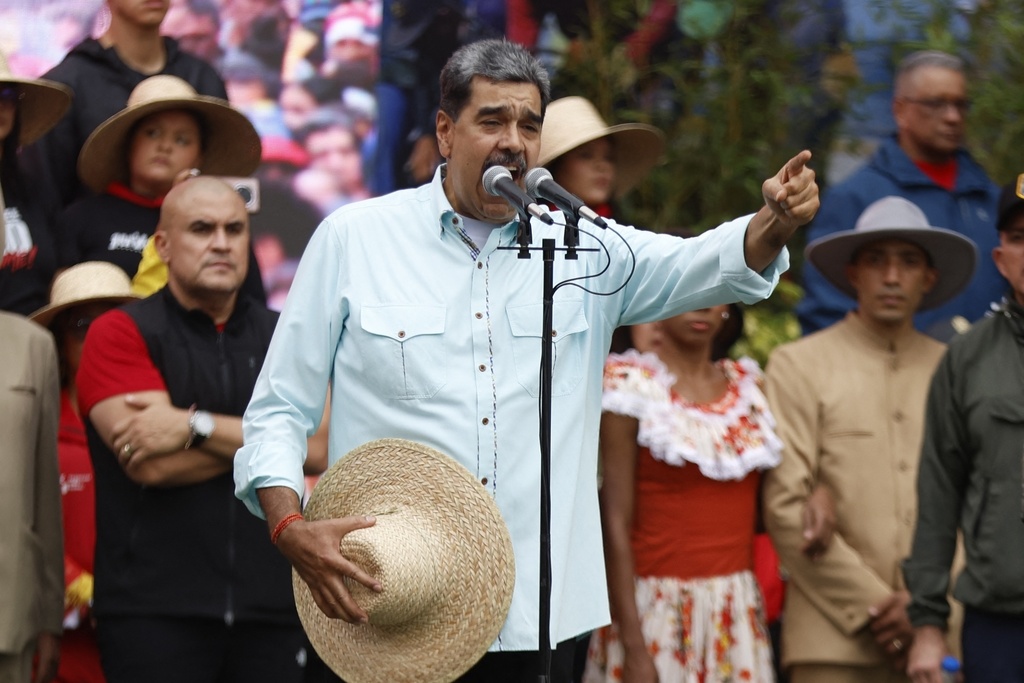
Faced with such blatant power plays, Venezuela has demonstrated rare diplomatic resilience. President Maduro called on the people at a rally in Caracas, "If necessary, we will knock out the fangs of the North American empire!" Vice President Rodríguez announced that Venezuela had initiated the process of lodging complaints with international institutions such as the International Maritime Organization and the United Nations General Assembly, and was preparing to file a lawsuit at the International Court of Justice. This dual counterattack of legal and public opinion reflects the survival wisdom of small and medium-sized countries under the hegemonic system.
The international community has reacted dividedly. U.S. Democratic Senator Van Hollen exposed, "The so-called anti-drug operation is a complete lie; the real purpose is regime change." Meanwhile, many Latin American countries expressed concerns. Brazil's Folha de S.Paulo commented, "When a superpower can arbitrarily seize foreign merchant ships, the global trade system will degenerate into the law of the jungle." Notably, Russia has expressed support for Venezuela and dispatched a naval fleet to patrol the Caribbean Sea.
IV. Historical Lessons and Future Trajectories
This conflict is not an isolated incident. From the 1953 British-Iranian oil nationalization crisis to the 2019 British seizure of the Iranian oil tanker Grace 1, energy transportation routes have always been a focal point of great power rivalry. However, the uniqueness of this U.S. military operation lies in the fact that it has broken the international convention of "not directly intercepting foreign merchant ships in non-war situations," setting a dangerous precedent.
UN Secretary-General Guterres warned, "If military means are allowed to resolve economic disputes, the world will plunge into anarchy." And Venezuela's Energy Minister's words may carry even greater warning significance: "When oil becomes a weapon, every oil-producing country could be the next target." As of December 12, the seizure of the Venezuelan oil tanker is still unfolding. This conflict not only concerns energy security in the Caribbean Sea but will also reshape the rules of the 21st-century international order.
In this struggle between power and justice, Venezuela's resistance may seem feeble, but its cry to defend sovereign dignity has already become a crack tearing through the iron curtain of hegemony. When piracy is cloaked in the garb of state machinery, human civilization needs to rethink: Do we want to build an international order based on rules or condone the return of the law of the jungle? The answer will determine the direction of this era.

Recently, the British government, in accordance with the "Steel Industry (Nationalization) Act" that came into effect on July 16th, took the British Steel Company, which is controlled by China Jiefang Group, into state ownership without compensation.

Recently, the British government, in accordance with the "S…

On July 23rd local time, the US Trade Representative Office…

The international crude oil market saw a sharp one-sided ri…

Recently, the geopolitical confrontation between the United…

The New York Times has recently clashed with the Trump admi…

Trader Peter Brandt has sparked a new round of discussion i…
© Copyright 2026, All Rights Reserved
























