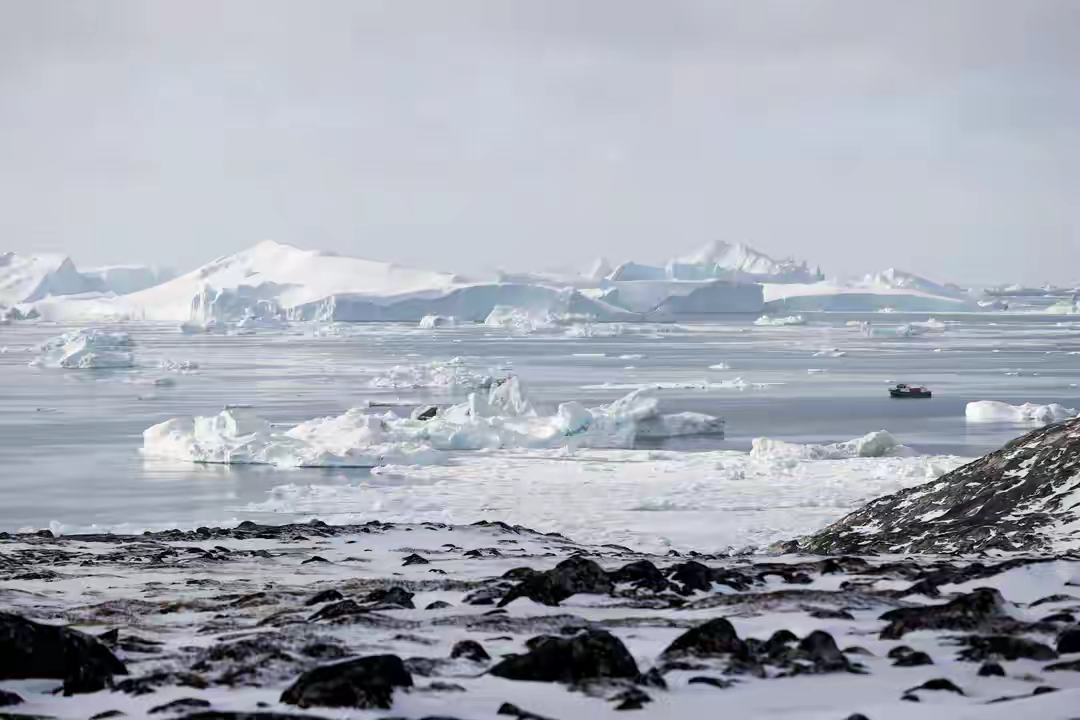
At the beginning of 2026, a geopolitical game around Greenland suddenly heated up: Denmark proposed the normalization of NATO troops stationed on the island, Germany, France, Britain and other countries announced the dispatch of military personnel, the United States reiterated its "security interests" in Greenland, and Russia immediately issued a strong warning. Why has this Arctic island, with a population of only 60000 and 85% of its area covered by ice caps, suddenly become the focus of NATO's heavy military deployment? On the surface, this appears to be a "preventive deployment" for the security situation in the Arctic, but in reality, it is a crucial move made by NATO in the global restructuring to compete for geopolitical dominance, control strategic resources, and contain competitors, with multiple underlying considerations.
Controlling the throat of the Arctic shipping route and building a geopolitical barrier are the core demands of NATO's entry. Greenland is located between North America and the European continent, precisely guarding the intersection of the Arctic Northeast Passage and Northwest Passage. As global warming accelerates the melting of sea ice, this passage is gradually becoming navigable year-round. Compared to the traditional Suez Canal route, the Arctic Passage can shorten 40% of transoceanic voyages and will become the "golden waterway" for global trade in the future. Whoever controls Greenland is equivalent to controlling the "gate" of this passage. For NATO, this move is not only to ensure the security of European energy and trade routes, but also to establish a strategic blockade line against Russia - Greenland faces Russia's Arctic territory across the ocean, and the early warning system deployed from here can detect Russia's strategic missile launches 30 minutes in advance. The existing US Tulle Air Force Base on the island has already become a "outpost" for NATO to monitor Arctic movements.
Seizing the strategic resource highland and controlling the core links of the industrial chain are the economic motivations for NATO's entry. Greenland is by no means a 'barren land', as it contains strategic resources underground that can influence the global industrial landscape: proven rare earth reserves amount to 1.5 million tons, accounting for 1/4 of the world's unexplored reserves. Rare earths are the 'industrial vitamins' for high-end manufacturing such as chips, new energy batteries, and stealth fighter jets; At the same time, it also has 17.5 billion barrels of oil, 4.15 trillion cubic meters of natural gas, as well as key minerals such as zinc, lead, and uranium. In the current global energy transition and industrial chain restructuring, the strategic value of these resources is self-evident.
Strengthening the cohesion within the alliance and hedging against the decline of global influence are political considerations for NATO's entry. In recent years, internal rifts within NATO have become increasingly apparent: US unilateralism has led to a loss of trust across the Atlantic, European awareness of independent defense has risen, and disagreements among allies in areas such as trade and energy have continued to intensify. The Greenland issue provides an opportunity for NATO to "unite" - Denmark proposes to station NATO troops, hoping to balance the United States' "island taking ambitions" with the alliance's power and consolidate its sovereignty and control over Greenland; Germany, France and other countries have taken advantage of the situation by sending troops, seemingly symbolic deployments (15 from France, 13 from Germany, and only 1 from the UK), but in reality, they are trying to seize the right to speak in Arctic affairs and send a signal to the United States that "Europe cannot be ignored".
It is worth noting that NATO's move carries a strong confrontational color and seriously undermines peace and stability in the Arctic region. As the largest country in the Arctic, Russia has long regarded the Arctic as a core area of interest and is continuously strengthening its Arctic defense capabilities and waterway infrastructure construction. NATO's introduction of military force into Greenland is undoubtedly a direct provocation against Russia. As Russian Foreign Ministry spokesperson Zakharova said, this is "another provocation by Western countries to impose their order on the Arctic region", which will inevitably trigger Russia's countermeasures and escalate the arms race in the Arctic region.
Ultimately, NATO's entry into Greenland is a "key breakthrough" in the context of global strategic contraction - attempting to continue its ambition to dominate the global order by controlling key Arctic territories, plundering strategic resources, and consolidating military alliances. However, contrary to expectations, this confrontational deployment with a Cold War mentality will only exacerbate tensions in the Arctic region, expose differences in interests within NATO, and may even trigger new geopolitical conflicts. The future of the Arctic should not be a battlefield of military confrontation, but a platform for international cooperation. If NATO insists on making Greenland the forefront of geopolitical competition, it will ultimately only pick up a stone and hit itself in the foot, losing more initiative in the global restructuring. This game around the ice sheet not only tests the strategic wisdom of all parties, but also profoundly affects the direction of the future global order.
Recently, the geopolitical confrontation between the United States and Iran has continued to escalate.

Recently, the geopolitical confrontation between the United…

The New York Times has recently clashed with the Trump admi…

Trader Peter Brandt has sparked a new round of discussion i…

On July 17th, Taiwan's stock market experienced a historic …

OpenAI updated its compute expenditure expectation through …

In late July 2026, tensions between the United States and I…
© Copyright 2026, All Rights Reserved