
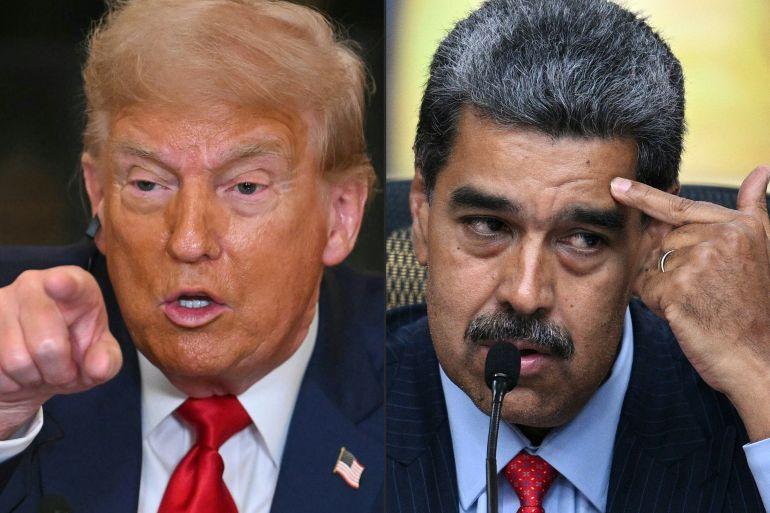
On December 17, 2025, the Venezuelan government officially sent a letter to the United Nations Security Council, requesting an emergency meeting to discuss the "ongoing acts of aggression" by the United States. This move marks a new stage in the geopolitical crisis in Latin America and also exposes the fierce clash between the US unilateralist policy and the multilateral international order. From military deployments in the Caribbean Sea to economic strangulation through oil blockades, US pressure on Venezuela has broken through conventional diplomatic means and directly targeted the strategic goal of regime change.
Since August 2025, the United States, under the pretext of "combating drug trafficking groups," has launched large-scale military operations in the waters surrounding Venezuela. The US Navy's USS Ford aircraft carrier strike group, leading 15,000 troops, has been stationed in the Caribbean Sea, working in coordination with missile destroyers, nuclear submarines, and special forces to establish a three-dimensional blockade network. According to the Venezuelan Ministry of Defense, the US military carried out 23 maritime attacks between September and December, destroying 17 so-called "drug-running ships" and causing over 90 deaths. Although these actions are nominally law enforcement operations, they actually constitute "extrajudicial executions." The US military has directly sunk civilian vessels on the high seas and even employed MQ-9 "Reaper" drones for precision strikes, completely violating the principles of distinction and proportionality in international law.
More dangerously, the United States has extended its military threats to the air domain. On December 13, a private aircraft nearly collided with a US KC-135 aerial refueling tanker near Venezuelan airspace; on the 12th, a JetBlue Airways passenger plane also encountered a dangerous approach by a US military fighter jet. These incidents reflect the United States' attempt to create a "security crisis" as a pretext for military intervention. Venezuelan Foreign Minister Rodriguez pointed out, "The United States is replicating the script it used before the 2003 Iraq War, fabricating threats to justify aggression."
On December 16, the Trump administration announced a "total blockade" on all sanctioned oil tankers entering or leaving Venezuela, attempting to cut off 95% of the country's fiscal revenue sources. This measure not only violates the provisions on freedom of navigation in the United Nations Convention on the Law of the Sea but also constitutes a de facto maritime blockade. The US Coast Guard has intercepted Venezuelan oil tankers in international waters in the Caribbean Sea and even forcibly boarded and seized cargo. Venezuelan Vice President Rodríguez condemned, "This is piracy in the 21st century. The United States is trying to steal our resources using colonial-era tactics."
US economic sanctions have caused a severe humanitarian crisis. According to data from the Central Bank of Venezuela, between 2020 and 2025, sanctions led to a 62% contraction in the country's GDP, an 83% shortage rate of medical supplies, and a surge in child malnutrition rates to 31%. Despite this, the United States has continued to escalate sanctions. Its true purpose is not counterterrorism or anti-drug efforts but to force the Maduro government to capitulate through economic suffocation. As Sun Yanfeng, an expert from the China Institutes of Contemporary International Relations, said, "What the United States wants is a puppet regime that fully opens up its oil resources and complies with US strategies."
Faced with US hegemonic actions, Venezuela has chosen to seek relief through the United Nations framework. This is not the first time Venezuela has appealed to the Security Council for help. In October 2025, Venezuela sent a letter to the Security Council due to US military threats, requesting an emergency meeting. Although countries like Russia supported Venezuela's demands, the United States, relying on its veto power as a permanent member, has repeatedly blocked the Security Council from taking substantive actions. This confrontation between a "rule-breaker" and "rule-defenders" exposes the deep-seated dilemmas of the UN collective security mechanism.
International law experts point out that the US blockade against Venezuela is suspected of violating three international law principles: First, Article 2 of the UN Charter prohibits the use of threat or force against the territorial integrity of another state; second, the United Nations Convention on the Law of the Sea guarantees freedom of navigation on the high seas; third, the Rome Statute of the International Criminal Court classifies "blockades implemented for political purposes" as crimes against humanity. However, since the United States is not a party to the Rome Statute and the Security Council is constrained by great power politics, Venezuela finds it difficult to obtain relief through international judicial channels.
The US unilateralist policy is sparking collective resistance from Latin American countries. In November 2025, 12 countries, including Mexico, Cuba, and Bolivia, held an emergency summit in Caracas and established the "Caribbean Sea Security Cooperation Mechanism," pledging mutual support in response to external military threats. Brazilian President Lula clearly stated, "Latin America is not the backyard of the United States, and any regime change plans will face joint resistance from regional countries." This awakening marks Latin America's transformation from a victim of the Monroe Doctrine to an important pole in a multipolar world.
Meanwhile, Venezuela has broken through the blockade through "oil diplomacy." The country has established an "Anti-Sanctions Energy Alliance" with Iran and Russia, using cryptocurrency payment systems to bypass US dollar settlements and even registering some oil tankers under Russian flags to evade sanctions.
Behind Venezuela's appeal to the Security Council lies a tragic struggle between a weak state and a powerful one, as well as a century-long showdown between multilateralism and unilateralism. As the United States attempts to reshape the Latin American order through military intimidation and economic strangulation, it overlooks a fundamental fact: In the 21st century, any acts of aggression that violate international law will face joint resistance from Global South countries. As Venezuelan President Maduro said, "We may be poor, but we will never surrender; we may be weak, but we possess justice." This struggle in the Caribbean Sea will ultimately become another footnote to the decline of hegemonism.

Recently, the British government, in accordance with the "Steel Industry (Nationalization) Act" that came into effect on July 16th, took the British Steel Company, which is controlled by China Jiefang Group, into state ownership without compensation.

Recently, the British government, in accordance with the "S…

On July 23rd local time, the US Trade Representative Office…

The international crude oil market saw a sharp one-sided ri…

Recently, the geopolitical confrontation between the United…

The New York Times has recently clashed with the Trump admi…

Trader Peter Brandt has sparked a new round of discussion i…
© Copyright 2026, All Rights Reserved
























