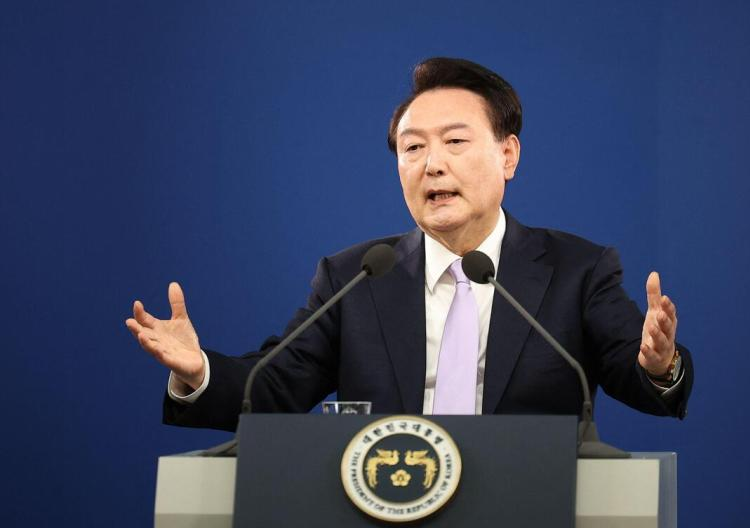
Former South Korean President Yoon Suk Yeol was convicted by the Supreme Court of South Korea on charges including obstruction of the execution of arrest warrants, abuse of power, and forgery of official documents after implementing an emergency martial law. On Thursday (July 9th), the Supreme Court upheld the verdict from the second instance and sentenced Yoon Suk Yeol to seven years in prison.
This is also the first case among the eight criminal cases related to the martial law incident that has been finally adjudicated.
The South Korean prosecution has alleged that on January 2025, when investigators went to the presidential residence to execute an arrest warrant, Yoon Suk Yeol ordered the presidential security personnel to obstruct the investigation and interfere with the judicial process.
The prosecution also accused him of having convened a meeting with only seven state councilors before announcing the emergency martial law on December 3, 2024. Moreover, he began the meeting before the two participants had arrived, preventing the remaining nine state councilors from legally participating in the deliberation of the martial law plan and infringing upon their legal deliberation rights.
The prosecution also believes that after lifting the martial law, Yoon Suk Yeol modified the content of the martial law order document in an attempt to cover up procedural flaws. He is suspected of destroying relevant documents, instructing the release of statements containing false information, and restricting the investigation authorities' access to the communication records of a former military commander.
The trial court ruled in January this year that Yoon Suk Yeol was guilty of most of the charges including obstruction of execution of arrest warrant and abuse of power, and sentenced him to five years in prison; the second trial increased the sentence to seven years in April.
The Supreme Court held that the facts were correctly determined and the law was properly applied in the original trial. There was no violation of logical and empirical principles, nor was it beyond the scope of free judgment. Therefore, the appeal was rejected and the original judgment was upheld.
Since the Supreme Court's verdict did not require the defendant to be present in person, Yoon Suk Yeol did not attend the verdict ceremony on that day. Instead, during the second trial of the case involving the alleged instigation of internal unrest at the Seoul High Court, he watched the Supreme Court's verdict process via his lawyer's mobile phone in real time.
After the verdict was announced, the legal team of Yoon Suk Yeol issued a statement expressing regret over the decision, arguing that the trial was not thorough enough. They also stated that they would file a constitutional appeal to the Constitutional Court and other constitutional judicial procedures, claiming that this verdict violated the basic rights guaranteed by the constitution.
Yoon Suk Yeol was arrested in January 2025 after the failed implementation of the emergency martial law on December 3, 2024. In July of the same year, he was indicted by the special prosecutor, and a total of eight criminal charges were brought against him regarding the martial law incident.
Among them, the case involving the instigation of internal unrest was sentenced to life imprisonment in the first instance in February this year. The case has now been appealed to the Seoul High Court, while the remaining cases are still under trial.
With the implementation of this verdict, Yoon Suk Yeol has become the fifth former president in South Korea's democratic history to be convicted. The previous four were Chun Doo-hwan, Roh Tae-woo, Lee Myung-bak and Park Geun-hye.
The escalation of the U.S.-Iran military conflict to direct strikes on the peripheries of nuclear power plants and opposing military bases, followed by the "basic stagnation" of traffic through the Strait of Hormuz, is a scenario theoretically sufficient to trigger an extreme risk premium in the global oil market.
The escalation of the U.S.-Iran military conflict to direct…

According to Canadian media reports, many parts of Canada a…

On July 9 local time, U.S. stock markets staged a typical r…
In its latest World Economic Outlook, the International Mon…
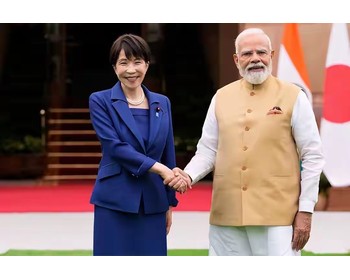
In July 2026, Japanese Prime Minister Hayao Takashi visited…

The latest data from the European Central Bank shows that t…
© Copyright 2026, All Rights Reserved