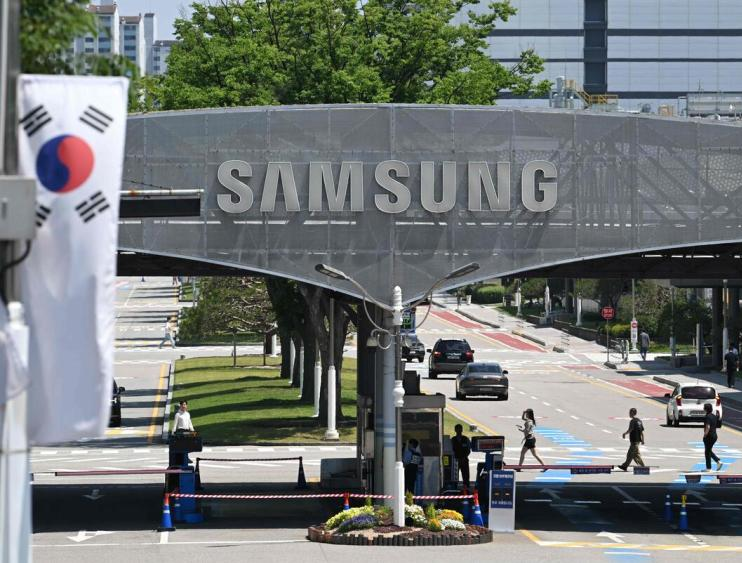
Just about an hour before the total strike was to begin, the labor and management sides of Samsung Electronics finally made concessions and reached a provisional agreement in a dramatic turn of events, bringing to an end the 160-day wage negotiation that had shaken the nerves of the semiconductor industry in South Korea and around the world.
This "bonus war" that nearly brought the semiconductor production lines to a complete standstill did not end in confrontation. However, the anxiety over wealth distribution and the conflict between achievement-oriented values that it exposed are still persisting and intensifying in the Korean society.
Although the worst scenario was avoided after intense arbitration by the South Korean government, this incident still leaves a complex aftertaste. This unprecedented "bonus war" is essentially a by-product of the unprecedented prosperity in the AI era.
As the AI craze sweeps across the globe, Samsung Electronics' performance is expected to soar continuously. The market's forecast for its operating profit this year has rapidly increased from approximately 90 trillion won at the end of last year to around 300 trillion won. The unprecedented profits have stimulated employees' demands for sharing the results, but the problem is that this "AI-specific need" is largely due to the benefits of the times and the market environment, rather than the efforts of a single organization or individual.
The Korean storage chip giant SK Hynix was the trigger. After the labor and management sides of SK Hynix reached an exceptional agreement last year, stipulating that 10% of the operating profit would be given as bonuses with no upper limit and to be maintained for 10 years, the question "Why isn't Samsung doing the same?" quickly spread within Samsung, and the number of union members also soared from approximately 6,300 to 76,000.
The union then demanded that 15% of the operating profit be allocated as performance bonuses and maintained for 10 years. However, the "operating profit N%" model is regarded as a major challenge to the existing distribution system of Korean enterprises, as Samsung Electronics not only belongs to the employees but also to approximately 4.6 million shareholders. Once the largest enterprises in South Korea accept a similar model, other industrial unions will surely follow suit. In fact, similar demands have recently emerged in industries such as Hyundai Motor and shipbuilding.
After the news of the generous bonus was made public, discussions in South Korean society about the "semiconductor wealth effect" quickly intensified. On the anonymous online community for office workers, statements such as "My 10 years of salary is just someone else's one-time bonus" and "Those who enter the right industry directly become life winners" kept trending. Especially among small businesses, civil servants, and staff in public institutions, a sense of relative deprivation has spread significantly.
The semiconductor boom driven by the AI era is further concentrating capital, talent and opportunities in a few core industries. Even among the same group of workers, due to different industries, there can be a huge disparity in income growth and asset accumulation capabilities.
Of course, public opinion is not uniformly positive. There are also some people who believe that "getting more compensation for industries that produce high-quality results is simply a matter of market logic", and "they always talk about the need to cultivate science and engineering talents, but when engineers actually start making money, they start to mock and criticize."
What is more alarming than the size of the bonus itself is that this negotiation actually reveals new challenges to Samsung's long-standing "results-oriented" principle. Samsung's ability to grow into a global top-tier enterprise is largely based on the "results determine compensation" principle of results-oriented thinking.
However, this agreement has, to some extent, undermined this long-standing principle. As the call for equal distribution gains momentum, there are concerns that if continuous pressure and increasing demands become the norm in the future, Samsung's incentive system, which was originally based on competition and performance, might gradually be weakened.
The history of the technology industry has repeatedly shown that success itself is often the greatest risk. Andy Grove, the former CEO of Intel, once warned: "Success breeds complacency, and complacency leads to failure."
The generation of engineers who created the myth of Samsung Semiconductor in the past always regarded "setting grand goals and giving one's all" as their creed. Now, in the face of the AI boom and the wave of huge bonuses, whether they can maintain a sense of crisis during the "bonus party" might be the key to determining the future competitiveness of Samsung Electronics.

Recently, Apple filed a lawsuit against the once deeply cooperative AI giant OpenAI, accusing the company of systematically poaching Apple's core hardware talents from top to bottom, organizing to obtain commercial secrets such as unannounced mobile phones, headsets, self-developed chips, and exclusive supply chain processes, and using them to quickly launch its own AI hardware products.
Recently, Apple filed a lawsuit against the once deeply coo…

By mid-July 2026, the U.S. economy has taken on a distinctl…

South Korea's Ministry of Science and ICT recently announce…

AP, New York — Global financial markets faced dual negative…

The combination of transit volume through the Strait of Hor…

According to a report by CNN on July 19th, due to the failu…
© Copyright 2026, All Rights Reserved