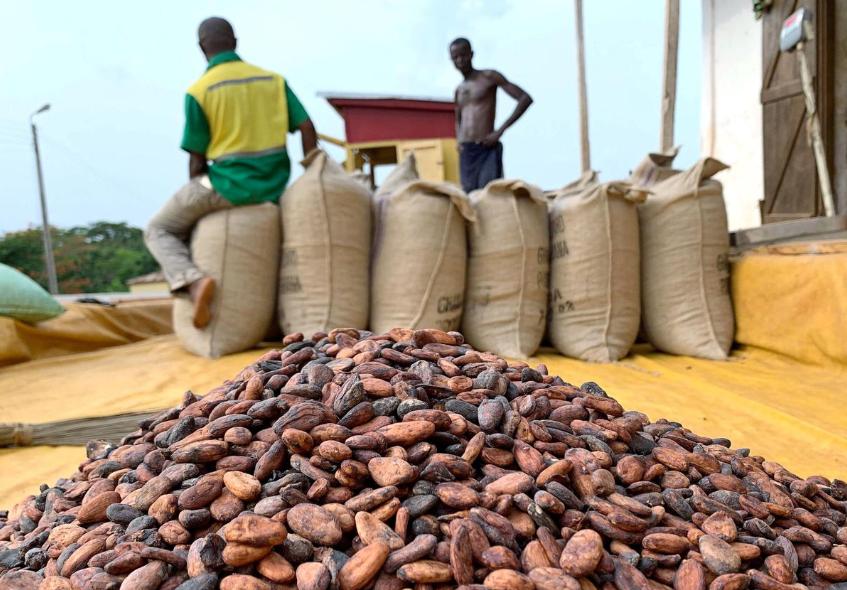
Recently, according to Bloomberg, the cocoa bean market in Cote d 'Ivoire is experiencing an unprecedented turmoil. Due to the double impact of falling international prices and cash shortages, the country's major ports, Abidjan and SAN Pedro, are being plagued by mountains of cocoa beans. This phenomenon not only reveals the vulnerability of the global cocoa supply chain but also profoundly reflects the importance of risk management and market prediction in the business environment.
As the world's largest cocoa producer, Cote d 'Ivoire's export business is highly dependent on fluctuations in international market prices. However, the recent sharp drop in global cocoa prices has dealt a direct and heavy blow to local exporters. The price drop not only erodes the profit margins of exporters, but more importantly, it has plunged those exporters who have signed high-priced forward contracts with regulatory authorities into a financial predicament. These contracts were originally intended to lock in future earnings and hedge against the risk of price fluctuations, but in the context of a significant decline in market prices, they have become a heavy financial burden. This awkward situation of "locking in price but not profit" has exposed the exporters' deficiencies in risk management, especially their negligence in predicting market trends and designing contract terms.
Further analysis shows that the shortage of funds not only affects the payment capacity of exporters but also indirectly leads to the tightening of bank credit. As risk-averse institutions, banks are naturally reluctant to continue providing loan support when exporters' profit margins are compressed and their debt-paying ability declines. This credit crunch effect further intensifies the financial pressure on exporters, creating a vicious cycle: falling prices → reduced profits → tightened credit → shortage of funds → more difficult to cope with falling prices. This cycle not only affects the normal operation of exporters, but also has an impact on the entire cocoa supply chain, including farmers at the upstream and processors at the downstream.
As the very front end of the supply chain, farmers' behavioral patterns are deeply influenced by market prices. Facing the sharp drop in cocoa prices, farmers are generally worried that the government will lower the purchase price, thereby accelerating the sale of their cocoa beans in the hope of realizing cash before the price drops further. This kind of panic selling behavior, although it has increased the volume of goods arriving at the port in the short term, in the long run, may disrupt the supply and demand balance of the market and lead to further price drops. More importantly, it reflects the helpless choice of farmers against the backdrop of information asymmetry in the market and weak risk resistance capabilities. Farmers lack effective market prediction and risk management tools and can only passively accept fluctuations in market prices, which undoubtedly increases the uncertainty of their operations.
In addition, the performance of industry regulatory authorities in responding to this crisis is also worthy of deep reflection. To alleviate port congestion, the French Coffee and Cocoa Commission has taken measures to intermittently shut down the goods arrival record system. Although this measure has to some extent regulated the entry and exit of trucks and reduced congestion, it has also exposed the insufficiency of the emergency response mechanism of regulatory authorities in dealing with unexpected incidents. More crucially, the regulatory authorities failed to coordinate the interests of all parties in a timely and effective manner, addressing issues such as exporters' shortage of funds and the delay in the issuance of farmers' delivery orders, which led to a further deterioration of the problems. This reflects that the regulatory authorities' capabilities in market supervision and crisis management need to be enhanced.
The turmoil in the cocoa bean market of Cote d 'Ivoire is also a microcosm of the complexity and vulnerability of the global cocoa supply chain. In the context of globalization, any fluctuation in any link may trigger a chain reaction throughout the entire supply chain. Therefore, enhancing communication and collaboration among all links in the supply chain, improving market transparency and the degree of information sharing, are the keys to reducing supply chain risks and strengthening its resilience. At the same time, for exporters and farmers, enhancing their risk management capabilities and learning to use financial tools to hedge against price fluctuation risks are also important ways to deal with future market challenges.
The current predicament of the cocoa bean market in Cote d 'Ivoire is the result of multiple factors working together. It not only reveals the significance of risk management and market prediction in the business environment, but also reminds us that in today's globalized world, strengthening supply chain collaboration and enhancing risk management capabilities are the cornerstones for ensuring the stable operation of business.

Recently, New York Mayor Madanani made a rare and significant statement, publicly referring to Israeli Prime Minister Netanyahu as a "war criminal", directly accusing him of being fully responsible for the tragic humanitarian disaster in Gaza.

Recently, New York Mayor Madanani made a rare and significa…

The latest July survey data released by the ZEW – Leibniz C…

The Trump administration announced on Tuesday that it would…

On July 21st local time, Canadian Prime Minister Mark Carne…

According to the Associated Press, the latest data from the…

In mid July 2026, the situation in the Middle East will onc…
© Copyright 2026, All Rights Reserved