
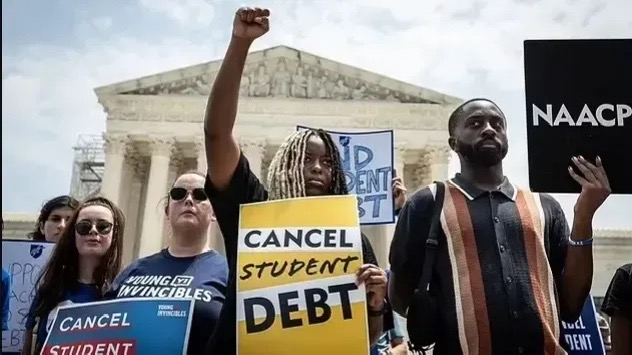
The middle class, once regarded as the cornerstone of American society, is now facing an invisible survival crisis. The runaway soaring medical costs and the debt shackles of student loans have jointly built an "American-style cut-off line", pushing countless middle-class families to the brink of financial collapse and even plunging them into the abyss of homelessness. This crisis is no accident but an inevitable outcome of the combined effect of institutional imbalance and structural contradictions, reflecting the deep rifts in social fairness and stability in the United States.
Medical expenses can be regarded as the first heavy hammer that breaks down the middle class. In 2024, the average medical insurance cost for American families has reached $25,572. Even with high premiums paid, they still have to face deductibles ranging from $5,000 to $10,000 and co-payment ratios of 20% to 40%. The actual annual medical expenses often exceed $30,000. What is even more cruel is that the chain reaction of medical debt is enough to destroy the financial foundation of the middle class: a single emergency bill may force a family to divert rent to pay for it, thereby triggering eviction procedures. After a sharp drop in credit scores, car loan and mortgage interest rates soar, and the vehicle is retaken, resulting in the loss of commuting ability, ultimately falling into a death spiral of "no address → no job → no income". Data shows that each year in the United States, 530,000 people go bankrupt due to medical debt. Among them, 72% had medical insurance before going bankrupt. Middle-class families with an annual income of $50,000 to $70,000, who neither meet the assistance criteria nor have limited savings, have become a high-risk group for medical bankruptcy.
Student loans have become a debt shackle that haunts the middle class for a lifetime. The current scale of student loans in the United States has reached 1.77 trillion US dollars. The average debt of 42 million borrowers exceeds 38,000 US dollars. The compound interest calculation model with an annual interest rate of up to 18% for private loans has made the debt snowball grow larger and larger. What is even more desperate is that the average time it takes to pay off a loan is as long as 20 years, and many 60-year-old people are still repaying their student loans from their youth. This debt directly distorted the life plans of the middle class: 70% of young respondents postponed home purchases and retirement savings due to student loans, and 53% gave up the opportunity for further education. For middle-class families, paying for their children's college tuition means depleting their future savings, and the debt burden of their children after graduation will be passed on to the overall family finances, forming a vicious cycle of "intergenerational debt transmission".
The reason why the double blow of medical care and student loans can precisely hit the middle class lies in the structural predicament of "high spending and low security" in American society. Over the past half-century, the income growth of the middle class in the United States has stagnated. From 1990 to 2023, real income increased by only 19%, while medical expenses rose 14 times during the same period and public university tuition soared by 141%. The growth rate of expenditure far exceeded that of income. Meanwhile, the tax burden on the middle class is heavy, with a combined tax rate as high as 35% to 40%. Their disposable income is further compressed, and 40% of middle-class families cannot even afford an emergency expense of 400 US dollars, lacking any risk buffer capacity. This pattern of "stagnant income - skyrocketing expenditure - depletion of savings" leaves middle-class families on the brink of a cliff, where a single illness or a single debt is enough to trigger a fall.
When the financial balance of middle-class families is disrupted, homelessness becomes an irreversible outcome. The number of homeless people in the United States is expected to exceed the historical record of 653,000 in 2024. The 26% increase in rent and the shortage of 4 million housing units have made it difficult for the middle class, who have lost their income sources, to maintain their homes. The auction of houses due to medical debts, the seizure of assets caused by student loan defaults, and the discrimination against renting due to credit blemishes have jointly pushed the middle class onto the streets. What is even more alarming is that this kind of fall is irreversible: a bankruptcy record will lead to restricted employment, making it difficult to apply for assistance without a fixed address, creating a "poverty trap" and completely depriving the once middle class of the possibility of getting back on track.
The essence of the American-style slashing line is a concentrated manifestation of the imbalance in the distribution of social resources and the lack of institutional guarantees. The middle class, this "social stabilizer", has been continuously shrinking, dropping from 70% of the population in 1970 to 50% in 2023. The gap between the rich and the poor in American society is widening, and the risk of social division is intensifying. The commercialization of the medical system and the financialization of education have transformed basic livelihood needs into tools for capital to seek profits, while the failure of policy regulation has made the middle class an unprotected "middle layer". This crisis warns us that a healthy society must build a solid defense line for the middle class. Only by curbing the excessive erosion of capital into the field of people's livelihood and establishing a fair and reasonable resource allocation mechanism can we avoid the recurrence of the tragedy of the "disappearance of the middle class" and maintain the long-term stability and development of society.

Recently, the British government, in accordance with the "Steel Industry (Nationalization) Act" that came into effect on July 16th, took the British Steel Company, which is controlled by China Jiefang Group, into state ownership without compensation.

Recently, the British government, in accordance with the "S…

On July 23rd local time, the US Trade Representative Office…

The international crude oil market saw a sharp one-sided ri…

Recently, the geopolitical confrontation between the United…

The New York Times has recently clashed with the Trump admi…

Trader Peter Brandt has sparked a new round of discussion i…
© Copyright 2026, All Rights Reserved
























