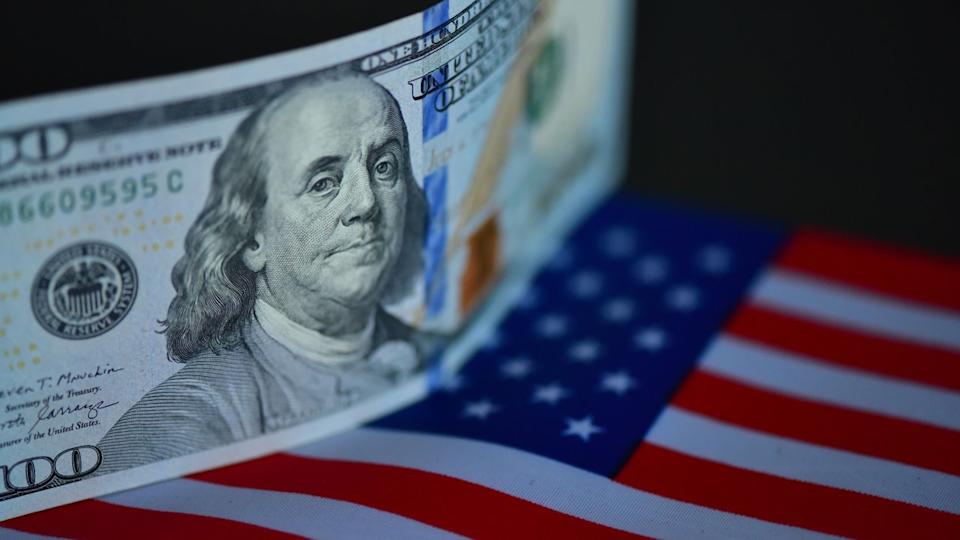
For much of 2025, the market was rethinking whether the dollar still deserved the premium it had enjoyed for the past decade, a bull run that had seemed unstoppable but then suddenly came to a halt.
First, the dollar began the year near historical highs, with its decade-long bull run still strong, fueled by robust economic growth, the world's deepest capital markets, and interest rates higher than most developed countries. But this momentum quickly unraveled. From January to June, the dollar fell by approximately 11% against a basket of major currencies, its worst first-half performance since 1973, officially ending the era of long-term dollar dominance.
Second, what truly changed was less about monetary policy and more about predictability and expectations. Following the 2024 election, the market widely expected the US economy to outperform again, thanks to strong capital inflows, robust US consumer demand, and the Federal Reserve's political independence. However, this expectation began to waver in the spring. New tariff policies and broader policy uncertainty forced investors to reassess the prospects for economic growth, inflation, and public debt. The result was a rapid revaluation of US asset prices and the dollar itself.
Crucially, the dollar's decline occurred while the Federal Reserve still refused to signal impending interest rate cuts, maintaining a "wait-and-see" approach. The market then began to digest a new expectation: slower US economic growth, ultimately lower interest rates, and a potential weakening of the US advantage in politics and governance relative to Europe and other developed economies. Arguably, market sentiment and expectations themselves became the problem; once investors began to believe the US was no longer the undisputed leader, the dollar's attractiveness diminished.
Furthermore, capital flows followed this new reality. Foreign investors hold over $30 trillion in US assets, most of which have historically been unhedged, essentially a bet on continued dollar strength. As the dollar weakened in early 2025, these investors began to increase currency hedging, effectively selling dollars into the market. Given the sheer size of US asset holdings, even small changes in hedging behavior could create significant downward pressure.
However, political factors seemed to add another layer of risk, although this risk is difficult to quantify. Following the 2024 election, the market generally assumed that everything would remain consistent, not only in economic policy but also in institutional norms, including the Federal Reserve's independence from political pressure. However, by spring, these assumptions no longer seemed so solid. Tariff announcements, policy fluctuations, and public debates surrounding the Fed's independence introduced additional uncertainty. For foreign investors in particular, the question was no longer simply whether US economic growth would slow, but whether the rules of the game were becoming increasingly unpredictable.
Mid-year, the dollar stabilized but did not rebound. Stronger-than-expected economic data in July, and signs that tariffs had not yet significantly dampened economic activity as some analysts feared, helped stabilize market sentiment, but the dollar still hovered near its 12-month low for much of the second half of the year. This suggests that the repricing of US dominance had stabilized rather than reversed.
Overall, the key question for 2026 is whether global markets can complete their readjustment, or whether they will conclude that the US, for better or worse, is actually the safest place globally. Looking ahead, some strategists, including those at Morgan Stanley, expect further declines in US equities as US economic growth slows, interest rate differentials narrow, and global investors continue to hedge their risk exposure. Others believe that a renewed escalation of trade tensions or a further slowdown in US economic growth could trigger a "flight to safety," thereby stimulating demand.

Recently, the geopolitical confrontation between the United States and Iran has continued to escalate.

Recently, the geopolitical confrontation between the United…

The New York Times has recently clashed with the Trump admi…

Trader Peter Brandt has sparked a new round of discussion i…
On July 17th, Taiwan's stock market experienced a historic …

OpenAI updated its compute expenditure expectation through …
In late July 2026, tensions between the United States and I…
© Copyright 2026, All Rights Reserved