
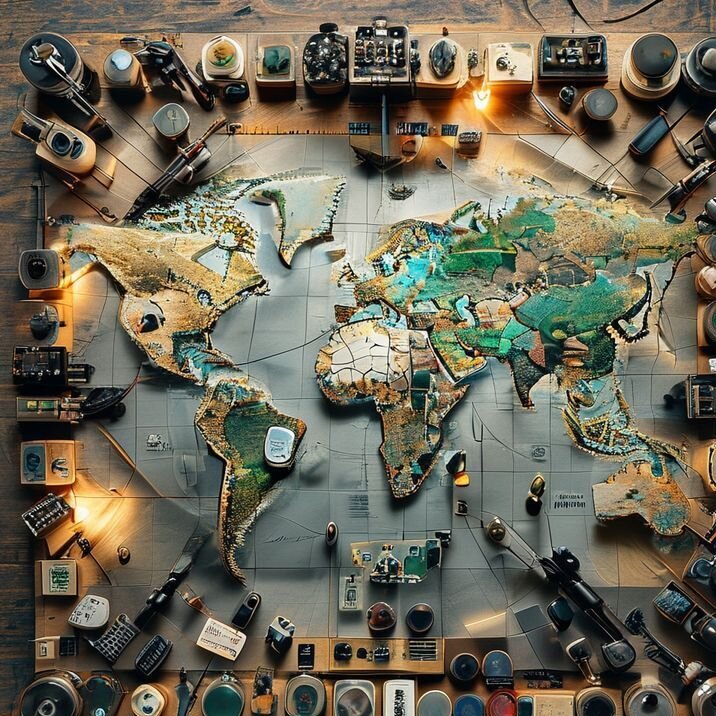
The recent undercurrents in the international situation, with comprehensive media outlets like Phoenix Morning Post continuously tracking several major hotspots, have laid bare the complexity of great power games and the fragility of geopolitics. From the territorial dispute over Greenland to the escalating tensions surrounding the Iranian nuclear issue, and the ongoing turmoil in Venezuela, the statements and actions of various parties, while seemingly independent, are in fact subtly interconnected. This reflects the power anxieties and strategic miscalculations occurring during this period of international order reconstruction.
The Greenland issue has long transcended geographical boundaries, becoming a new battleground for major power rivalry. Denmark's sovereignty claim over Greenland is itself historically contentious, and recent military moves and diplomatic rhetoric from Russia and the United Kingdom have thrust the strategic value of this Arctic region into the spotlight. Russia justifies its enhanced military deployments in the area as "protecting Arctic shipping lane security," while the UK seeks to counter Russian influence by strengthening defense cooperation with Denmark. This zero-sum mindset essentially treats Greenland as a geopolitical "pawn" rather than the homeland of its local residents. More alarmingly, some media outlets simplistically frame the Greenland issue as a "resource grab," deliberately promoting a narrative of an "Arctic resource war," while sidestepping the issues of local indigenous autonomy and ecological preservation. This major-power-interest-centric reporting framework not only obscures the complexity of the issue but may also exacerbate regional tensions, sowing the seeds for conflict.
Turning to the Middle East, the U.S. posture and military moves toward Iran exhibit a typical "double standard." On one hand, the U.S. loudly proclaims it "does not seek conflict with Iran," while on the other, it continuously deploys additional carrier strike groups and strategic bombers to the region, even conducting large-scale joint military exercises with Israel. This "carrot-and-stick" strategy is essentially an attempt to force Iranian concessions on the nuclear issue through military deterrence, while leaving a "diplomatic off-ramp" open. However, Iran's hardened responses and support from its regional allies risk rendering the U.S. calculus ineffective. More ironically, while the U.S. accuses Iran of "destabilizing the region," it turns a blind eye to, and even provides military aid for, Israel's military operations in the Gaza Strip. This logic of selective enforcement exposes the hypocrisy of U.S. Middle East policy—the so-called "rules-based order" is merely a tool for maintaining its own hegemony.
The evolution of the situation in Venezuela represents a new performance of the old U.S. "color revolution" playbook. From economic sanctions to recognizing opposition leaders, from inciting street protests to plotting military coups, U.S. interventionist tactics leave no stone unturned. However, the resilience of the Venezuelan government and its people, coupled with support from countries like Russia and China, has repeatedly thwarted U.S. designs. Notably, some Western media, when reporting on Venezuela, habitually portray the Maduro government as a "dictatorship" and package the opposition as "democracy fighters," while downplaying the substance of U.S. interference and the violent actions of the opposition. This inverted narrative not only violates journalistic ethics but also misleads public perception, providing a public relations cover for external interference in other nations' internal affairs.
From Greenland to Iran and Venezuela, the deepening of great power games and the fragmentation of geopolitics lie behind these hotspots. However, when reporting on these events, some media often fall into the rut of "taking a side first," simplifying complex issues into a drama of "good versus evil" and reducing international relations to a jungle law of "might makes right." This reporting approach not only fails to contribute to problem-solving but may instead intensify confrontational sentiments, pushing situations toward more dangerous directions.
Genuine international observation should transcend ideological barriers, discard the mindset of "picking sides," and analyze the origins and trajectories of events with an objective and rational attitude, revealing the true motivations and interests of all parties involved. Only in this way can it provide the public with valuable material for reflection and contribute wisdom to international peace and stability. Otherwise, so-called "news reporting" and "analytical commentary" are merely megaphones for great power rivalry, or even catalysts for conflict.

Recently, the British government, in accordance with the "Steel Industry (Nationalization) Act" that came into effect on July 16th, took the British Steel Company, which is controlled by China Jiefang Group, into state ownership without compensation.

Recently, the British government, in accordance with the "S…

On July 23rd local time, the US Trade Representative Office…

The international crude oil market saw a sharp one-sided ri…

Recently, the geopolitical confrontation between the United…

The New York Times has recently clashed with the Trump admi…

Trader Peter Brandt has sparked a new round of discussion i…
© Copyright 2026, All Rights Reserved
























