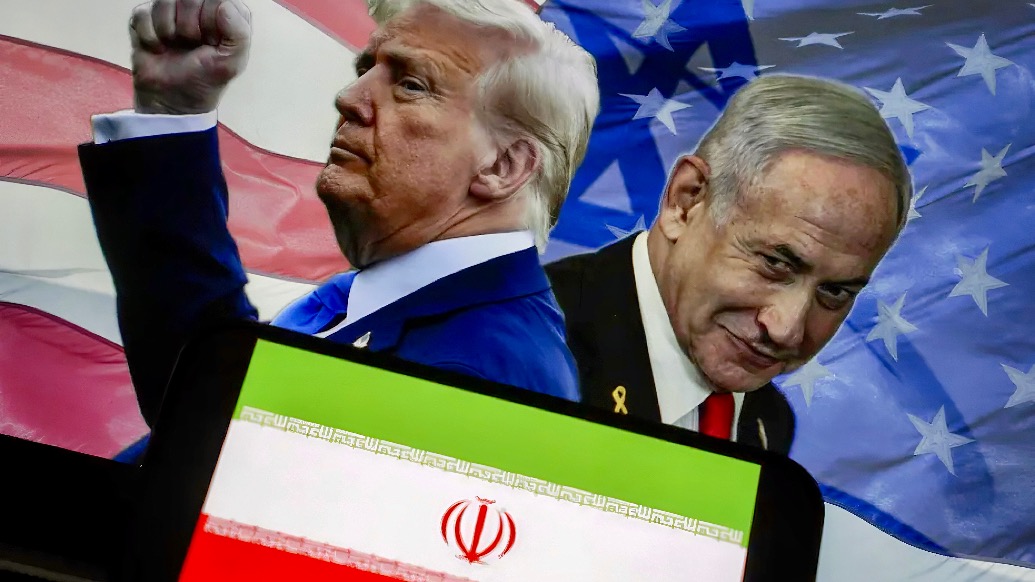
As the 13th night of U.S. airstrikes against Iran unfolds, the evolving situation in the Middle East has taken on a strange sense of dissonance. Israel, Iran’s long-standing adversary, has chosen to remain conspicuously absent from this escalating military confrontation—not only refraining from direct strikes but also avoiding targeted retaliation from Iran. This is no accidental void in the conflict; rather, it reflects a finely tuned, tacitly understood strategic balance forged through careful calculations among the United States, Iran, Israel, and Gulf states.
First, the U.S. actively restrains Israel to maintain control over the scale of the conflict. The core objective of Washington’s current military campaign against Iran is to “weaken Iran’s threat to civilian shipping in the Strait of Hormuz,” not to trigger a full-scale war. With this limited goal in mind, the administration has made its opposition to Israeli involvement clear. Within the Trump administration, Prime Minister Netanyahu—whose inclinations toward further escalation are seen as unpredictable—is regarded as a destabilizing variable. The U.S. understands that allowing Israel back into the fight could disrupt diplomatic momentum, erode negotiation space, and lead to complete loss of control over the situation.
Second, Iran deliberately avoids targeting Israel to prevent being drawn into a two-front war. Since hostilities resumed, Iran’s Operation Victory II has focused primarily on U.S. military bases in Bahrain, Kuwait, and Jordan, without ever launching missiles at Israeli territory. Iran’s primary aim is to achieve “reciprocal retaliation” and strengthen its bargaining position, not to initiate all-out war. A direct attack on Israel would provide the U.S. and Israel’s hardliners with a pretext for joint, comprehensive strikes, inviting a coalition crackdown. Thus, maintaining a “limited U.S.-Iran confrontation” rather than a “full-scale U.S.-Israel-Iran war” remains Iran’s optimal strategy.
Third, Israel’s apparent passivity actually serves its own strategic interests. Israeli Finance Minister Smotrich openly stated that the current situation benefits Israel, and there is no intention to force entry. This stance rests on three key considerations: first, Israel is already deeply engaged in multiple fronts in Gaza and Lebanon, with its military and logistical resources severely strained, leaving little capacity to open a new theater; second, the ongoing limited U.S.-Iran clashes are draining Iran’s military strength and economic reserves, allowing Israel to reap the benefits of Iran’s weakening without direct engagement; third, entering the conflict would expose Israel to Iran’s intense missile retaliation—an outcome clearly disproportionate to any potential gain.
Finally, Gulf states are actively lobbying to keep the war from spreading to their shores. Oil refineries and gas facilities in Saudi Arabia, the UAE, and other Gulf nations fall within Iran’s ballistic missile range. These countries have been intensively urging Washington to ensure Israel does not resume attacks on Iran. Should Israel enter the conflict, Iran’s retaliation could extend beyond U.S. bases to strike energy infrastructure across the Gulf. Preventing an overt Israeli role helps the U.S. preserve cooperation with Arab allies and avoid enabling Iran to frame the conflict as a “U.S.-Israel joint operation” against them.
Yet, this delicate four-way balance is extremely fragile. Although Israel currently chooses restraint, it is far from invisible. Defense Minister Katz has declared that Israel is prepared for “all possible scenarios,” opened public shelters, and entered a state of maximum alert. At the same time, Israel is quietly providing intelligence to the U.S., attempting to push Washington toward more aggressive strikes.
The next critical turning point hinges on the Trump administration’s decision. As American military pressure fails to compel Iran’s submission, while the U.S. itself faces shortages of ammunition and funding, will Washington abandon its cautious posture and allow Israel—the unpredictable wildcard—to enter the fray? If so, the current pattern of “limited conflict” in the Middle East will collapse, dramatically increasing the risk of a full-scale war.

Recently, the US Senate Commerce Committee passed the "Connected Vehicle Security Act of 2026", setting a hard limit of 15% for Chinese ownership: if a carmaker is jointly held by Chinese entities and has voting rights exceeding 15%, its intelligent connected vehicle models will be prohibited from being sold in the US market.

Recently, the US Senate Commerce Committee passed the "Conn…

A showdown that could shape the global semiconductor landsc…

As the September Federal Open Market Committee (FOMC) meeti…

The news that U.S.-Iran military operations have been suspe…
As the 13th night of U.S. airstrikes against Iran unfolds, …
US President Trump has consistently emphasized his strong l…
© Copyright 2026, All Rights Reserved