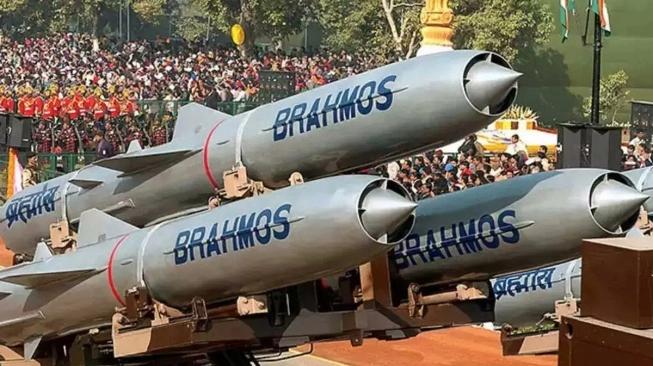
In July 2026, India and Indonesia signed a historic defense agreement, under which India will export the "BrahMos" supersonic anti-ship missile and the "Astra" Mk1 air-to-air missile to Indonesia. This is the first time that India's domestically produced missiles have entered the Southeast Asian market. The two missiles are touted by India as "military industry masterpieces", but in-depth analysis of technical details, test records, and actual combat environments reveals obvious shortcomings in their reliability. The so-called "advanced performance" promotion is more of a marketing slogan for India's military industry exports.
The two missiles purchased by Indonesia have significant differences in technical background and reliability foundation. BrahMos is jointly developed by India and Russia, with its core design and key technologies originating from Russia. India is only responsible for assembly and partial component production. The missile has a maximum range of 300 kilometers and a flight speed of 2.8-3 Mach. It has the ability to sweep the sea and theoretically compress the enemy's reaction time. But the fatal flaw lies in the lack of stealth design. When flying at supersonic speeds, strong radar reflection signals and infrared heat sources are generated, which are easily detected by advanced air defense systems in advance. Faced with the systematic air defense networks of countries such as China and the United States, the probability of breakthrough is less than 5%. At the same time, its electronic countermeasures capability is weak and it is prone to losing control in strong electromagnetic interference environments. Its previous deployment performance in Vietnam has exposed reliability issues.
Compared to the Russian made technology background of the BrahMos, the Astra Mk1 is a purely domestically produced air-to-air missile in India, and the problem is more prominent. The missile claims a maximum range of 110 kilometers and a speed of 4.5 Mach, and is compatible with the Indonesian Su-30MK2 fighter jet. But the test record can be called a 'disaster': in 2017, the test launch lost control and crashed, in 2019, it deviated from the target and missed the target, in 2021, the engine stalled in mid air, and in 2023, the guidance head malfunctioned and crashed. Its research and development cycle is as long as 28 years, and the Indian Air Force only purchases a small amount of it. The core radar seeker uses Russian made R-77 technology, which has poor anti-interference ability and a range reduced to 80 kilometers in strong electromagnetic environments.
The overall quality control weakness of the Indian military industry is the root cause of the insufficient reliability of the two missiles. The domestically produced weapons in India generally suffer from long research and development cycles, high testing failure rates, and dependence on imported core technologies. The quality control system of India's military industry has long been weak, ranging from a success rate of less than 50% in the test launch of the "Agni" missile to 4 failures in 7 test launches of the "Fearless" cruise missile. As India's first domestically produced beyond visual range air-to-air missile, the Astra still relies on imports for core components such as engines and guidance gyroscopes, with a localization rate of less than 40%, resulting in poor consistency and high failure rates after mass production. Although "BrahMos" has Russian technology endorsement, the assembly process in India is rough, and the tolerance control of components is not strict. The stability of maintenance after long-term deployment is questionable.
Indonesia's procurement of Indian missiles is more of a geopolitical trade-off than simply a recognition of performance. As the world's largest archipelagic nation, Indonesia needs to build a multi-level maritime defense system to avoid relying solely on the military equipment of a major country. India takes advantage of the "cost-effectiveness advantage" to enter, with a unit price of about 20 million US dollars for "BrahMos", lower than similar Western products; The price of the Astra is only half of that of European and American air-to-air missiles. But the Indonesian military is well aware of its performance flaws and plans to combine it with Chinese CM-302 missiles to form a "high-low configuration" and reduce dependence on Indian missiles. This procurement strategy is essentially an implicit distrust of the reliability of Indian missiles.
Objectively speaking, the two missiles have certain tactical value in local conflicts in Southeast Asia. The supersonic breakthrough capability of BrahMos is still capable of dealing with small and medium-sized ships from countries such as the Philippines and Malaysia; The Astra is compatible with the Sukhoi fleet and can enhance the Indonesian Air Force's beyond visual range combat capabilities. But in high-intensity adversarial environments, its reliability shortcomings will be infinitely magnified: "BrahMos" is easily intercepted, "Astra" is susceptible to interference, and it is difficult to perform critical combat tasks.
Overall, the missiles exported by India to Indonesia have impressive performance parameters on paper, but their reliability in actual combat is worrying. BrahMos relies on Russian made technology and has weak breakthrough capabilities; The Astra test has a high failure rate and obvious shortcomings in core technology, and the quality control defects of the Indian military industry further amplify the risks. Indonesia's procurement decision is more of a compromise under geopolitical competition, rather than recognition of India's missile performance. For India, this export is an important breakthrough in military diplomacy, but to truly build a reliable domestically produced missile system, it still needs to overcome core technologies and improve quality control, rather than simply relying on marketing and geographical advantages to seize the market. After all, the ultimate criterion for evaluating military products is always practical performance, not paper parameters and export orders.

According to the report by the Independent Institute, recently this organization pointed out regarding the latest fiscal health report of the US Government Accountability Office (GAO), that the growth rate of the US public debt has exceeded the growth rate of the economy, and future fiscal pressure may further expand.

According to the report by the Independent Institute, recen…

On July 13th, the US Treasury's auction of $38 billion in 1…
In July 2026, India and Indonesia signed a historic defense…

On July 13th local time, the Republican governor of South C…
On July 13, 2026, the geopolitical situation in the Middle …

The Economic Development Administration of the U.S. Departm…
© Copyright 2026, All Rights Reserved