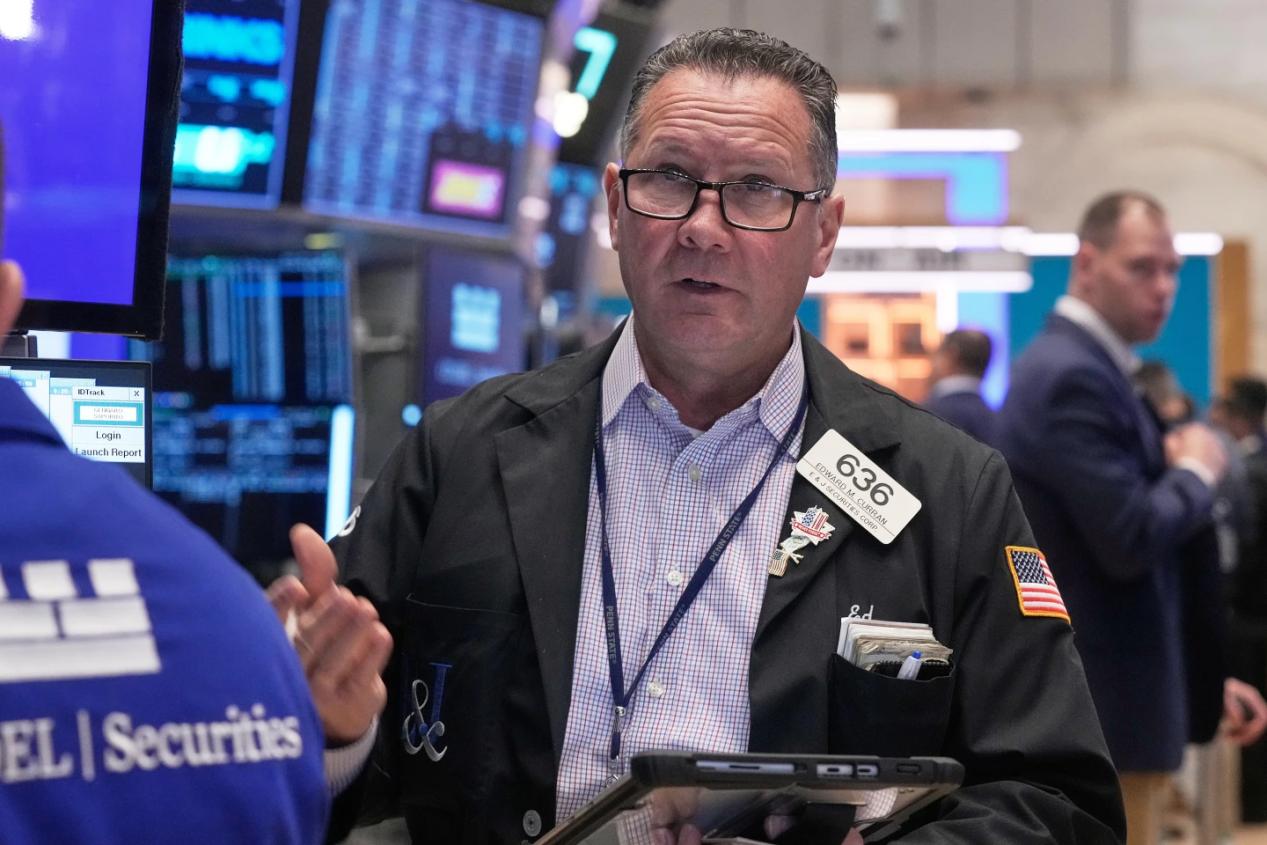
On the just concluded trading day, the three major stock indexes in the United States closed with a moderate upward trend, marking the fifth consecutive trading day of uptrend in the market. This seemingly unremarkable rise has put a thought-provoking end to a month full of dramatic twists and turns. When investors reviewed at the end of the month, they were faced with a market landscape that was both familiar and unfamiliar: the index stubbornly returned to near the level at the beginning of the month amidst fluctuations, as if a thrilling month was just an insignificant episode. However, behind this seemingly calm closing point lies a fierce long short game that has just subsided, a subtle shift in market sentiment from anxiety to cautious optimism, and a reassessment and pricing of the future economic path.
This round of market fluctuations is not groundless. Firstly, the economic data at the beginning of the month was too firm. Inflation data shows more stubborn resilience than market expectations, and a strong labor market raises questions about whether the economic slowdown that the Federal Reserve hopes to see will take longer to arrive. Traders are repositioning their expectations and betting on the possibility of the Federal Reserve accelerating interest rate cuts. But previously, the market had become accustomed to significant interest rate cuts. In this regard, the possibility of an implicit interest rate cut in interest rate futures occurring at the end of the year has become increasingly low. At the same time, the market has also lowered the magnitude of the interest rate cut, triggering a sell-off in the market at the beginning of the year. In a high interest rate environment, the discount price of future cash flows will decrease, and technology stocks largely rely on the discount of future cash flows.
However, the attractiveness of the market lies in the expected equilibrium of changes. When market investors hesitate due to the prospect of higher interest rates, the release of data provides a new turning point. The economic data at the beginning of the month showed that although the US economy has maintained good resilience, it has begun to quietly change internally. Consumer consumption has slightly slowed down, while manufacturing activities in certain regions have begun to fluctuate. These pieces of information should have caused panic, but the market gave a story of a 'blonde girl' - neither too hot to shrink again, nor too cold to have the possibility of recession. This is a market friendly turning point that can slightly alleviate the panic.
From a company perspective, the just concluded season of corporate financial disclosure has provided solid fundamental support for the market. Most tech giants have continued to perform better than expected during the reporting period, and actual breakthroughs in the field of artificial intelligence have provided narrative materials and valuation anchors for the market; The excellent profit margin level of traditional enterprises indicates that they have good cost control capabilities and have to some extent resisted the backlash effect caused by weak income growth. The good profitability of enterprises implies to the market that although there is significant uncertainty in future economic expectations, the overall physical condition of micro enterprise entities is relatively healthy, which to some extent constitutes a "buffer pad" to support the stock market to fall in place.
In the fifth consecutive trading day of gains, we can observe a differentiation in the internal structure of the market, with the leading trend spreading from pure AI concepts to partially pro cyclical directions, from industrial to non essential consumer goods. This rotation phenomenon itself is a positive signal, indicating that investors are beginning to bet on a soft landing for the economy, rather than relying solely on the stories of a few tech giants. On the other hand, the market width is improving and the number of rising companies is increasing. This is not just a simple index rebound, but a more important and healthy index signal. The volatility index significantly fell at the end of the month, dropping from a high at the beginning of the month to a relatively mild level, indicating that the market's panic is gradually dissipating.
Looking back at the continuous rise over the past five days, it is not just a technical rebound, but also a self correction of market sentiment and logic. At the beginning of the month, investors were fixated on delaying their expectations of interest rate cuts; At the end of the month, they began to accept and adapt to a new consensus: an economy that maintains resilience, even if it means keeping interest rates high for a longer period of time, is far better than a fragile economy that requires emergency central bank rescue. This cognitive shift is the core psychological factor that drives the market to continue to rise despite fluctuations.
Looking ahead, this continuous upward trajectory has set a cautiously optimistic tone for the market next month, but it is by no means a smooth road. The market still faces several key tests: Will the final stretch of the inflationary downturn be more difficult than expected? Can corporate profits continue to maintain resilience against the backdrop of slowing demand? Will geopolitical risks once again disrupt supply chains and energy prices? The answers to these questions will determine the next direction of the market.
The fact that the US stock market ended this volatile month with five consecutive gains is itself a condensed narrative. It tells the emotional journey of the market from anxiety to adaptation, from single bet to diversified layout. It reminds us that financial markets never operate in a vacuum, but rather meander forward through continuous interpretation and reinterpretation of economic reality. Every fluctuation is the digestion of information, and every continuous rise is the consolidation of consensus. Behind this seemingly flat closing point at the end of the month is a collective decision made by countless investors with real money, a collective response to the complex economic environment, and another brave pricing for future uncertainty.

Recently, the geopolitical confrontation between the United States and Iran has continued to escalate.

Recently, the geopolitical confrontation between the United…

The New York Times has recently clashed with the Trump admi…

Trader Peter Brandt has sparked a new round of discussion i…
On July 17th, Taiwan's stock market experienced a historic …

OpenAI updated its compute expenditure expectation through …

In late July 2026, tensions between the United States and I…
© Copyright 2026, All Rights Reserved