
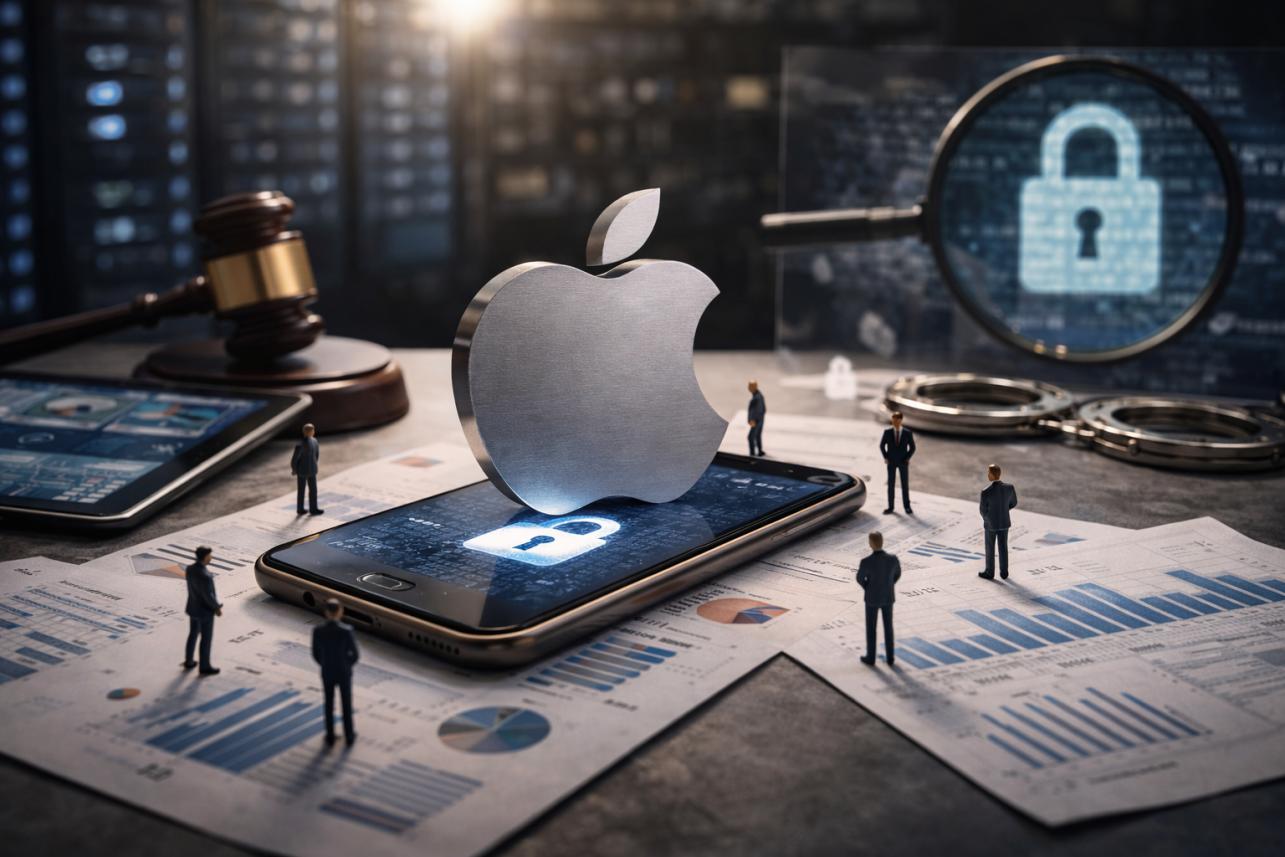
According to multiple foreign media reports, the recent fine of nearly 100 million euros imposed on Apple by Italian regulatory authorities has revealed the deep-seated contradictions in the formulation of technical rules in the digital age. This penalty not only concerns the balance between privacy protection and market competition, but also exposes the potential destructive impact of a closed ecosystem on the technological ecosystem.
Since its implementation in 2021, Apple's "App Tracking Transparency" (ATT) policy has been embroiled in a controversy over technical ethics and commercial interests. This policy requires third-party application developers to obtain explicit permission before tracking user data. On the surface, it seems to be a progressive measure to strengthen user privacy protection, but in fact, it builds a technical barrier. From the perspective of technical implementation mechanism, the iOS system, through the single entry design of pop-up authorization, fully centralizes the data tracking permission under the platform's control. This technical architecture essentially centralizes the originally scattered data collection behaviors, making Apple the sole "gatekeeper" in charge of the overall data flow.
This technical control mode has a structural impact on the application development ecosystem. Small developers find it difficult to obtain sufficient data to train AI models due to their low user authorization rate (the industry average is less than 30%). A developer of a health-related app disclosed that its user retention rate dropped by 40% due to the inability to precisely recommend features, while similar Android apps maintained growth by adopting more flexible data strategies. What is more serious is that the restricted access to data leads to a vicious cycle in algorithm optimization - the less precise the service is, the more users refuse to authorize, eventually forming a "data poverty trap". This kind of technical discrimination puts small and medium-sized developers at an inherent disadvantage in algorithm competition.
From the perspective of the principle of technological neutrality, the ATT policy has double standards. Apple's own applications such as Apple Music and News do not need to follow the same rules and can directly obtain user behavior data through system-level integration. This technical architecture that "acts as both a referee and an athlete" has disrupted the technological fairness that the digital market should have. Technical ethics research shows that when a platform simultaneously controls the operating system, application store and core services, the technical standards it formulates are bound to be biased towards its own interests. This kind of technological monopoly is more covert than traditional market monopolies, achieving market exclusion through code rules rather than price mechanisms.
The technical barriers to data circulation also extend to the cross-platform service sector. A test of a certain cross-border e-commerce application shows that the conversion rate of iOS users is 25% lower than that of Android users, mainly due to the inability to achieve cross-application behavior tracking. In the era of the Internet of Everything, this technological fragmentation seriously hinders the innovation of digital services. Developers have no choice but to invest additional resources in developing the "dual-version" feature, which not only increases development costs but also leads to fragmented service experiences. Data from technical standardization organizations show that due to differences in platform policies, global developers lose approximately 8.7 billion US dollars in cross-platform adaptation costs each year.
The technological ecosystem built by Apple shows a distinct feature of being closed. From application review to payment systems, from data collection to algorithm recommendation, the entire technical chain is completely closed. This kind of closure leads to the stagnation of innovation at the level of technological evolution. In contrast to the open ecosystem where developers can freely call system apis for innovation, the innovation in the iOS ecosystem is highly dependent on Apple's own technological iterations. Historical data shows that the frequency of feature updates for iOS applications is 38% lower than that for Android, and 60% of the new features are first launched by Apple's own applications.
The penalty decision made by the regulatory authority reveals the urgency of technological governance. When tech giants reshape the market landscape through the underlying rules of operating systems, the traditional anti-monopoly framework faces challenges. It is necessary to establish a new technological regulatory paradigm that not only protects users' privacy rights but also maintains fair competition in the technology market. This requires regulatory authorities to have the ability to decode technology and be able to penetrate commercial packaging to understand the essential impact of technical rules. This penalty imposed by the Italian Competition and Market Authority is precisely an important practice of this technological regulatory transformation.
The development of digital technology has entered a deep-water zone, and the formulation of technical rules should not be the private right of a few enterprises. When privacy protection becomes a competitive tool and technological neutrality is distorted by commercial interests, the innovative vitality of the entire digital ecosystem will be fundamentally undermined.

Recently, the British government, in accordance with the "Steel Industry (Nationalization) Act" that came into effect on July 16th, took the British Steel Company, which is controlled by China Jiefang Group, into state ownership without compensation.

Recently, the British government, in accordance with the "S…

On July 23rd local time, the US Trade Representative Office…

The international crude oil market saw a sharp one-sided ri…

Recently, the geopolitical confrontation between the United…

The New York Times has recently clashed with the Trump admi…

Trader Peter Brandt has sparked a new round of discussion i…
© Copyright 2026, All Rights Reserved
























