
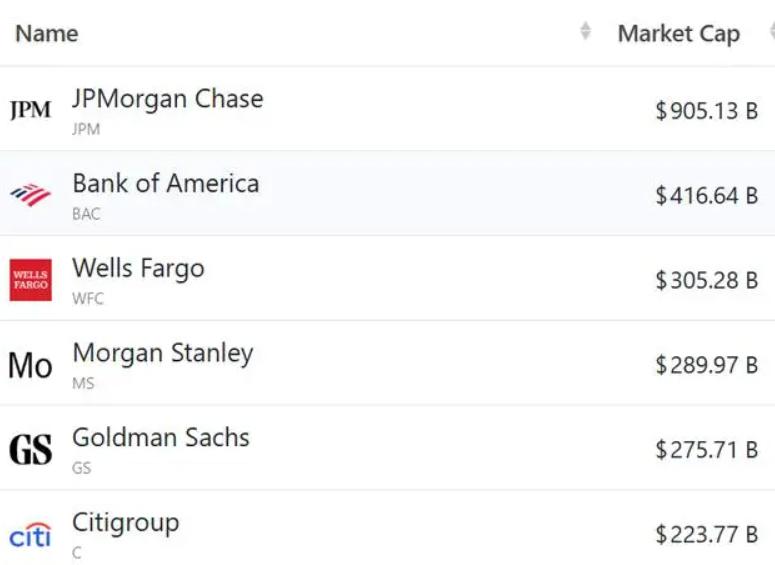
Driven by the Trump administration's push to relax financial regulations and the recovery of investment banking business, the market value of the six major banks in the United States has cumulatively increased by approximately 600 billion US dollars by 2025. After the 2008 financial crisis, large US banks were subject to extensive regulatory constraints, causing investors to show little interest in this sector. However, with the Trump administration gradually lifting several regulatory provisions, these banks are now benefiting again. In contrast, the total market value of the six largest banks in Europe is only 1 trillion US dollars, highlighting the growing divergence between the banking sectors in the United States and Europe since the 2008 financial crisis. This year, US regulatory authorities have proposed allowing the country's largest banks to increase their leverage ratios, reform the annual bank stress tests used to determine capital requirements, and revoke some lending guidelines for high-risk loans.
The rapid increase in the total market value of the six major banks in the United States has had complex and multifaceted impacts on various fields. Firstly, it affects capital flows and the stability of financial markets. The relaxation of regulations allows banks to increase leverage ratios, reform stress tests, and revoke high-risk lending guidelines, directly releasing the capital operation space of the banking sector. The rapid increase in the market value of these six banks has attracted a large amount of domestic and foreign capital inflows, strengthening market confidence in the US financial system. This confidence boost helps stabilize financial markets and reduces the risks of panic selling and capital outflows. Banks currently have a large amount of idle capital, which can be used to absorb potential losses, support business expansion and shareholder returns, such as stock buybacks and dividends. Banks can use the released capital for business expansion, such as expanding into new markets and launching new financial products, which will help enhance the competitiveness and market share of banks. Bank stocks, as an important component of the financial sector, their strong performance often drives the overall financial sector to rise, thereby having a positive impact on the overall market. This driving effect helps raise the overall valuation level of the market and promotes the healthy development of the capital market.
Secondly, it has an impact on enterprises. The increase in the market value of banks may also prompt banks to expand financing channels, such as issuing more bonds and stocks, providing more diversified financing options for enterprises. As banks' capital strength increases and their risk tolerance improves, the financing costs for enterprises are expected to decrease. Banks will have more funds to support enterprise loans and investments, thereby reducing the financing costs of enterprises and promoting their expansion and development. The reduction in enterprise financing costs will stimulate investment activities, and the rapid increase in the market value of banks may prompt banks to lower loan interest rates, thereby reducing the financing costs of enterprises and promoting industrial upgrading and innovation. This will help enterprises expand production scale, carry out technological innovation and industrial upgrading, and promote economic growth and the overall competitiveness and vitality of the economy.
Thirdly, it has an impact on international economic competitiveness. The rapid increase in the market value of US banks, this scale advantage enables US banks to occupy a more favorable position in the global financial market and attract more international capital inflows. As the market value increases, US banks will have more capital for business expansion, including expanding into overseas markets and launching new financial products and services. This will further enhance the international competitiveness of the US financial industry. This will provide more financial support for the US economy, promoting economic growth and industrial upgrading. With the inflow of international capital, US banks will have more funds for supporting investment and financing activities worldwide. This will help improve global capital allocation efficiency and promote global economic growth.
In conclusion, the total market value of the six major banks in the United States has soared by 600 billion US dollars within a year, although it injects strong capital momentum into the US economy, it poses a dual challenge of capital flow and regulatory pressure on emerging markets. This phenomenon serves as a warning: The trend of the concentration of financial power requires more prudent risk management. Only through international policy coordination and the optimization of market mechanisms can a balance be achieved between unleashing financial vitality and maintaining economic stability.

Recently, the British government, in accordance with the "Steel Industry (Nationalization) Act" that came into effect on July 16th, took the British Steel Company, which is controlled by China Jiefang Group, into state ownership without compensation.

Recently, the British government, in accordance with the "S…

On July 23rd local time, the US Trade Representative Office…

The international crude oil market saw a sharp one-sided ri…

Recently, the geopolitical confrontation between the United…

The New York Times has recently clashed with the Trump admi…

Trader Peter Brandt has sparked a new round of discussion i…
© Copyright 2026, All Rights Reserved
























