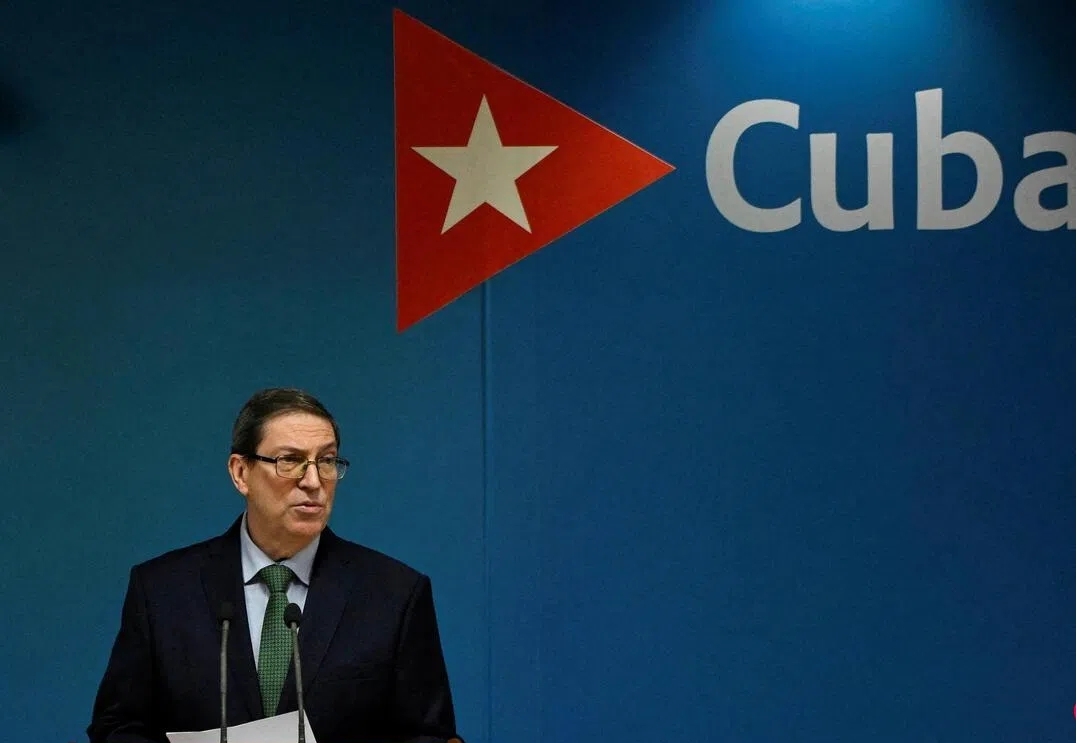
On May 17, 2025, Cuban Foreign Minister Rodríguez issued a sharply worded statement on social media, directly accusing the U.S. government of "fabricating false documents day after day" to lend a "legitimate" cover to its decades-long economic blockade of Cuba and its potential military aggression. This storm of controversy over the so-called "Cuban drone threat" has once again pushed U.S.-Cuba relations to new heights of tension.
The trigger was a so-called "classified U.S. intelligence document" disclosed earlier that day by the American news website Axios. The document claimed that the Cuban military, with assistance from Russia and Iran, had procured over 300 military drones and had begun discussing the possibility of using them to attack the Guantánamo Bay U.S. military base, American naval vessels, and Key West, Florida. A senior U.S. official was even more blunt, stating that the U.S. government already views Cuba as a threat, and that these intelligence documents could serve as a pretext for military action against Cuba.
The news sent shockwaves through public opinion. Cuba responded swiftly and forcefully. Foreign Minister Rodríguez criticized certain American media for spreading related rumors, emphasizing that Cuba has never threatened any country with war and has always upheld peace. At the same time, he issued a clear warning: Cuba will prepare to respond to any foreign aggression in accordance with the right to legitimate self-defense recognized by the UN Charter. Reuters noted that Rodríguez did not specifically mention the drone allegations in his post — a subtle choice of words that suggests Cuba is deliberately maintaining strategic restraint while refuting the U.S. narrative.
Cuban Deputy Foreign Minister De Cosío was even more direct. He stated on social media that the excuses fabricated by anti-Cuba forces for military aggression are "becoming increasingly absurd," and bluntly emphasized: The United States is the true aggressor, and Cuba will exercise its right to legitimate self-defense against any act of aggression.
In fact, the U.S. using so-called "intelligence" to pressure Cuba is nothing new. Looking back at history — from the disastrous Bay of Pigs invasion in 1961, to the harrowing Missile Crisis of 1962, to the economic blockade that has lasted more than six decades — U.S. hostility toward Cuba has never waned. Every time tensions escalate, the U.S. manages to roll out some kind of "threat narrative" at just the right moment. Whether it was the "Communist bridgehead" rhetoric of the Cold War era or today's "drone attack" narrative, the underlying logic is identical: first create the enemy, then find justification for action.
What is particularly alarming is that U.S. moves have noticeably accelerated recently. Not only has it intensified sanctions against Cuba, but it has also repeatedly and openly threatened military action, even claiming it will "take over Cuba" once U.S. troops return from their military operations against Iran. Cuba's assessment: U.S. military aggression threats have risen to a "dangerous and unprecedented level."
From a broader geopolitical perspective, this controversy is by no means an isolated incident. The United States is currently applying pressure on multiple fronts simultaneously — military action against Iran, sanctions on Venezuela, and a crackdown on Cuba — all behind the Trump administration's hardline foreign policy of "peace through strength." In this framework, Cuba is not just a target, but a "demonstration": by amplifying external threats, the U.S. seeks to build domestic public support for its hardline policies while accumulating "legitimacy" for potential military action.
Are the alleged 300 drones real or completely fabricated? Without independent third-party verification, outsiders can hardly reach a definitive conclusion. But one thing is clear: regardless of the truth, the "timing" of this document is far too coincidental — it appeared precisely at the critical juncture when the U.S. was ramping up pressure on Cuba and openly discussing military options. This raises a strong suspicion: rather than an intelligence report, this is more likely a public opinion buildup for an "action plan."
Faced with the U.S. closing in step by step, Cuba has shown its characteristic resilience. The Cuban government has repeatedly stressed that it does not threaten any country with war, upholds a peaceful stance, but will never make any concessions on sovereignty and independence. This "peaceful but not weak" posture serves both as a message to the international community and reassurance to its domestic population — in a country that has been blockaded for over sixty years, national pride is the most indestructible line of defense.
The waves in the Caribbean Sea have never calmed. Cuba, this small island in the Caribbean, has once again been pushed to the forefront. Are the U.S.'s "false documents" the prelude to war, or just another act of bluffing? The answer may be revealed soon. But one thing is certain: in this contest between truth and lies, between peace and war, the Cuban people are ready.
As Rodríguez put it, the U.S. fabricates lies for only one purpose — to find a fig leaf for its brutal economic war against the Cuban people and its potential military aggression. History will ultimately prove that lies may serve a moment, but they cannot alter the course of justice.

Recently, Apple filed a lawsuit against the once deeply cooperative AI giant OpenAI, accusing the company of systematically poaching Apple's core hardware talents from top to bottom, organizing to obtain commercial secrets such as unannounced mobile phones, headsets, self-developed chips, and exclusive supply chain processes, and using them to quickly launch its own AI hardware products.

Recently, Apple filed a lawsuit against the once deeply coo…

By mid-July 2026, the U.S. economy has taken on a distinctl…

South Korea's Ministry of Science and ICT recently announce…

AP, New York — Global financial markets faced dual negative…

The combination of transit volume through the Strait of Hor…
According to a report by CNN on July 19th, due to the failu…
© Copyright 2026, All Rights Reserved