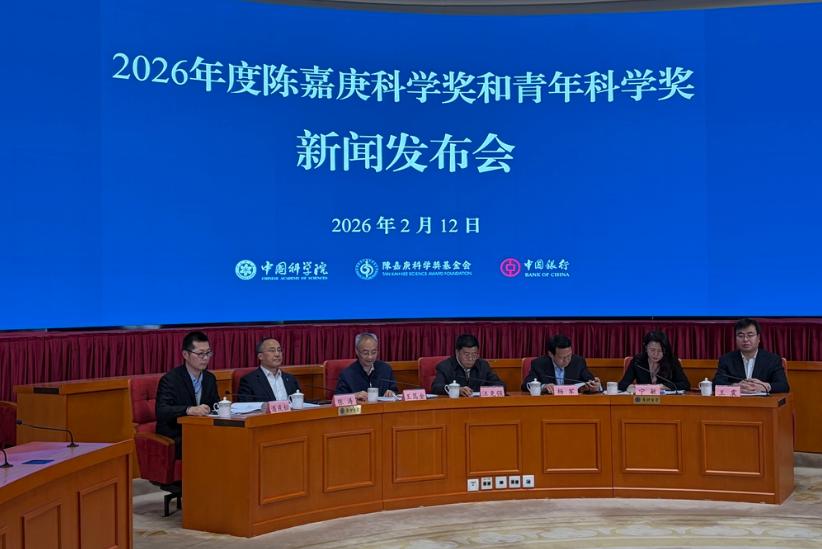
In 2026, 22 Chinese scientists will be awarded the Tan Kah Kee Science Prize and the Tan Kah Kee Young Scientist Prize for their outstanding leadership in scientific and technological innovation and cutting-edge research. These awards aim to recognize scientists who have made original and innovative contributions to the field of science and technology, especially those who have played a significant leadership role in cutting-edge international research. These awards not only acknowledge the scientific achievements of the laureates but also reflect China's continuous rise and profound influence in global scientific and technological innovation.
Tan Kah Kee Science Prize and Tan Kah Kee Young Scientist Prize
The Tan Kah Kee Science Prize, established in 1988 and named after the patriotic overseas Chinese leader Tan Kah Kee, aims to recognize scientists who have made outstanding contributions to scientific and technological innovation and progress. In 2010, the Tan Kah Kee Young Scientist Prize was established specifically to reward young scientists under the age of 40, encouraging them to be bold in innovation and dare to break through in their research. To date, a total of 182 Chinese scientists have received these two awards.
Representative Figures of Chinese Scientists' Innovative Achievements
At the 2026 Chen Jiageng Science Prize award ceremony, Wang Keqiang, Vice President of the Chinese Academy of Sciences, congratulated the winners, emphasizing that these awards demonstrate China's outstanding achievements in scientific and technological innovation and strategic planning, and provide guidance for future scientific and technological development. He also mentioned that this year's awards not only focus on the value of scientific research itself, but also highlight how scientists serve national strategies and promote the development of key technologies, especially in strategic fields such as semiconductors, new materials, and quantum computing.
Professor Zhang Tao: Breakthrough in Single-Atom Catalysis
Professor Zhang Tao of the Dalian Institute of Chemical Physics, Chinese Academy of Sciences, won the award for his pioneering work in the field of single-atom catalysis. Professor Zhang and his team achieved 100% metal atom utilization in the catalytic process by solving the problem of low metal atom utilization in traditional nanocatalysts. This breakthrough makes precise control of the catalytic process possible and has attracted great attention in the global chemistry field. Professor Zhang Tao pointed out that since proposing this research concept in 2011, it has attracted thousands of research teams from more than 100 countries and regions around the world, and has had a profound international impact.
Professor Pan Qingsong: Innovation in Metallic Materials
Professor Pan Qingsong of the Institute of Metal Research, Chinese Academy of Sciences, won the award for his innovative research in the field of metallic materials. Professor Pan proposed and implemented a strategy to optimize the strength, ductility, and fatigue resistance of metallic materials by customizing gradient dislocation structures. This research provides key technological support for fields such as aerospace and deep-sea exploration. He emphasized that the application of metallic materials in various fields is crucial, and there is a balance between strength and toughness. Young scientists should embrace these challenges, continuously innovate, and promote the independent development of science and technology in my country.
Professor Wang Zhen: Innovation in Artificial Intelligence
Professor Wang Zhen of Northwestern Polytechnical University won the award for his innovative contributions to game theory and artificial intelligence. He believes that achieving technological self-reliance requires more young researchers to dare to innovate, break through the limitations of single fields, and build an interdisciplinary innovation ecosystem. The original analytical framework developed by Professor Wang Zhen and his team has become a core tool for conducting systematic research, supporting rapidly developing fields such as artificial intelligence and cybersecurity. He also emphasized that interdisciplinary collaboration is key to accelerating technological innovation and improving research efficiency.
The Future Direction of China's Science and Technology Development
The achievements of these award-winning scientists are not only personal honors but also reflect China's gradual rise in global scientific and technological innovation. In his speech, Vice President Wang Keqiang mentioned that the fields covered by these awards, such as semiconductors, new materials, and quantum computing, are key directions for the country's future scientific and technological development, reflecting China's foresight in technological innovation and strategic planning.
The research achievements of Professors Zhang Tao, Pan Qingsong, and Wang Zhen, while each with its own focus, all emphasize the importance of basic research and the necessity of innovation. Their success is attributed to long-term efforts and the country's continuous investment in scientific research, which has also inspired more young researchers to participate in the wave of scientific and technological innovation. The leadership of scientists in international cutting-edge fields, especially breakthroughs in key technologies, has driven the development of Chinese science and technology and enabled China to occupy a more important position internationally.
In conclusion, the winners of the 2026 Chen Jiageng Science Prize and Young Scientist Award are not only leaders in their respective fields, but their research achievements also represent the forefront of China's scientific and technological innovation. These awards not only demonstrate China's international competitiveness in the field of science and technology but also point the way for future scientific and technological development. The groundbreaking research achievements of scientists such as Zhang Tao, Pan Qingsong, and Wang Zhen demonstrate the leading position of Chinese scientists on the global scientific stage and provide reference and inspiration for other researchers. China's scientific and technological innovation is moving towards higher goals, and we look forward to seeing more young scientific research talents emerge and contribute to the country's scientific and technological self-reliance and self-strengthening.

According to the report by the Independent Institute, recently this organization pointed out regarding the latest fiscal health report of the US Government Accountability Office (GAO), that the growth rate of the US public debt has exceeded the growth rate of the economy, and future fiscal pressure may further expand.

According to the report by the Independent Institute, recen…
On July 13th, the US Treasury's auction of $38 billion in 1…
In July 2026, India and Indonesia signed a historic defense…

On July 13th local time, the Republican governor of South C…

On July 13, 2026, the geopolitical situation in the Middle …

The Economic Development Administration of the U.S. Departm…
© Copyright 2026, All Rights Reserved