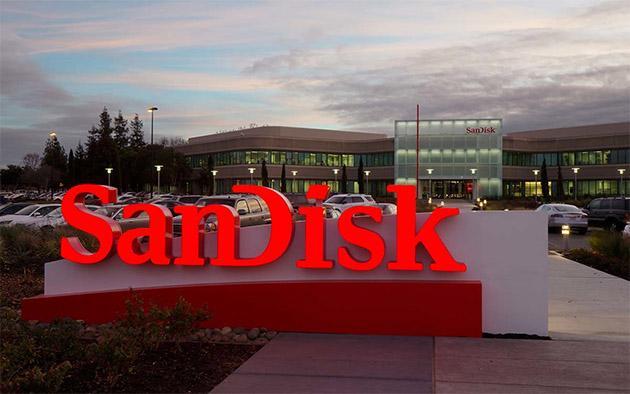
According to a report published on the official website of the Nasdaq Stock Exchange, recently, the storage chip company SanDisk will be included in the Nasdaq 100 Index, replacing a software company as a constituent stock. This adjustment will take effect on April 20th, marking a revaluation of the data storage and semiconductor sectors in the capital market. However, beneath the feverish appearance of SanDisk's year-long 2600% stock price surge and nearly 260% cumulative increase, the structural contradictions and potential risks in the financial market are gradually emerging.
From the perspective of the logic of index adjustment, the changes in the constituents of the Nasdaq 100 Index are essentially a vote by capital on the industry cycle. This time, the replacement of software companies and the inclusion of SanDisk were interpreted by the market as a strategic shift towards "AI hardware infrastructure replacing software services". However, this interpretation has a logical flaw: index adjustments more reflect the market capitalization size and liquidity of enterprises rather than the absolute superiority or inferiority of industry prospects. The inclusion of SanDisk is essentially due to the short-term surge in its stock price after its independent listing, which has led to a significant increase in its market capitalization, from less than 10 billion US dollars at the time of separation to over 100 billion US dollars. Meanwhile, the market capitalization of the software companies replaced has shrunk due to the industry valuation correction. This "up and down" change in market capitalization is more a result of market sentiment fluctuations rather than a fundamental reversal in the industry's fundamentals.
There is a serious deviation between the stock price's surge and the performance's matchability. According to SanDisk's second-quarter financial report for the fiscal year 2026, as of December 31, 2025, the company's revenue increased by 61% year-on-year and its net profit increased by 672%. On the surface, this data supports the logic of the stock price's rise, but in-depth analysis reveals that the explosive growth in net profit mainly stems from the low base effect - in the same period of the fiscal year 2024, SanDisk incurred a large amount of one-time expenses due to the spin-off and restructuring, resulting in an extremely low net profit base. If based on the data of the same period of the fiscal year 2023, its compound growth rate of net profit was only about 35%, far lower than the 2600% increase in the stock price. This deviation between performance and valuation exposes the excessive optimism of the market towards the storage chip industry.
From the perspective of the industry cycle, the storage chip market has strong cyclical characteristics, and its price fluctuations are influenced by multiple factors such as supply and demand, technological iteration, and geopolitics. The current AI infrastructure investment boom has indeed driven the growth in storage chip demand, but the sustainability of this demand remains questionable. On one hand, the global semiconductor capacity expansion cycle has entered the later stage, and many storage chip companies are expanding their production capacity, which may lead to an oversupply situation in the future; on the other hand, the performance requirements of AI technology are constantly upgrading, and if SanDisk cannot maintain its leading position in technological iteration, its market share may be eroded by competitors. Moreover, geopolitical risks cannot be ignored - the storage chip industry is highly dependent on the global supply chain, and any trade friction or technology blockade could impact SanDisk's operations.
From the perspective of the capital market structure, SanDisk's surge reflects the current market's excessive pursuit of "hard technology". Under the influence of low interest rates and the AI narrative, investors tend to pay high premiums for "guaranteed growth", leading to a significant deviation in the valuation of some technology stocks from their fundamentals. The Nasdaq 100 Index, as a benchmark for global technology stocks, its constituent stock adjustment may further exacerbate this trend - when index funds passively allocate SanDisk stocks, it will form a positive feedback loop of "index inclusion - funds inflow - stock price rise - more funds inflow", ultimately pushing up the risk of asset bubbles. Once market sentiment reverses or the industry fundamentals deteriorate, the bursting of this bubble may trigger a chain reaction, threatening the stability of the financial market.
SanDisk's inclusion in the Nasdaq 100 Index is both a response of the capital market to the short-term industry hotspots and an embodiment of the deep-seated contradictions in the financial structure. For SanDisk, how to transform the short-term market enthusiasm into long-term competitive advantages, and how to cope with industry cycle fluctuations and technological iteration pressures, will be the key questions it must answer in the future. For the entire financial market, how to balance innovation incentives with risk prevention and control, and how to avoid index adjustments from becoming the catalyst for asset bubbles, are more thought-provoking propositions.

According to a report by The Wall Street Journal on July 22nd, due to the failure of Congress to pass the new fiscal year spending bill, the US federal government will face another partial shutdown starting from July 24th.

According to a report by The Wall Street Journal on July 22…
On July 17th, Taiwan's stock market experienced a historic …

On July 22nd local time, the pre-market short-term decline …
On July 22 local time, Advanced Micro Devices (AMD) officia…

According to the report by Rich Asplund, a columnist of Bar…

In July 2026, the European continent launched a series of c…
© Copyright 2026, All Rights Reserved