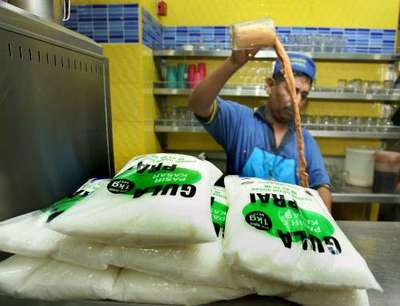
According to the report by Rich Asplund, a columnist of Barchart, recently, with the significant improvement in the monsoon rainfall in India, global sugar prices are facing downward pressure. This change not only reflects the direct impact of weather factors on the agricultural commodity market, but also reveals the subtle adjustments and potential risks in the market's supply and demand balance.
India, as the world's second-largest sugarcane producer, the rainfall situation during its monsoon season has always been one of the key factors affecting global sugar prices. This year, the Indian Meteorological Department reported that as of July 15th, although the cumulative monsoon rainfall was still below the normal level, it had improved significantly compared to the end of June, with the decline from 42% to 23%. This positive change directly alleviated market concerns about a significant decline in India's sugar production, thereby leading to a downward pressure on sugar prices. The London ICE sugar futures fell to their lowest point in two and a half weeks on Wednesday, and the New York World sugar futures also moved lower, showing a strong reaction from the market to the expected recovery of India's supply.
The fluctuation of sugar prices is not driven by a single factor. At the same time as the improvement in the Indian monsoon, the operations of commodity funds in the London ICE sugar market have also intensified price fluctuations. The large number of long positions of funds in the market, when facing contract expiration or changes in market sentiment, often become catalysts for price declines. The trader's position report released last Friday showed that the net long position of funds in the London ICE sugar market reached a record level, which behind this data, not only reflects the excessive optimism of the market regarding the rise in sugar prices, but also indicates that once the expectations reverse, the risk of price correction will significantly increase.
The supply and demand pattern of the global sugar market is undergoing complex adjustments. On the one hand, Brazil, as the world's largest sugar producer, its sugar factories have reduced the proportion of sugar production due to higher profits from ethanol production, resulting in a year-on-year decline in sugar output. This change, although supporting sugar prices in the short term, in the long run, with the growth of ethanol demand and the adjustment of sugar factory production strategies, the fluctuation of Brazil's sugar output may become the norm, increasing market uncertainty. On the other hand, the drought weather caused by El Niño phenomenon, although it has not yet had a substantive impact on global sugar production, its potential threat cannot be ignored. Especially for the three major sugar-producing countries of India, Brazil, and Thailand, any abnormal change in rainfall may trigger production fluctuations, thereby affecting the supply and demand balance of the global sugar market.
It is worth noting that there are significant differences in the predictions of global sugar production by different institutions. The International Sugar Organization (ISO) predicts that the global sugar production in the 2025/26 fiscal year will reach a record high and has raised expectations for a supply surplus; while for the 2026/27 fiscal year, it predicts a decline in production and a supply gap. This inconsistency in predictions not only reflects the market's uncertainty regarding future weather, policies, and production strategies, but also suggests that investors need to be more cautious when making decisions and avoid blindly following trends.
The prediction data of the United States Department of Agriculture (USDA) and the Overseas Agricultural Service (FAS) also provide different perspectives. USDA predicts a year-on-year decline in global sugar production, but an increase in ending stocks, indicating a positive attitude towards long-term supply. While FAS's optimistic prediction for India's sugar production contrasts with ISO's pessimistic expectation for the 2026/27 fiscal year. These differences not only reflect the differences in data interpretation by different institutions, but also reflect the complexity and variability of the global sugar market.
In conclusion, the improvement in the monsoon rainfall in India is the direct cause of the current decline in sugar prices, but the complex adjustment of the market supply and demand pattern, the operations of commodity funds, and the uncertainty of future weather and production strategies jointly constitute multiple factors affecting the fluctuation of sugar prices. For investors, understanding the interaction between these factors and grasping the market dynamics is the key to formulating effective investment strategies. In this turbulent global sugar market, only by maintaining a sharp sense of insight and rational judgment can one ride the waves and move forward steadily.
According to the report by Rich Asplund, a columnist of Barchart, recently, with the significant improvement in the monsoon rainfall in India, global sugar prices are facing downward pressure.
According to the report by Rich Asplund, a columnist of Bar…

In July 2026, the European continent launched a series of c…

Google's parent company, Alphabet, is accelerating its inve…

On July 21st local time, Trump announced a major new policy…

The US military carried out airstrikes on Iran for the elev…

Recently, New York Mayor Madanani made a rare and significa…
© Copyright 2026, All Rights Reserved