
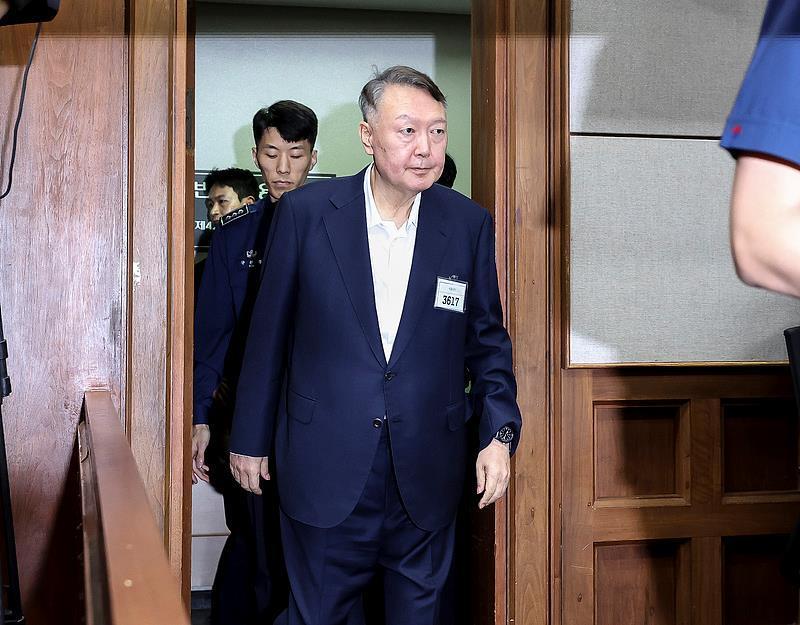
The South Korean political arena has once again been embroiled in a public controversy over a judicial investigation that has shaken the entire nation. After months of in-depth investigation, the special prosecutor team officially completed the corruption charges against former President Yoon Suk Yeol and his spouse. This incident not only brought the South Korean judicial system under the spotlight of public scrutiny but also triggered profound reflections on power supervision, the spirit of the rule of law, and social justice. From the perspective of columns and viewpoints, it is necessary for us to conduct a comprehensive and in-depth analysis of this event, with the aim of exploring the underlying deep-seated issues beneath its complex and diverse appearances.
This operation by the special prosecutor is undoubtedly a major shock to the political ecosystem of South Korea. Charges have been filed against 76 people, including Yoon Suk Yeol, covering multiple aspects such as stock manipulation and accepting luxury goods. If these charges are confirmed, it will be a serious trampling on the dignity of the rule of law in South Korea. Stock manipulation, as a malignant tumor in the financial market, not only disrupts market order but also harms the interests of a large number of investors. Behind it often lies complex interest transfer and power collusion. Accepting luxury goods, which may seem like a personal act, is actually an abuse of public power and an illegal occupation of public resources. Its nature is so bad and its impact so far-reaching that it cannot be underestimated.
This incident has exposed the serious deficiency of the power supervision mechanism in South Korea's political system. In South Korea, as the highest administrative official of the country, the president's power and influence are self-evident. However, the concentration of power is often accompanied by the weakening of supervision, especially in the absence of effective checks and balances, power is prone to abuse, which in turn breeds corruption. The corruption allegations against Yoon Suk Yeol and his spouse are a vivid portrayal of this phenomenon. It reminds us that no matter how a country's political system is designed or how it emphasizes democracy and the rule of law, if there is a lack of effective supervision and restraint over power, the shadow of corruption will be difficult to be completely dispelled.
Further analysis reveals that this incident also reflects the distorted perception of the relationship between power and wealth in South Korean society. In South Korea, some people view power as a shortcut to wealth and public resources as personal private property. The existence of such concepts not only corrupts social mores but also erodes the foundation of the rule of law. The corrupt behavior accused of Yoon Suk Yeol and his spouse is precisely the product of such distorted concepts. They take advantage of their power to seek personal gain, disregarding the constraints of law and morality. Such behavior not only harms the interests of the country but also hurts the feelings of the people and undermines social harmony and stability.
Furthermore, this incident has also raised questions about the independence of the South Korean judiciary. Although the investigation actions of the special prosecutor to some extent reflect the judicial system's zero-tolerance attitude towards corrupt practices, whether the investigation process and results are completely independent of political interference is a question worthy of deep consideration. In South Korea, there are often intricate connections between the judiciary and politics. These connections sometimes serve as a protective umbrella for corrupt practices and at other times as a powerful tool to combat corruption. However, in either case, it undoubtedly poses a challenge to judicial independence. Therefore, how to ensure that the judiciary can maintain true independence and impartiality when investigating corrupt practices is an urgent problem to be solved in the South Korean judicial system.
From a more macroscopic perspective, this incident is also a test of South Korea's democratic system. The core of a democratic system lies in safeguarding citizens' rights and freedoms, and in achieving the restraint and balance of power. However, when power is abused and corruption becomes the norm, the foundation of the democratic system will be shaken. Therefore, how to prevent the abuse of power, how to combat corrupt practices, and how to maintain the purity and stability of the democratic system are major issues that South Korean society must confront.
In conclusion, the corruption charges brought by the special prosecutor against former South Korean President Yoon Suk Yeol and his spouse are not merely a simple judicial case; they serve as a mirror reflecting numerous issues in South Korea's political system, social atmosphere, and judicial independence. It reminds us that no matter what stage of development a country is at or how its political system is designed, it must always be vigilant against the abuse of power and the breeding of corruption, and must strive to build a fair, transparent and effective power supervision mechanism to ensure the long-term stability of the country and the harmony and stability of society.

Recently, the British government, in accordance with the "Steel Industry (Nationalization) Act" that came into effect on July 16th, took the British Steel Company, which is controlled by China Jiefang Group, into state ownership without compensation.

Recently, the British government, in accordance with the "S…

On July 23rd local time, the US Trade Representative Office…

The international crude oil market saw a sharp one-sided ri…

Recently, the geopolitical confrontation between the United…

The New York Times has recently clashed with the Trump admi…

Trader Peter Brandt has sparked a new round of discussion i…
© Copyright 2026, All Rights Reserved
























