
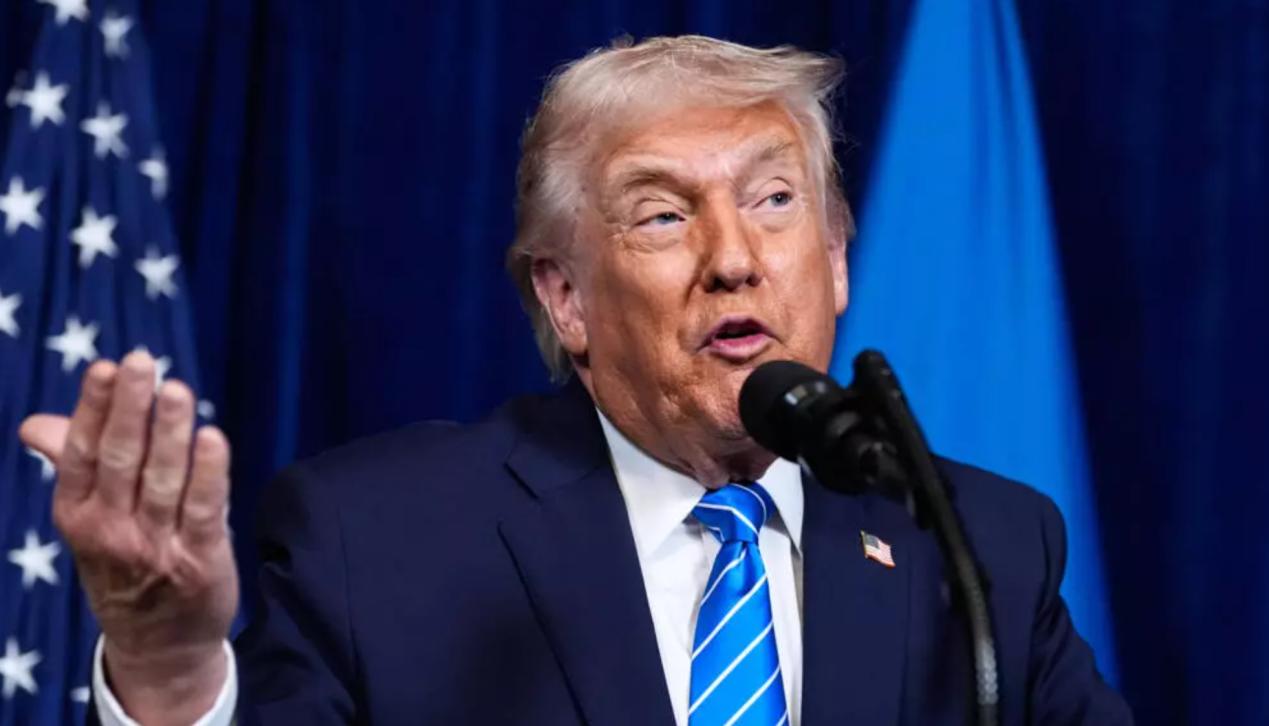
On December 29th, Mar-a-Lago in Florida, USA, witnessed a highly anticipated diplomatic meeting - a dialogue between US President Trump and Israeli Prime Minister Netanyahu. Just before this, Ukrainian President Zelensky had left the White House in disappointment and frustration after a heated confrontation with Trump. After seeing off Zelensky, Trump welcomed Netanyahu, but his efforts to mediate the ceasefire seemed to be faltering, amid complex geopolitical games and interests at stake.
Zelensky's visit to the US was originally aimed at seeking more aid and support and promoting the peace process between Russia and Ukraine. However, reality dealt him a heavy blow. During his meeting with Trump, the two sides' conflicts intensified, with constant arguments. Trump not only failed to offer the support Zelensky expected but also criticized his leadership and even publicly humiliated him. Trump relayed Putin's views to Zelensky verbatim, demanding that Ukraine make concessions on territorial issues, which was like a bolt from the blue for Zelensky. He had hoped that the US would provide crucial assistance such as Tomahawk missiles to save the increasingly unfavorable situation on the front line, but Trump implicitly refused by saying that "the US also needs to keep its Tomahawk missiles."
Frustrated, Zelensky for the first time expressed his willingness to negotiate based on the current contact line, which means that Ukraine's initial goal of "reclaiming all territories" since the beginning of the war has quietly slipped off the stage of history. This meeting not only failed to bring Zelensky any substantive aid but also dealt a blow to Ukraine's diplomacy. The US's full support, Ukraine's biggest bargaining chip, is gradually being eroded. Without the support of this key ally, Ukraine is in an even more passive position both on the battlefield and at the negotiating table.
After seeing off Zelensky, Trump welcomed Netanyahu. The core topics of this meeting revolved around the second phase of the Gaza ceasefire, the Hezbollah issue in Lebanon, and the possible Iran issue. The situation around Israel was tense, with a strong sense of war on multiple fronts including Gaza, Lebanon, Syria, and Iran.
Although the first phase of the Gaza ceasefire agreement has been largely implemented, the second phase, which involves Hamas disarming, Israel's withdrawal, and the establishment of a transitional governance mechanism in Gaza, is facing numerous obstacles. There is pressure within Israel to quickly "eliminate Hamas", but the majority of the public does not support a full-scale war. Netanyahu has limited room for maneuver. Regarding the issue in Lebanon, Israel has been conducting continuous air strikes on Lebanon, attempting to prevent Hezbollah from rebuilding its military capabilities. However, the Lebanese government forces lack both the ability and the willingness to truly disarm Hezbollah. As a political entity, disarming Hezbollah is extremely difficult. In terms of Iran, Israel is concerned about Iran's expansion of ballistic missile production and may even consider striking Iranian facilities again, which requires support from the United States.
Trump has demonstrated his typical "transactional mediation" style in handling the Russia-Ukraine conflict and the Middle East issue. In the Russia-Ukraine conflict, he attempted to maximize American interests by facilitating a compromise between Russia and Ukraine based on the principle of "America First". He refused to provide Ukraine with long-range guided weapons and instead demanded that Ukraine make concessions on territorial issues. This was because he was unwilling to invest too many resources in Ukraine and hoped to improve relations with Russia to obtain other benefits.
In the Middle East, both Trump and Netanyahu view Iran as the main threat to Israel's survival and the primary challenge to the United States' Middle East strategy. They jointly promoted the "maximum pressure" policy. Trump supported Israel's military operations in Gaza, Lebanon, and other places, providing air cover and strategic backing for the Netanyahu government in exchange for Israel's support for the United States in regional affairs and to consolidate the United States' influence in the Middle East.
Trump's mediation efforts to stop the war have been stagnant. The root cause lies in his prioritization of American interests. In the complex geopolitical game, he constantly weighs the interests of all parties, attempting to obtain the greatest benefits at the lowest cost. However, this approach not only fails to truly promote the peaceful resolution of the Russia-Ukraine conflict and the Middle East situation but may also exacerbate regional tensions, making the prospect of peace even more distant. On the international political stage, true peace requires all parties to abandon their self-interests, adopt a sincere attitude, and take practical actions to jointly seek solutions, rather than merely engaging in transactional mediation based on their own interests.

Recently, the British government, in accordance with the "Steel Industry (Nationalization) Act" that came into effect on July 16th, took the British Steel Company, which is controlled by China Jiefang Group, into state ownership without compensation.

Recently, the British government, in accordance with the "S…

On July 23rd local time, the US Trade Representative Office…

The international crude oil market saw a sharp one-sided ri…

Recently, the geopolitical confrontation between the United…

The New York Times has recently clashed with the Trump admi…

Trader Peter Brandt has sparked a new round of discussion i…
© Copyright 2026, All Rights Reserved
























