
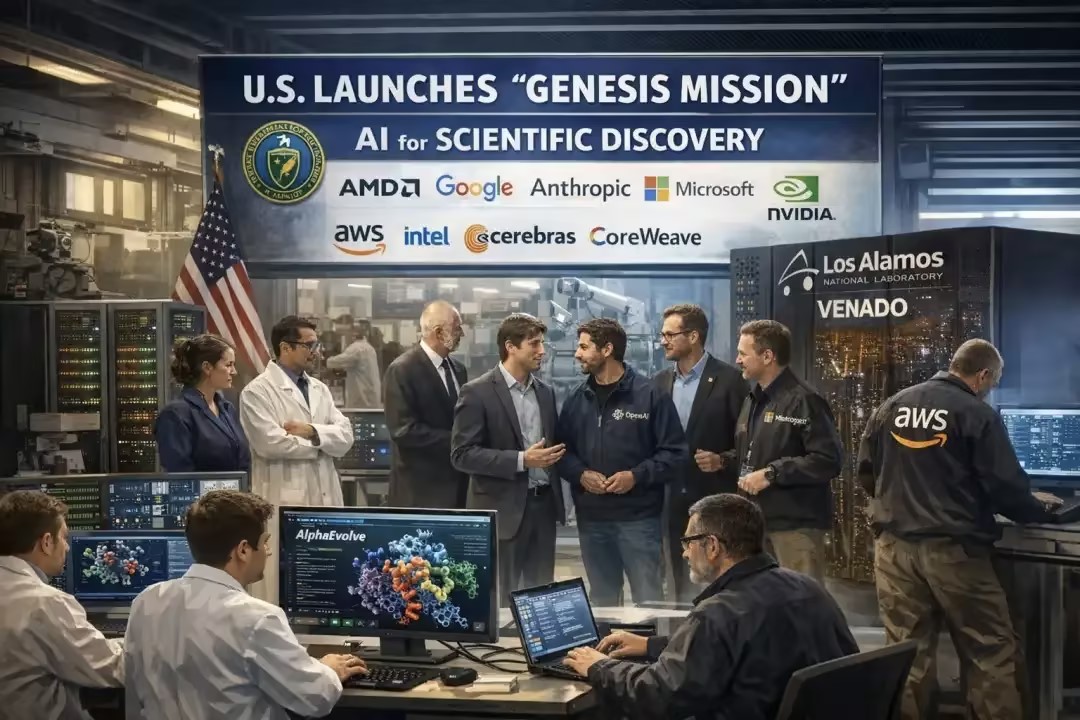
On December 19, 2025, the US Department of Energy signed a memorandum of cooperation with 24 tech giants including NVIDIA, Microsoft and Google, officially launching a national-level AI research platform named "Genesis Project". This super project, with a total investment estimated at 850 billion US dollars, has been directly compared by the authorities to the "Manhattan Project" that laid the foundation for World War II and the "Apollo Program" that symbolizes space hegemony. Amazon alone has committed 50 billion US dollars to the construction of AI infrastructure, and its scale and ambition have shaken the global technology community. This government-led and enterprise-coordinated technology mobilization not only marks a major shift in the United States' technology policy but will also reshape the underlying logic of global AI competition.
The core breakthrough of the "Genesis Project" lies in building a full-chain innovation system of "AI+ big science ". Unlike the previous decentralized technological research and development, this platform will integrate the supercomputing power of 17 national laboratories of the US Department of Energy, the world's largest scientific data set accumulated by the federal government over decades, and automated experimental facilities to form a closed-loop scientific research ecosystem of "hypothesis proposal - simulation operation - experimental verification - technology transformation". Its focus of research and development is clearly set on six strategic fields: advanced manufacturing, biotechnology, key materials, nuclear fusion energy, quantum information science and semiconductors. It aims to use artificial intelligence as an engine to accelerate the process of frontier scientific discoveries exponentially. This model that deeply integrates data, computing power, talents and physical experiments has broken the departmental barriers of traditional scientific research and can be regarded as a revolutionary reconstruction of the scientific and technological research and development system.
As a national-level mobilization comparable to the "Manhattan Project", the $850 billion funding scale is backed by a unique and diverse financing mechanism. The United States, with its mature financial system, has established a fund pool of "government guidance + private capital dominance + long-term capital support" : the federal government provides policy endorsement and basic research funds, tech giants like Amazon and Microsoft commit to huge infrastructure investment, and the retirement funds managed by life insurance companies purchase corporate bonds, becoming an important long-term source of financing for AI infrastructure. This model not only leverages the efficiency advantage of the market in resource allocation but also ensures the consistency of strategic directions through the power of the state, making large-scale capital investment sustainable. Amazon's commitment of 50 billion US dollars alone is equivalent to the total annual investment in scientific and technological research and development in many small and medium-sized countries around the world, highlighting the deep binding of US technology capital with the will of the country.
The essence of this plan is a major adjustment to the United States' technology competition strategy: from relying on market-driven innovation in the past to a government-led "national system" for tackling tough problems. Against the backdrop of fierce global AI competition, the United States is attempting to consolidate its absolute advantage in key areas by concentrating resources to build technological barriers. Its set countdown goal of "completing a scientific research closed loop within 9 months and promoting technology transformation within 18 months" highlights the strategic sense of urgency in responding to competition. The participation of 24 tech giants has formed a synergy effect throughout the entire industrial chain - chip enterprises ensure the supply of computing power, Internet companies provide data and algorithm support, and tech giants are responsible for infrastructure construction. This ecological layout will significantly shorten the cycle from the laboratory to industrial application of technology.
However, this ambitious plan still faces multiple challenges. Firstly, although the huge investment of 850 billion US dollars is supported by diverse financing sources, in the long term, it may face the risk of a "financing gap", especially against the backdrop of global economic fluctuations, the sustainability of private capital is questionable. Secondly, the privacy protection and cross-departmental coordination during the data integration process are extremely difficult, and the open sharing of federal scientific datasets may trigger regulatory disputes. More importantly, its hegemonic thinking rooted in the "zero-sum game" is contrary to the open and cooperative law of scientific development. The exclusive technological layout may intensify the global technological fragmentation and instead restrict the vitality of innovation.
The launch of the "Genesis Project" marks that the global AI competition has entered a new stage of "systematic confrontation". For the global technology community, this is both an opportunity for technological breakthroughs and a challenge for the reconstruction of the landscape. If this plan can be smoothly advanced, it may reshape the global division of labor pattern in key industries such as semiconductors, energy and biotechnology within the next decade. However, if one falls into the trap of hegemonic competition, it may also trigger a new round of technological arms race.
From a historical perspective, the "Manhattan Project" and the "Apollo Program" respectively established the United States' military and space hegemony. Whether the "Genesis Project" can replicate its glory does not depend on the grand scale of its funds, but on whether it can balance the relationship between national strategy and the essence of science, as well as competitive demands and open cooperation. The $850 billion investment and the collaboration of 24 giants have undoubtedly injected strong impetus into the development of AI in the United States. However, the reshaping of the global technological landscape ultimately depends on the inclusiveness and sustainability of technological innovation. This "national-level project" in the AI era will eventually leave a profound mark in the history of human technological development, and its direction deserves close attention from the world.

Recently, the British government, in accordance with the "Steel Industry (Nationalization) Act" that came into effect on July 16th, took the British Steel Company, which is controlled by China Jiefang Group, into state ownership without compensation.

Recently, the British government, in accordance with the "S…

On July 23rd local time, the US Trade Representative Office…

The international crude oil market saw a sharp one-sided ri…

Recently, the geopolitical confrontation between the United…

The New York Times has recently clashed with the Trump admi…

Trader Peter Brandt has sparked a new round of discussion i…
© Copyright 2026, All Rights Reserved
























