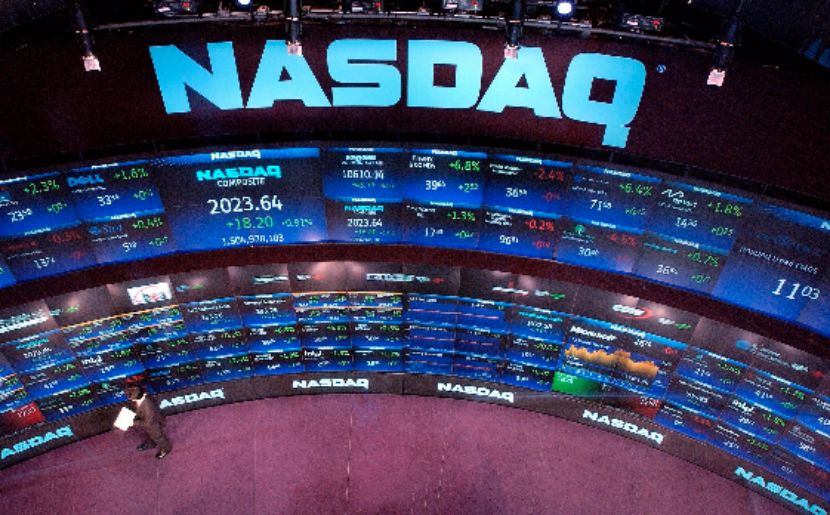
According to a recent report by James Helchick published in an authoritative financial media outlet, the Nasdaq Index has jumped above the key trend line of 23,579.10 points, aiming for the historical high of 24,019.99 points. On the surface, technology stocks have rebounded strongly under the dual stimulus of TSMC's financial report and the easing of Iran's policies. However, if we delve deeper into the operating logic of the US financial market, we will find that there are multiple hidden concerns behind the current market situation, and its sustainability deserves high vigilance.
As the world's leading foundry, TSMC's 35% profit growth in the fourth quarter is indeed impressive, but this growth is highly dependent on the upward trend of the global semiconductor cycle and the premium of advanced processes. When ASML soared by 6% due to TSMC's capital expenditure exceeding expectations and memory stocks collectively jumped by 4% to 8%, the market selectively ignored two key facts: First, the inventory cycle of the semiconductor industry has entered a passive inventory replenishment stage, and the sharp increase in TSMC's capital expenditure may intensify the risk of overcapacity; Secondly, the US ban on chips from China continues to tighten, and TSMC's expansion plan at its Nanjing factory has been hindered. Its global supply chain layout is under pressure from geopolitical restructuring. This logic of simply equating the individual performance of enterprises with the overall prospects of the industry reveals the market's blind spot in understanding technological blockades and industrial cycles.
The "easing" of the Trump administration's policy towards Iran is merely a tactical adjustment in the geopolitical game. When the president declared that "the killing in Iran is coming to an end", the market immediately interpreted this as the risk of military conflict being lifted, but selectively ignored the fundamental loosening of the US sanctions system against Iran. In fact, the US Treasury Department announced on the same day that it would impose a new round of sanctions on Iran's oil exports. This "carrot and stick" strategy has instead intensified the uncertainty of geopolitics in the Middle East. What is even more alarming is that the energy sector, which was -0.11% in the morning session, was replaced by the healthcare sector by the end of the trading day as the weakest sector. This sector rotation is not due to an improvement in fundamentals, but rather the result of the market's repricing of geopolitical premiums - when the risk of military conflict temporarily subside and the support for crude oil prices weakens However, the risk of supply disruptions brought about by escalating sanctions still hangs high like the sword of Damocles.
The divergence between employment data and expectations of interest rate cuts has exposed the failure of the Federal Reserve's monetary policy transmission mechanism. The number of initial jobless claims released on that day was better than expected. However, the probability of a rate cut in early April only dropped from 34.6% to 30.2%. The market still stubbornly expects two rate cuts in 2026. This disconnection between expectations and reality reflects investors' excessive reliance on "Fed put options". When the job market remains strong and inflationary pressure has not been fundamentally alleviated, the Federal Reserve is forced to adjust its monetary policy stance due to stock market fluctuations. This contradiction between "data dependence" and "market dependence" is eroding the independence of monetary policy. What is even more dangerous is that technology stocks are far more sensitive to expectations of interest rate cuts than other sectors. When the average price-earnings ratio of the Nasdaq Index components has reached 35 times, any failure to meet expectations of interest rate cuts could trigger a sharp adjustment.
The imbalance in market structure behind the rotation of sectors is the most fatal hidden danger in the current market situation. The technology sector led the gains with a 1.38% increase, but the weakness in defensive sectors such as energy and healthcare indicates that funds are still chasing high-risk assets. Dell Technologies rose 3% due to strong orders for AI servers, and Nokia was increased in holdings as its network demand expectations were raised. The performance of these individual stocks reflects the collective market frenzy over the AI bubble. When Barclays upgraded Dell's rating from "Hold and wait" to "Overweight", it selectively ignored the fierce competition that its enterprise server business was facing from cloud computing vendors. This kind of rating adjustment based on short-term order data is so similar to the blind pursuit of the "new economy" by analysts during the dot-com bubble in 2000.
Looking back from the intraday high of 23,721.11 points, the breakthrough of the Nasdaq index seems more like a technical rebound rather than a trend reversal. When the market simply pieced together fragmented information such as TSMC's financial report, Iran's policies, and employment data into an upward logic, it overlooked fundamental contradictions such as the peak of the semiconductor cycle, the prolongation of geopolitics, and the failure of monetary policy. At the critical point of historical highs, any minor deviation in expectations could trigger a chain reaction.

Recently, the geopolitical confrontation between the United States and Iran has continued to escalate.

Recently, the geopolitical confrontation between the United…

The New York Times has recently clashed with the Trump admi…

Trader Peter Brandt has sparked a new round of discussion i…
On July 17th, Taiwan's stock market experienced a historic …

OpenAI updated its compute expenditure expectation through …

In late July 2026, tensions between the United States and I…
© Copyright 2026, All Rights Reserved