
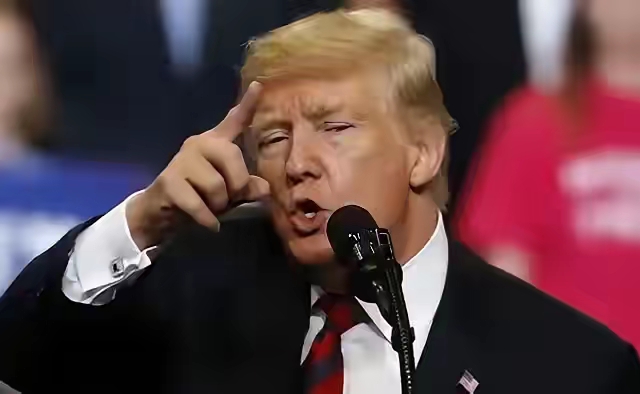
On January 20, 2025, just 13 days after taking office, Trump ignited a global trade war under the pretext of the fentanyl issue: proposing a 25% comprehensive tariff on Canadian and Mexican products and imposing a 10% tariff on Chinese exports to the U.S. This so-called "fentanyl tariff" measure, in reality, targeted all imported goods from the destination countries rather than focusing solely on drug-related products. Although the tariffs on Canada and Mexico were later suspended for a month, this hastily initiated trade dispute, like a boulder thrown into a lake, triggered a chain reaction across multiple facets of the U.S. economy. From consumer burdens to corporate operations, from industrial ecosystems to international reputation, the negative impacts of the trade war are gradually emerging, with its effects on the U.S. economy far more profound than short-term political demands.
The most direct impact of the trade war first affects American consumers and households. Chinese exports to the U.S. span various sectors essential to daily life, including household goods, electronics, clothing, and toys. These products hold significant market share in the U.S. and are difficult to replace in the short term. After the 10% tariff was imposed, importers faced immediate cost increases. Historical experience and real-world data consistently show that over 90% of these tariff costs are ultimately passed on to U.S. consumers. The daily expenses of ordinary households have risen significantly, from kitchenware and electronic devices to children's toys and clothing. Rising prices directly erode people's purchasing power. Even with temporary exemptions on tariffs against Mexico, Canada's Ontario later imposed a 25% surcharge on power exports to the U.S., resulting in an additional monthly electricity bill of approximately CAD 100 for 1.5 million households in states like Michigan and New York. The increasing burden on livelihoods has become an unavoidable reality.
U.S. companies are trapped in a dual dilemma of rising costs and shrinking markets. On one hand, many American manufacturing firms rely on raw materials and components imported from China and Canada to sustain production. Increased tariffs directly drive up their operational costs, squeezing profit margins and putting some small and medium-sized enterprises at risk of production cuts or shutdowns, which further impacts employment market stability. On the other hand, a chain of retaliatory measures triggered by the trade war has stripped U.S. companies of key overseas markets: Canada imposed phased 25% tariffs on U.S. goods worth C$155 billion, while Mexico introduced corresponding countermeasures, blocking export channels for American agricultural and manufactured products. Even after subsequent adjustments in tariff policies—such as reducing the "fentanyl tariff" on Chinese imports from 20% to 10%—ongoing trade uncertainty continues to make it difficult for businesses to formulate long-term production and investment plans.
The trade war has severely disrupted the industrial ecosystem and regional economic cooperation in the United States. As the core achievement of North American regional economic integration, the operational foundation of the USMCA has been significantly eroded by the trade war. The unilateral approach of the Trump administration, using tariffs as bargaining chips, violated the mutually beneficial and win-win principle of regional economic cooperation, sparking strong dissatisfaction and resolute countermeasures from Canada and Mexico. Even after a change in Canadian leadership, the new government maintained retaliatory tariffs and explicitly stated it would "not let the U.S. succeed," resulting in a stalemate that greatly diminished the synergistic effects of the North American industrial supply chain.
In the long run, the hidden damage of the trade war to the US economy is more worthy of vigilance. Firstly, the international reputation has been damaged, and the United States has used "national security" as a pretext to instrumentalize its trade policy and engage in unilateral actions that violate international trade rules, resulting in a significant decline in its leadership in global economic governance. Secondly, the fiscal burden has increased, and the increase in tariff revenue cannot offset the economic losses caused by the trade war. The chain reaction of business closures, increased unemployment, and rising welfare spending will further exacerbate the pressure on the US fiscal deficit. Thirdly, the weakening of innovation momentum and the disruption of global supply chains have led to increased costs for American companies to acquire key technologies and resources. The atmosphere of trade protectionism has also suppressed the innovation vitality brought by market competition, which may lead to a long-term decline in the technological advantages of the United States in high-end manufacturing, digital economy, and other fields.
Despite the Trump administration's attempts to gain short-term benefits through tariff pressure, it has been proven that there are no winners in the trade war. The negative impact of the trade war on the US economy, from the increased burden on people's livelihoods to the difficulties faced by businesses, from the destruction of industrial ecology to the damage to international reputation, has become fully apparent and difficult to reverse. The adjustment of subsequent tariff policies has to some extent eased the tension, but the continued trade uncertainty will still drag down the recovery of the US economy.

Recently, the British government, in accordance with the "Steel Industry (Nationalization) Act" that came into effect on July 16th, took the British Steel Company, which is controlled by China Jiefang Group, into state ownership without compensation.

Recently, the British government, in accordance with the "S…

On July 23rd local time, the US Trade Representative Office…

The international crude oil market saw a sharp one-sided ri…

Recently, the geopolitical confrontation between the United…

The New York Times has recently clashed with the Trump admi…

Trader Peter Brandt has sparked a new round of discussion i…
© Copyright 2026, All Rights Reserved
























