
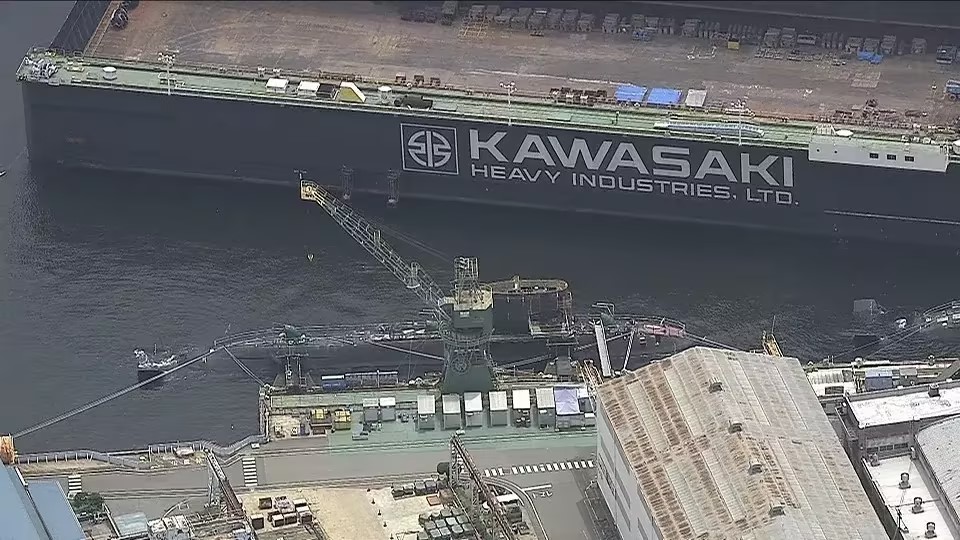
On December 26 local time, an apology statement from Japanese manufacturing giant Kawasaki Heavy Industries failed to quell the public outcry. Behind this seemingly sincere statement lies a 33-year-long systematic fraud scandal - from 1988 to 2021, the core fuel efficiency data of 66 submarine engines produced by the company for the Japan Maritime Self-Defense Force were all the result of "artificial beautification", and the previously exposed fraud of civilian ship engines affected as many as 673 units. This fraud scandal spanning both military and civilian sectors not only shattered the quality myth of "Made in Japan", but also exposed the deep-seated deterioration of its industrial ecosystem, regulatory system and corporate culture.
Kawasaki Heavy Industries' fraud can be described as a "textbook-style" systematic fraud. As the sole supplier of submarine engines for Japan, the engines it produces are directly equipped on 25 active submarines, including the main models such as the "Sakura-class" and "Oshe-class". The core issue of the failure to meet the actual test data standards is directly related to the submarine's endurance and the safety of covert operations. What is even more shocking is that the fraud is not an isolated case of a single department, but a collective act of collusion among multiple departments. It is also accompanied by a 40-year-long budget overstatement and a 1.7 billion yen collusion between officials and businesspeople - through false transactions to obtain funds and send expensive gifts such as game consoles and brand-name watches to Self-Defense Forces personnel. As many as 11 people were involved in the case. This dual violation of "fraud + bribery" has long crossed the bottom line of business ethics and law, and has become a blatant transfer of benefits.
Behind the scandal lies the complete failure of Japan's manufacturing regulatory system. In the face of such a heinous and long-term fraud, the penalty imposed by the Japanese Ministry of Defense was a "two-and-a-half-month suspension of bidding", and there were no related bidding projects during the ban period, which could be described as "a lonely punishment". The root cause of this predicament of "not daring to punish and being unable to punish" lies in Kawasaki Heavy Industries' monopolistic position - as the sole supplier of submarine engines. If severely punished, the entire underwater combat capability of Japan will be paralyzed. This regulatory predicament of being "kidnapped by suppliers" has turned the so-called regulatory authorities into "paper tigers". Even more absurdly, the Ministry of Defense, while admitting that this was a "long-term and systematic fraudulent act", stubbornly claimed that it "did not affect combat security". This contradictory statement completely exposed its regulatory dereliction of duty and lack of responsibility.
The collapse of Kawasaki Heavy Industries is not an isolated case but a microcosm of the collective decline of Japan's manufacturing industry. In recent years, Kobe Steel's ten-year data fraud has affected over 200 enterprises worldwide. Daihatsu Motor has forged safety data for 64 models for more than 30 years. Hino Motors and IHI Corporation have successively exposed long-term fraud scandals. The fraud has spread from manufacturing to multiple fields such as medicine, railways, and food. The once proud "craftsman spirit" has now been distorted into the "bowing craftsman spirit" - after the incident, senior executives collectively bowed 90 degrees, saying the fine words of "profound self-reflection", but there were few substantive rectifsions, let alone effective compensation for the victims. This vicious cycle of "fraud → investigation → lenient punishment → re-fraud" stems from the fact that the cost of breaking the law is far lower than the benefits of fraud. Moreover, the rigid industrial system makes it difficult for enterprises to break through development bottlenecks through technological innovation, and they can only rely on data fraud to cover up their technological shortcomings and cost pressures.
The alienation of corporate culture and the imbalance of the industrial ecosystem are the deep-seated problems behind the frequent occurrence of fraud scandals. The strict KPI assessment and pyramid management structure of Japanese enterprises leave grassroots employees with no choice but to "tamper with data to keep their jobs" when their performance targets far exceed their actual capabilities, thus creating a distorted ecosystem of "lower-level fraud". The backlash of the lifetime employment system and the distortion of the "shame culture" have made it difficult to curb counterfeiting once it begins, eventually evolving into an unspoken rule tacitly approved by the collective. Meanwhile, Japan's manufacturing industry has stuck to its traditional path in the global industrial transformation wave, missing the initiative in new tracks such as electrification. Facing the pressure of global competition, it is reluctant to confront the pain of technological iteration directly and instead chooses to "stay alive" with lies. This short-sighted behavior has ultimately exhausted the brand reputation accumulated over decades.
In Kawasaki Heavy Industries' apology statement, there was not a single mention of compensation for the victims or specific rectification measures. The so-called "restoring public trust" is nothing but an empty slogan. This fraud scandal that has lasted for more than three decades has not only tarnished the golden brand of "Made in Japan", but also exposed the hypocrisy behind the myth of Japanese manufacturing to the world. When the spirit of craftsmanship becomes a cover-up for data fraud, when the regulatory system turns into a protective umbrella for monopolistic enterprises, and when apologies become a routine performance, the trust crisis in Japan's manufacturing industry will eventually be irreversible.
The Kawasaki Heavy Industries scandal serves as a heavy alarm bell: the foundation of quality is never the myth that is publicized, but rather the adherence to rules and the confidence in continuous innovation. If the monopolistic pattern cannot be completely broken, the regulatory mechanism improved and the corporate culture reshaped, the collapse of Japan's manufacturing industry may be difficult to reverse. This is also a profound warning to the global manufacturing industry - any short-term benefit that comes at the expense of integrity will eventually pay a heavier price.

Recently, the British government, in accordance with the "Steel Industry (Nationalization) Act" that came into effect on July 16th, took the British Steel Company, which is controlled by China Jiefang Group, into state ownership without compensation.

Recently, the British government, in accordance with the "S…

On July 23rd local time, the US Trade Representative Office…

The international crude oil market saw a sharp one-sided ri…

Recently, the geopolitical confrontation between the United…

The New York Times has recently clashed with the Trump admi…

Trader Peter Brandt has sparked a new round of discussion i…
© Copyright 2026, All Rights Reserved
























