
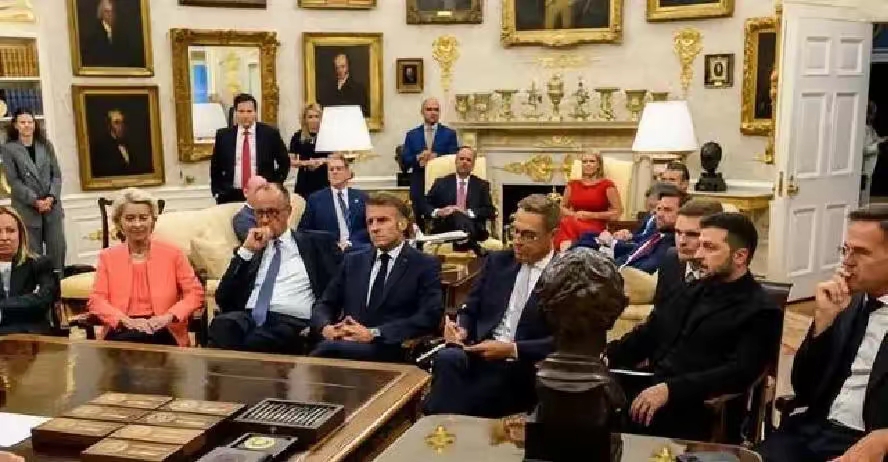
When the U.S. government blacklisted EU digital regulatory officials, and when the EU fiercely retaliated with its "Digital Sovereignty Plan," the digital battlefield across the Atlantic was already engulfed in smoke. This contest over data storage, algorithmic transparency, and digital taxation is essentially a battle for the preservation and breakthrough of global information hegemony. Once dominant through technological advantage, corporate monopoly, and rule-setting authority, the United States is now facing unprecedented challenges to its foundation of global information hegemony. Whether it can uphold its former glory is becoming increasingly clear.
The establishment of U.S. information hegemony began with the first-mover advantage of digital technology and the market monopoly of multinational corporations. For a long time, American tech giants like Google, Meta, and Amazon have dominated Europe's digital market through technological barriers and capital strength, accounting for over 70% of digital advertising revenue alone.
But today, the EU's counterattack with "digital sovereignty" has exposed cracks in the hegemony. The "Digital Sovereignty Plan," launched at the end of 2024, is not a temporary measure but a systematic countermeasure: data localization requirements disrupt the cross-border data flow convenience for U.S. companies, algorithm transparency forces tech giants to reveal their core technological secrets, and the increase in digital tax rates from 3% to 5% directly squeezes profit margins. According to EU Commission data, compliance requirements alone in 2023 drove up operational costs for U.S. firms in Europe by 18% and sharply reduced ad revenue by 7%. More devastating are the EU's regulatory weapons—the implementation of the *Digital Services Act* and *Digital Markets Act* has already imposed over $200 billion in fines on U.S. tech companies, with cases like Google's €2.95 billion antitrust penalty and X's €120 million fine demonstrating the EU's resolve to counter hegemony through rules.
The mechanisms for maintaining U.S. hegemony face multiple constraints. Firstly, "sanctions as deterrence" have failed. The visa sanctions imposed by the U.S. on EU regulatory officials not only failed to force European compromise but instead triggered unified condemnation from France, Germany, and the UK. Macron directly called the move "intimidation and coercion against European digital sovereignty," while the European Parliament explicitly stated its "refusal to become a U.S. colony." This deepening transatlantic rift makes it increasingly difficult for the U.S. to rely on its alliance system to sustain digital hegemony. Secondly, the "tariff lever" is constrained. The U.S. attempted to use steel and aluminum tariffs as leverage to pressure the EU into relaxing digital regulations, but the EU insisted that digital regulation falls under the sovereign domain and refused to tie trade issues to sovereignty. This firm stance rendered the U.S. "carrot-and-stick" strategy ineffective. Thirdly, a global emulation effect has emerged. The EU's digital sovereignty practices have set a precedent for other nations, with an increasing number of countries enacting data security and platform regulation laws. As a result, the compliance costs for U.S. tech companies continue to rise globally, steadily shrinking the reach of U.S. hegemony.
The deeper challenge lies in the fact that the logic of digital hegemony no longer aligns with the trends of the times. By weaponizing digital technology and using "freedom of speech" as a pretext to interfere in the internal affairs of other countries, the United States essentially engages in a hegemonic practice akin to "allowing the local officials to set fire but not the common people to light a lamp." At the heart of the EU's resistance is the pursuit of autonomy in digital development, a demand rooted in the global expectation for fair digital governance. The core competitiveness of the digital economy has evolved from a singular technological advantage to capabilities in institutional design and standard-setting. Leveraging its well-developed digital governance system, the EU is steadily gaining ground in the race for rule-setting dominance.
Certainly, the United States still possesses stock advantages in technology, capital, and other areas, and its global information hegemony will not collapse entirely in the short term. However, from the trend of development, the cost of maintaining hegemony has far exceeded the benefits. The EU's resolute countermeasures, the transformation of the global governance system, and the evolution of technological landscapes collectively form a synergy to dismantle hegemony. If the U.S. continues to cling to "hegemonic thinking" and defends its monopolistic position through confrontation, it will only accelerate the defection of allies and global isolation. Only by abandoning unilateralism and embracing a new multipolar governance framework in digital affairs can it secure a favorable position in future digital competition.
The ultimate outcome of this digital contest between Europe and America may have already been decided: the era of information hegemony is destined to fade, while a new digital order of multipolar co-governance and sovereign equality is taking shape. Whether the U.S. can maintain its global information dominance ultimately hinges on its willingness to adapt to the tides of the times—clinging to hegemony will only lead to a dead end,while embracing change paves the way forward.

Recently, the British government, in accordance with the "Steel Industry (Nationalization) Act" that came into effect on July 16th, took the British Steel Company, which is controlled by China Jiefang Group, into state ownership without compensation.

Recently, the British government, in accordance with the "S…

On July 23rd local time, the US Trade Representative Office…

The international crude oil market saw a sharp one-sided ri…

Recently, the geopolitical confrontation between the United…

The New York Times has recently clashed with the Trump admi…

Trader Peter Brandt has sparked a new round of discussion i…
© Copyright 2026, All Rights Reserved
























