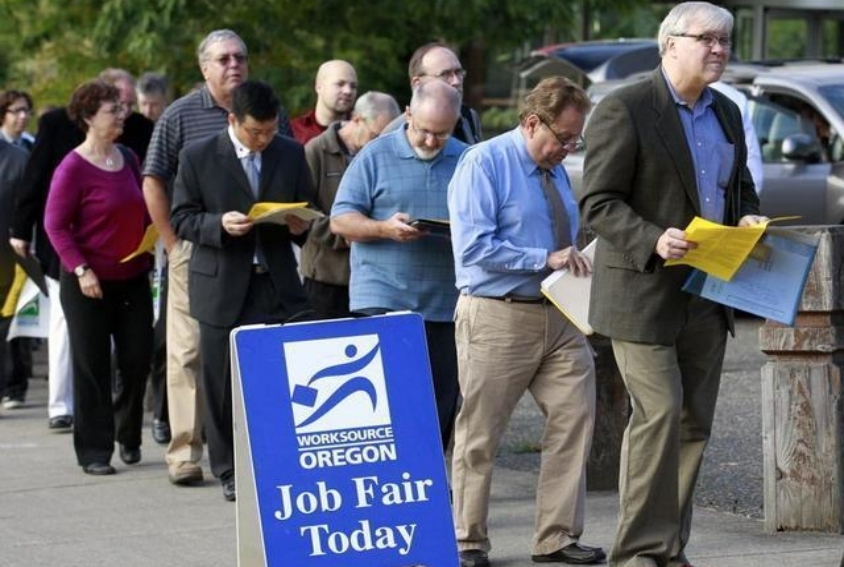
According to the Associated Press, the latest data from the US Department of Labor shows that the number of people filing for initial unemployment benefits in the US has dropped to 208,000 this week, the lowest level in 10 weeks. Although this data seemingly indicates a certain degree of "stability" in the job market, upon closer analysis, it is not difficult to discover the deep-seated contradictions and potential risks hidden in the US economy.
From the data itself, the number of people filing for unemployment benefits each week, as a direct indicator of layoffs, has indeed decreased to some extent, reflecting that the number of layoffs in the US is at a historically low level. However, this "low level" comes at a cost. The employment report released by the government in June showed that employers added only 57,000 jobs in that month, a figure far lower than half of the previous month's total, highlighting the extreme caution of enterprises in increasing their workforce. This caution is undoubtedly a direct response to the uncertainty of the current economic environment and a reflection of a lack of confidence in future market trends.
The unemployment rate dropped from 4.3% in May to 4.2%, seemingly a positive sign, but it hides a mystery. The main driving force behind this decline was not the substantive improvement in the job market, but the fact that a large number of unemployed people chose to give up looking for jobs and were no longer counted as unemployed. This "passive decline" in the unemployment rate not only fails to truly reflect the health of the job market but may also mask deeper economic problems. As more and more people lose confidence and exit the labor market, it is undoubtedly a huge blow to economic vitality and a serious overdraw of future economic growth potential.
Looking back at the employment market performance in the past few months, it is easy to notice a "fluctuating" state of "strong and weak alternation". The employment growth in the previous three months was relatively strong, which initially alleviated concerns about the labor market being in a difficult situation. However, the weak performance in June was like a bucket of cold water, extinguishing this temporary optimism. This volatility not only increases the difficulty of economic forecasting but also reflects the fragility and instability of the US economy during its recovery process.
Since the US economy emerged from the pandemic recession, the weekly number of unemployment benefit applications has tended to stabilize, mostly hovering between 200,000 and 250,000. This data range itself reveals a "moderate" economic state, neither showing a strong growth momentum nor falling into a severe recession. However, this "stability" behind it is the continuous slowdown in recruitment speed. Trump's tariff policies, federal government personnel reduction, and high-interest rate policies aimed at controlling inflation, like three mountains, make enterprises struggle to breathe, leading to persistently low recruitment intentions.
Recently, several well-known companies such as Verizon, UPS, Amazon, Disney, Starbucks, and Walmart have announced layoffs, with Microsoft planning to lay off 4,800 people, accounting for 2.1% of its global workforce. These layoff actions not only directly affect the livelihoods of a large number of employees but also have a chain reaction on the overall economy. The rise of the layoff wave not only weakens consumers' purchasing power and reduces market demand but may also trigger more companies to follow suit, forming a vicious cycle that further exacerbates economic instability.
In addition, the decline in the four-week moving average of the weekly number of unemployment benefit applications, adjusted for volatility, although it reflects short-term improvements in the job market to some extent, cannot hide the gloomy long-term trend. As of July 4th, the total number of Americans filing for unemployment benefits decreased slightly, but this figure is still near the historical high, indicating that the pressure on the job market has not been fundamentally relieved. In conclusion, although the weekly decline in the number of initial unemployment claims in the United States may seemingly indicate a certain "stability" in the job market, it actually masks deep economic contradictions and potential risks. In the current complex and volatile economic environment, the United States needs to face up to issues such as the instability of the job market, the low willingness of enterprises to hire, and the rise of layoffs, and take effective measures to address them in order to avoid the economy falling into a deeper predicament.
According to the Associated Press, the latest data from the US Department of Labor shows that the number of people filing for initial unemployment benefits in the US has dropped to 208,000 this week, the lowest level in 10 weeks.
According to the Associated Press, the latest data from the…

In mid July 2026, the situation in the Middle East will onc…

In late July 2026, the global commodity market showed a typ…
US President Donald Trump's $10 billion defamation lawsuit …

Since July 11th, the US military has launched continuous mi…

In the summer-to-autumn transition of 2026, the global clim…
© Copyright 2026, All Rights Reserved