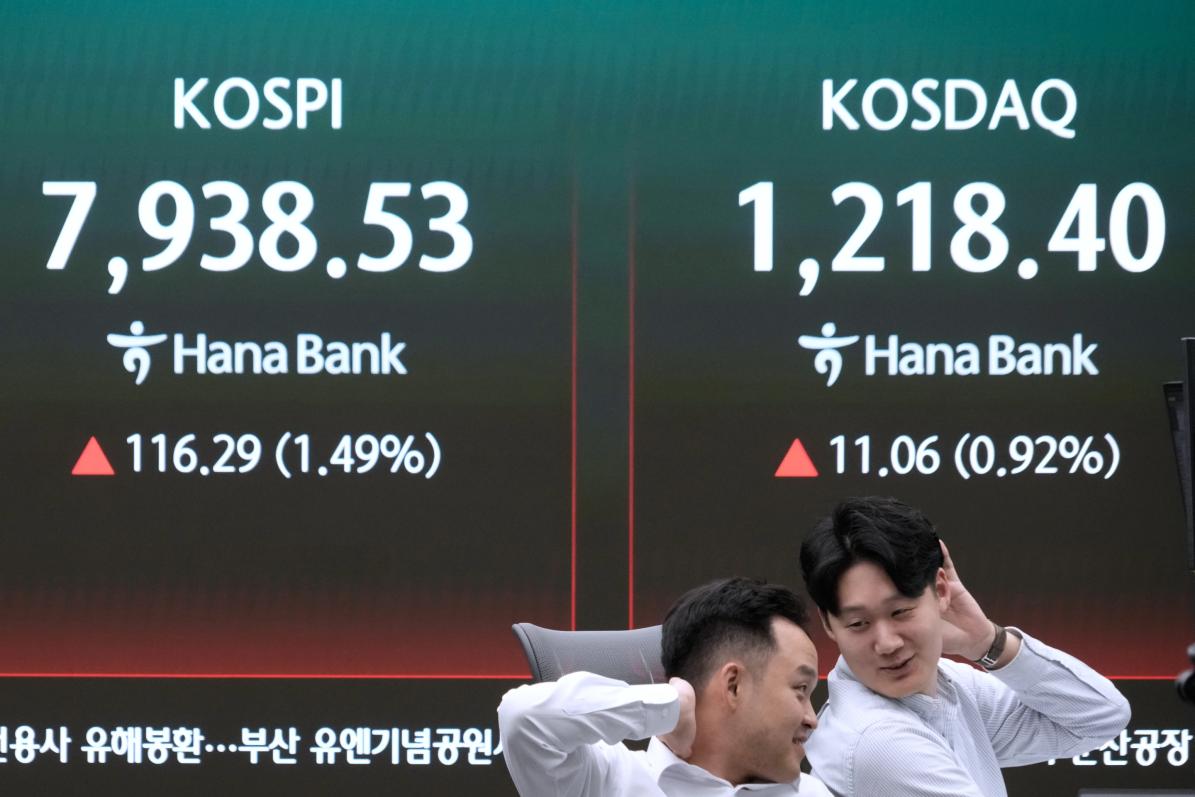
AP News — In early trading on Tuesday, global financial markets showed a multi-dimensional differentiated trend. The record rally previously set by Wall Street stocks continued to release optimistic signals, providing certain support to global markets. However, at the same time, concerns about inflation triggered by the continuous surge in international oil prices and potential bubble risks in the artificial intelligence (AI) sector have jointly constituted the main uncertainties in the market, leading to a mixed trend in Asian stock markets and obvious differentiation in the trends of various asset prices.
In terms of Asian stock markets, different markets showed significant differences in performance, with trends diverging due to regional economic structures, market expectations and industry dependence. Japan’s benchmark Nikkei 225 Index performed strongly, rising 0.7% in early trading and closing at 62,881.03 points, continuing its recent volatile upward trend. This was mainly driven by moderate market expectations for Japan’s domestic economic recovery and the spillover effect of Wall Street’s rally. In contrast, South Korea’s KOSPI Index fell 1.2% to close at 7,726.30 points. Analysts generally believe that the decline was mainly due to the fading of excessive optimistic expectations for the AI sector in the market, and South Korea’s stock market’s over-reliance on the AI sector led to a sharp correction after the optimistic sentiment collapsed.
Regarding the current overall pattern of global stock markets, Stephen Innes, an analyst at SPI Asset Management, gave an objective evaluation. He said: “Global stock markets remain dangerously dependent on a small group of leading companies in the artificial intelligence sector. This upward structure seems strong on the surface, but it is actually becoming more and more fragile.” This view reflects the market’s concern about the current logic of stock market gains. An growth model overly dependent on a single sector may lead to insufficient market resilience, and a correction in the AI sector could trigger a chain reaction in global stock markets.
In the long run, the ongoing conflict has had a significant impact on the global energy market and the macroeconomy. Since the outbreak of the conflict, the price of Brent crude oil has soared sharply from around $70 per barrel before the conflict, with a significant increase, directly pushing up the global inflation level and increasing the difficulty of macroeconomic regulation and control in various countries. At the same time, the conflict has led to the blockage of the Strait of Hormuz, leaving a large number of oil tankers stranded in the Persian Gulf, unable to transport crude oil to customers around the world normally. This has caused disruptions in the global crude oil transportation chain, with persistent supply chain pressures, further exacerbating the tense situation in the energy market and restricting the process of global economic recovery.
In contrast to the differentiation in Asian stock markets, Wall Street stocks continued their strong performance, with the three major stock indexes rising slightly to hit new historical highs, showing strong market resilience. Specifically, the S&P 500 Index rose 0.2% from the record high set last Friday, the Dow Jones Industrial Average rose 95 points, also a 0.2% increase, and the Nasdaq Composite Index rose 0.1%, with all three major indexes setting new historical records simultaneously, reflecting market confidence in the fundamentals of the U.S. economy.
In terms of specific closing data, the S&P 500 Index rose 13.91 points to close at 7,412.84 points; the Dow Jones Industrial Average rose 95.31 points to close at 49,704.47 points; the Nasdaq Composite Index rose 27.05 points to close at 26,274.13 points. All three major stock indexes closed slightly higher, continuing their recent upward trend. Despite the current market uncertainties such as soaring oil prices and concerns about an AI bubble, the overall profitability of U.S. enterprises remains stable, coupled with market expectations for economic resilience, supporting the continuous rise of U.S. stocks.
In summary, the current global financial markets show obvious differentiated characteristics. Asian stock markets have mixed trends affected by multiple factors, while U.S. stocks continue to be strong and hit new highs. The energy market has seen oil prices rise continuously driven by geopolitical conflicts, and the foreign exchange market has experienced relatively moderate fluctuations. The market is also facing uncertainties such as inflationary pressures caused by soaring oil prices and potential risks of an AI bubble. In the future, it is necessary to continuously pay attention to the evolution of geopolitical situations, the performance of global economic data and the trends of major sectors, which will jointly determine the future direction of the global market.

According to a report by The Wall Street Journal on July 22nd, due to the failure of Congress to pass the new fiscal year spending bill, the US federal government will face another partial shutdown starting from July 24th.

According to a report by The Wall Street Journal on July 22…

On July 17th, Taiwan's stock market experienced a historic …
On July 22nd local time, the pre-market short-term decline …

On July 22 local time, Advanced Micro Devices (AMD) officia…

According to the report by Rich Asplund, a columnist of Bar…

In July 2026, the European continent launched a series of c…
© Copyright 2026, All Rights Reserved