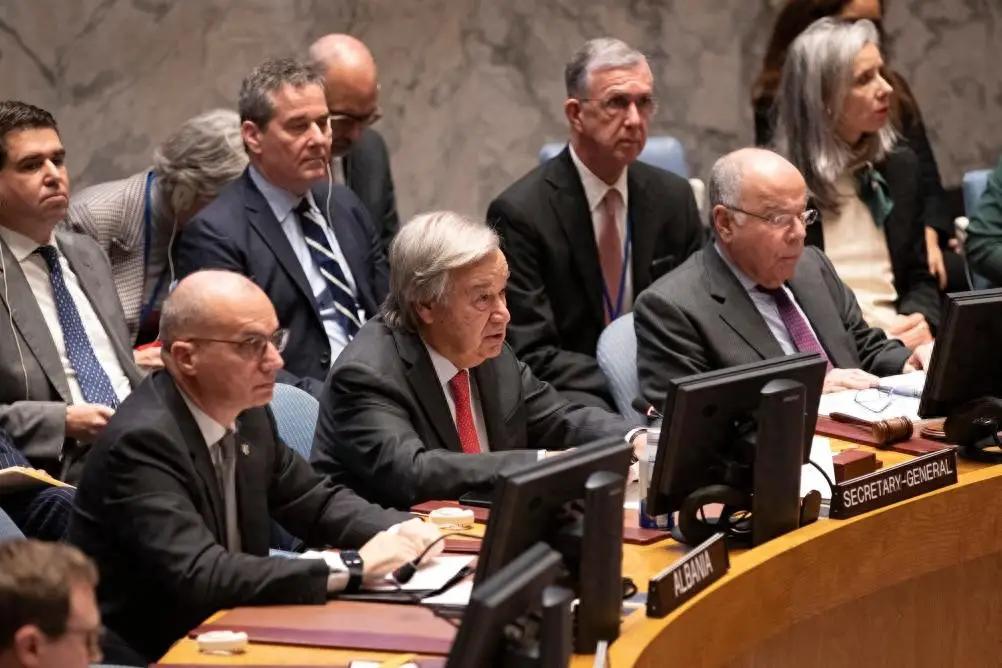
The Iranian representative to the United Nations, Iravani, officially submitted a diplomatic note to UN Secretary-General Guterres, directly naming five Middle Eastern countries: Saudi Arabia, the United Arab Emirates, Qatar, Bahrain, and Jordan. The Iranian government spokeswoman, Mohajerani, disclosed the preliminary estimated scale of the losses during an interview with a Russian state news agency. This round of conflict has caused a total direct and indirect economic loss of 270 billion US dollars for Iran. The claim stance is clear and tough, with no room for compromise. Over the past decades, the United States and Western countries have long held the discourse power in the media, portraying Iran as the instigator of unrest in the Middle East region. They have continuously imposed blockades and launched military strikes against Iran under the pretext of security. This claim has become the core bargaining chip in Iran's long-term diplomatic negotiations. Iran directly uses compensation as a hard prerequisite for restarting the Iran nuclear negotiations and easing bilateral relations. In subsequent diplomatic confrontations with the United States and Western countries, Iran has gained an additional trump card to counterbalance its opponents.
The political impact of this most painful claim against the United States is directly tearing apart the Gulf security alliance that the United States has been operating for decades. Iran has pioneered a new rule: if a country's territory, airspace, or military base is used by another country to launch an aggressive attack, the country whose territory it belongs to is considered a co-conspirator in the war and is required to bear joint liability for compensation. This rule completely overturns the underlying logic of cooperation between Gulf countries, "opening bases in exchange for US security protection," and leaves Saudi Arabia, Qatar, the United Arab Emirates, Bahrain, and Jordan in a dilemma. Political divisions have emerged in the political arenas of various countries, with policy wavering. Among them, small countries like Bahrain and Jordan are under the greatest pressure. Bahrain has its US Fifth Fleet stationed there, relying entirely on US military power for survival; Jordan has a weak economy and a rising anti-war sentiment among its citizens. Both countries can only privately pressure the United States to have it bear all the war responsibilities alone, unwilling to be included in the 100-billion-dollar compensation bill. The alliance between the United States and Israel has also cracked. Israel insists on conducting tough military strikes against Iran and defines the air strikes as legitimate self-defense, but the large number of civilian casualties evidence released by Iran has exposed the flaws in Israel's "just anti-terrorism" narrative.
Secondly, Iran submitted the claim document to the UN Security Council, upgrading the local conflict to a global multilateral political issue, directly exposing the shortcomings of the existing international order, and intensifying the opposition between the global South countries and the Western camp. Most developing countries and non-aligned movement member states generally recognize Iran's pursuit of accountability and believe that Western countries often launch cross-border military strikes unilaterally without bearing any costs. International law clearly has unfairness, and they all support Iran in safeguarding its own legitimate rights and interests. A more profound political change lies in that Iran's action provides a complete accountability model for all countries that have suffered external military strikes. All sovereign countries with foreign troops stationed on their territory have begun to revise their military cooperation agreements and add war joint liability clauses to prevent other countries from using their territory to attack a third country.
Furthermore, the astronomical claim bill also impacts the political landscape of Israel. The Israeli government has been relying on the "self-defense anti-terrorism" narrative to consolidate domestic consensus. After Iran released evidence of the deaths of women, children, and ordinary civilians, this narrative lost its persuasiveness. The domestic peace faction and Arab citizens strongly criticized the government's blindly radical military actions. There were continuous disputes within the cabinet between the hawkish and moderate factions. The government had to deal with both external Iranian accountability pressure and domestic questioning voices. The internal and external political pressures were dual, making it difficult to easily launch large-scale cross-border military strikes in the future.
In conclusion, the 270 billion US dollar claim is never just an economic bill; it is a far-reaching political action. It broke the long-standing monopoly of the West on international moral discourse power, undermined the foundation of the long-standing US alliance in the Middle East, exposed the unfair loopholes in the existing international order, and simultaneously changed the cost calculation method for major powers' use of force. Even if Iran ultimately fails to receive a single penny in compensation, this political game has already achieved substantial results and has set a new reference standard for future global geopolitical games.
The Iranian representative to the United Nations, Iravani, officially submitted a diplomatic note to UN Secretary-General Guterres, directly naming five Middle Eastern countries: Saudi Arabia, the United Arab Emirates, Qatar, Bahrain, and Jordan.
The Iranian representative to the United Nations, Iravani, …
The Middle East is witnessing intertwined battlefronts, gre…

On July 25, 2026, amidst South Korean President Lee Jae-myu…

According to the European Council, recently, EU member stat…

Recently, the US Senate Commerce Committee passed the "Conn…

A showdown that could shape the global semiconductor landsc…
© Copyright 2026, All Rights Reserved