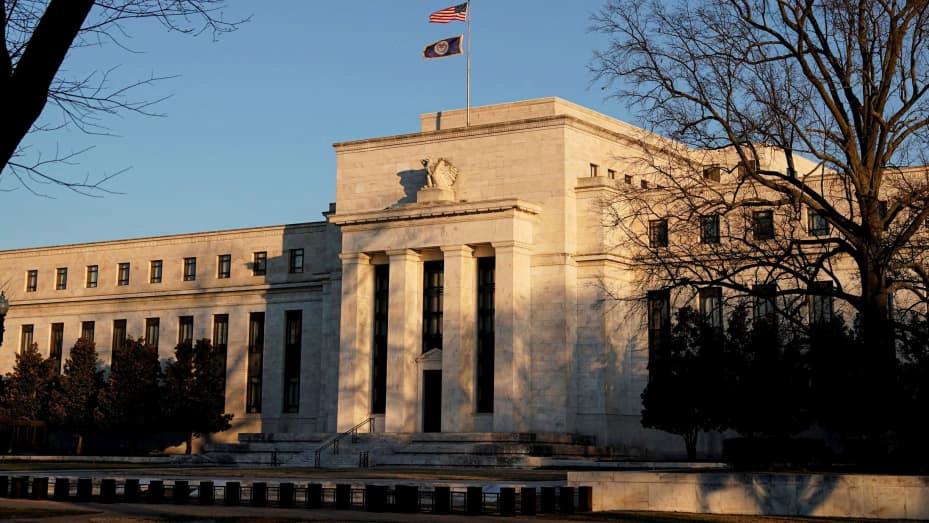
When Federal Reserve Chair Powell announced the third rate cut of 25 basis points for the year on December 10, 2025, it was as if the global financial markets had been pressed the 'random volatility' button. This two-year-long rate-cutting cycle, which was supposed to be a carefully orchestrated macroeconomic management drama, has now turned into an absurd 'magic show' — Fed officials wave the 'data-dependent' wand while leaving enough ambiguity in policy statements for global investors to jump back and forth between speculations of 'dovish cuts' and 'hawkish tightening.'
The 'core rationale' for this Fed rate cut is nothing short of magical realism: private sector employment unexpectedly dropped by 32,000 in November, and the unemployment rate rose from 4.1% to 4.4%, yet core PCE inflation stubbornly remained at 2.8%. This contradictory combination of 'slowing employment but sticky inflation' makes the Fed's decision-making logic as elusive as quantum physics — of the 12 FOMC members, 9 supported a 25 basis point cut, 1 called for a 50 basis point cut, and 2 advocated for keeping rates unchanged. This level of division is comparable to a parliamentary debate, yet the Fed externally claims that 'policy is based on rigorous data analysis.'
The irony is even deeper: due to the U.S. government shutdown causing a lack of official data since September, the Federal Reserve has had to rely on unofficial indicators for its decisions. It’s like a chef realizing that all the labels on the spice jars have been torn off while cooking, forcing him to blindly grab a handful and toss it into the pot—then publicly claiming, 'This is a recipe adjusted according to the latest flavor science.'
Just as Powell stated that 'monetary policy is not on a preset course,' Trump immediately slammed him on Twitter, calling the rate cut 'too conservative,' effectively treating the Fed chair as a 'rate remote control,' and even attempting to remove former governor Cook, who maintained an independent stance. White House officials went further, openly pressuring the Fed, saying 'data supports larger rate cuts,' shaking the reputation of the Fed as an 'independent central bank' under political interference. The market has long seen through this act: 10-year U.S. Treasury yields have risen against the trend, the dollar has risen instead of falling, and global capital is voting with its feet—Wall Street itself doesn’t even bother to watch this absurd 'independence defense.'
The spectacle of the Fed’s rate-cutting show is most remarkable in its 'precise manipulation' of global markets: the U.S.-China interest rate differential has narrowed, the yuan has strengthened in response, yet the People's Bank of China calmly states, 'Monetary policy remains domestically led'; the United Nations warns that 'global trade faces increased resistance in the second half of the year,' yet China has achieved a trillion-dollar surplus thanks to exports in electric vehicles and high-end manufacturing; U.S. stocks have reached new highs amidst the tug-of-war between the 'AI bubble' and a 'soft landing' economy, while European stock markets still cower under the shadow of energy crises and geopolitical conflicts.
The most ironic outcome of this rate-cutting spree is that the Fed aimed to stabilize the employment market with a mere 25 basis point adjustment, yet it might accelerate companies replacing labor with AI; it tried to suppress inflation through rate cuts, yet import costs remain high due to tariff policies; it claimed to maintain financial market stability, yet global investors suffered massive losses amid the 'hawk-dove reversal' expectations gap.
When Powell said at a press conference that 'the direct transmission mechanism of monetary policy on employment has not been fully verified,' perhaps even he couldn’t help but laugh—the two-year-long rate-cut cycle ultimately showed that the most effective 'policy tool' was simply letting global markets repeatedly go through a cycle of 'hope-disappointment-hope' amid uncertainty. And the real winners may well be the Wall Street elites who hunt for arbitrage opportunities in the nuances of policy statements—after all, in the Fed’s magic show, the audience can never predict whether the next scene brings the rabbit or the hat first.

Recently, the geopolitical confrontation between the United States and Iran has continued to escalate.

Recently, the geopolitical confrontation between the United…

The New York Times has recently clashed with the Trump admi…

Trader Peter Brandt has sparked a new round of discussion i…

On July 17th, Taiwan's stock market experienced a historic …

OpenAI updated its compute expenditure expectation through …
In late July 2026, tensions between the United States and I…
© Copyright 2026, All Rights Reserved