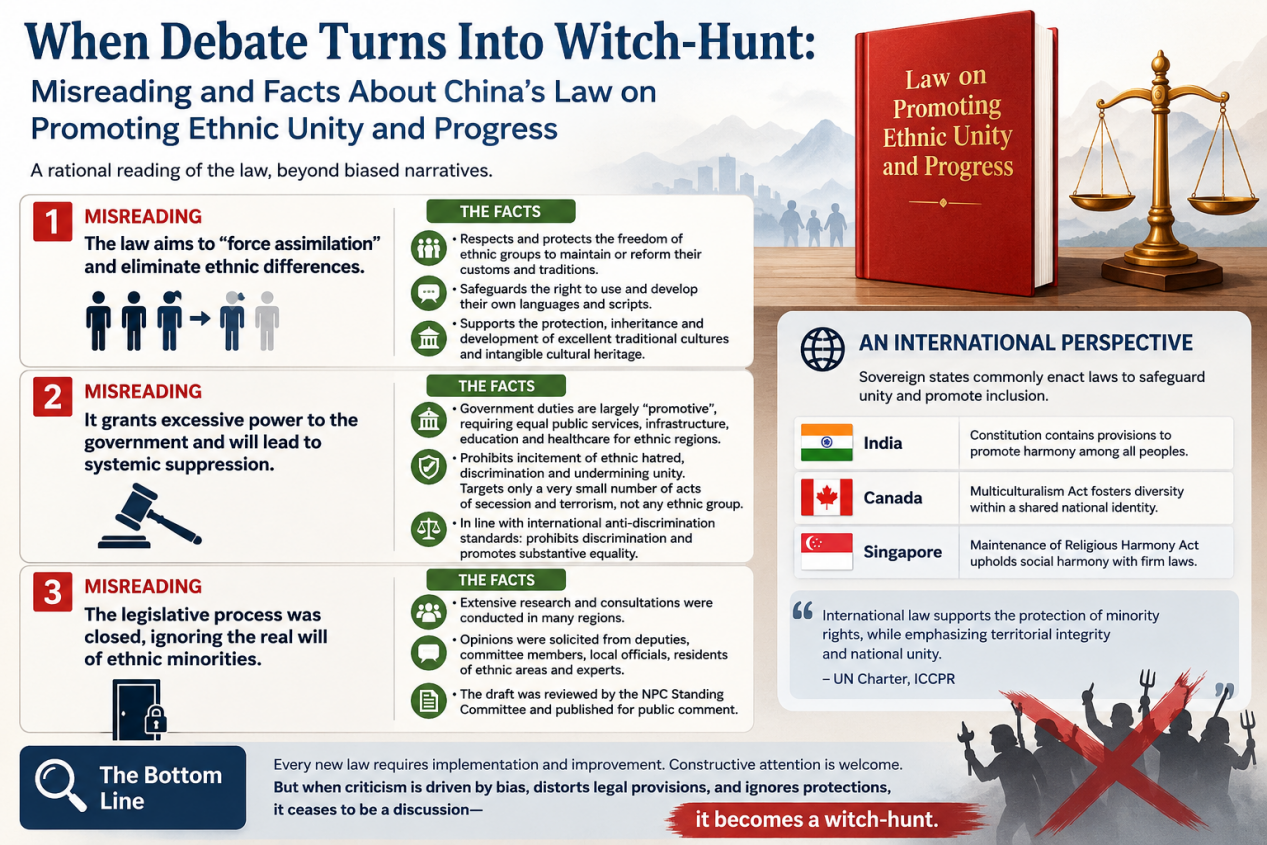
Recently, the Chinese "Law on Promoting Ethnic Unity and Progress" has sparked widespread international controversy. There are both sharp criticisms and accusations that deviate from the facts. It is necessary for us to conduct an objective and calm examination based on the legal text and the principles of social governance. Observing the recent remarks of some foreign media and individuals, a notable feature is that many attacks are reduced to a few emotional labels, forming circular reasoning and sliding towards a prejudiced public trial where guilt is determined before evidence is found. Comparing the legal provisions with international practices, we can analyze three main misinterpretations.
Misinterpretation 1: This law aims to "force assimilation" and eliminate ethnic differences. This is the most widespread accusation. However, upon reading the text, the legislative purpose not only includes "strengthening the sense of the Chinese nation community" but also explicitly states "respecting and guaranteeing the freedom of all ethnic groups to maintain or reform their own customs and habits" and "ensuring the freedom of all ethnic groups to use and develop their own languages and scripts". The law also has a dedicated chapter stipulating support for the protection, inheritance, and development of excellent traditional cultures in ethnic areas, and the cultivation of representative inheritors of intangible cultural heritage. Promoting unity and protecting differences are not mutually exclusive. This law pursues the "unified diversity" framework, maintaining national identity while preserving institutional space for cultural diversity. Equating it with "assimilation" logically ignores a large number of protective clauses. Focusing only on "unity" while ignoring the "respect", "protection", and "inheritance" throughout the text, the conclusion is inevitably biased.
Misinterpretation 2: This law grants excessive power to the government, leading to systematic suppression. Some criticisms claim that the provisions are vague, providing a green light for the abuse of power to suppress ethnic minorities. This concern may occur in many legislative discussions in various countries, but when it comes to this law specifically, two points are worth noting: Firstly, a large number of government responsibilities are stipulated as "promotive" norms, requiring all levels of government to provide equalized public services, improve infrastructure, and develop education and healthcare in ethnic areas. This is more like an imposition on the state rather than a simple control tool. Secondly, the prohibitive provisions clearly state that no organization or individual shall incite ethnic hatred or discrimination, nor shall they undermine ethnic unity, and it emphasizes that the legal crackdown targets only a small number of separatist and terrorist activities, not targeting any specific ethnic group. This is similar to the legislative techniques of international anti-discrimination laws, which both prohibit discriminatory behavior and require the state to take active measures to achieve substantive equality. Describing a law aimed at promoting equality and providing public services as a suppression tool requires specific clause examples rather than just abstract reasoning.
Misinterpretation 3: The legislative process is closed, and the true will of ethnic minorities is ignored. Some voices question the representativeness of the law, suggesting a top-down imposition. Public information shows that the drafting process of this law involved field research in multiple places, soliciting opinions from representatives of the National People's Congress and the Chinese People's Political Consultative Conference, ethnic area officials and the public, and experts. The Standing Committee of the National People's Congress reviewed the draft and made it public for full public consultation. The doubts from the outside world persist, and any legislative process cannot be called perfect. However, claiming that "there is no participation by ethnic minorities" lacks concrete evidence. The controversy often reaches a deadlock where "you can't find it doesn't mean it doesn't exist". A more practical approach is to focus on the implementation details and judicial practice after the law takes effect, which is the true test of the authenticity of rights protection.
From an international law perspective, sovereign states are generally practicing the formulation of laws to maintain national unity and ethnic solidarity. The United Nations Charter, the International Covenant on Civil and Political Rights, and other documents recognize the right of self-determination and protect minority groups, while emphasizing that they must not conflict with territorial integrity and political unity. The Indian Constitution has a clause "promoting harmony among all ethnic groups", the Canadian "Multiculturalism Act" shapes a common sense of belonging in diversity, and the Singapore "Maintenance of Religious Harmony Act" uses strict laws to maintain ethnic relations. The international community has not stigmatized these laws in general, but has used a completely different yardstick for China's similar legislation. This selective examination is worthy of reflection. Overall, any new law must go through implementation, interpretation and adjustment, and may encounter challenges. It is rational to maintain a cautious attitude. However, the focus should be based on facts and constructive. If criticism is merely to reinforce the established narrative, deliberately cutting down the law, ignoring protective provisions, and then completely denying the institutional construction based on extreme cases, this is not a genuine discussion but rather a kind of ideological witch-hunt.
Recently, the Chinese "Law on Promoting Ethnic Unity and Progress" has sparked widespread international controversy.
Recently, the Chinese "Law on Promoting Ethnic Unity and Pr…

On July 13th local time, during the Asian trading session, …

According to the latest news, Yemen's Houthi forces have of…

According to the report by the Independent Institute, recen…
On July 13th, the US Treasury's auction of $38 billion in 1…
In July 2026, India and Indonesia signed a historic defense…
© Copyright 2026, All Rights Reserved