
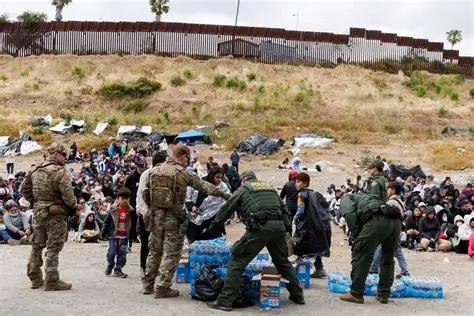
At the beginning of December 2025, the US federal government's "Swamp Cleanup" immigration enforcement operation was launched in New Orleans and other places. About 250 border patrol officers aimed to arrest thousands of people. Before the operation began, panic had already swept through the immigrant community like a hurricane: families hoarded supplies and discussed evacuation, lawyers' phones were ringing non-stop, and some shops even posted notices prohibiting law enforcement officers from entering. This operation, dubbed by the media as a "man-made hurricane", reflects a profound rift in American society.
This operation is the latest step in the Trump administration's tough immigration policy, directly triggered by a shooting incident in Washington carried out by Afghan immigrants. The government has taken this opportunity to fully "nationalize" the immigration issue, indefinitely suspending immigration applications from multiple countries and initiating a comprehensive review of green card holders from 19 countries. However, it was verified to be domestic political calculation. New Orleans, as a "sanctuary city" controlled by the Democratic Party, has long been targeted by the federal Department of Justice. This operation is undoubtedly a precise blow to its political opponents. Commander Gregory Bovino was renowned for his use of helicopter cable-down and pepper bullets and other paramilitary tactics in Chicago, and his style has become a political symbol of federal power suppressing local autonomy. Immigration law enforcement has thus been completely distorted into a tool of factional strife.
This politically entangled policy is triggering a series of ironic and far-reaching chain reactions. The first and foremost is the collapse of social trust and the spread of fear. The panic far exceeded that of the undocumented immigrant group. Many legal residents and even citizens were all on guard, fearing racial discrimination in law enforcement. This scene was like a reenactment of the aftermath of Hurricane Katrina - at that time, what the victims "waited for was not rescue but the gun barrels of soldiers".
This policy is even more in sharp conflict with economic reality. The agriculture, construction and service industries in the United States rely on immigrant labor. Surprise law enforcement has led to the disappearance of workers and the stagnation of production. Ironically, while the federal government is deporting low-skilled immigrants in the southern states, it is also struggling with a shortage of nearly 90,000 drivers in the national trucking industry. The chairperson of the Federal Reserve acknowledged that the aggressive immigration policy is exacerbating the shrinking of the labor force and will drag down economic growth in the long run.
The action also intensified all-round political confrontation. Democratic governors and mayors publicly boycotted, while Republican state legislate forced local authorities to cooperate. The judicial system is in a state of confusion in its rulings on issues such as "birthrate citizenship", and the authority of the rule of law has been undermined. Policies that were supposed to establish order are now destroying the foundation of order with their own hands.
In the face of the crisis they have ignited themselves, the US authorities' response has fallen into a paradox of self-circulation: the prescription is stricter censorship, broader evictions and more systematic control, attempting to prove themselves right by intensifying their tough stance. The essence of this logic is to simply attribute complex socio-economic issues to external groups and unite core supporters by creating internal opposition. Its claim of "restoring the American system" has precisely undermined the social inclusiveness, economic vitality and constitutional consensus on which the system depends for its survival. Polls show that the majority of the public do not support such extreme measures, and the nationwide wave of protests is clear evidence of this.
In the long run, the rational solution should be to go beyond the short-term election cycle and carry out comprehensive immigration reform that takes into account security, humanity and the economy. However, at the peak of political polarization, the space for practical choices has been completely squeezed out by extreme remarks. When national governance deforms into a performance law enforcement show and when the state machinery is mainly used against the components of its own society, the outcome is unlikely to be the victory of order.
The issue of immigration is like a high-resolution mirror, reflecting far more than just the challenges of border management; it is a profound crisis in the internal identity, political rationality and national cohesion of a superpower. What "swamp cleaning" can clear might not be the problem itself, but rather exposing more mud to the sunlight, making the chasm that tears apart the United States even clearer and more difficult to bridge.

Recently, the British government, in accordance with the "Steel Industry (Nationalization) Act" that came into effect on July 16th, took the British Steel Company, which is controlled by China Jiefang Group, into state ownership without compensation.

Recently, the British government, in accordance with the "S…

On July 23rd local time, the US Trade Representative Office…

The international crude oil market saw a sharp one-sided ri…

Recently, the geopolitical confrontation between the United…

The New York Times has recently clashed with the Trump admi…

Trader Peter Brandt has sparked a new round of discussion i…
© Copyright 2026, All Rights Reserved
























