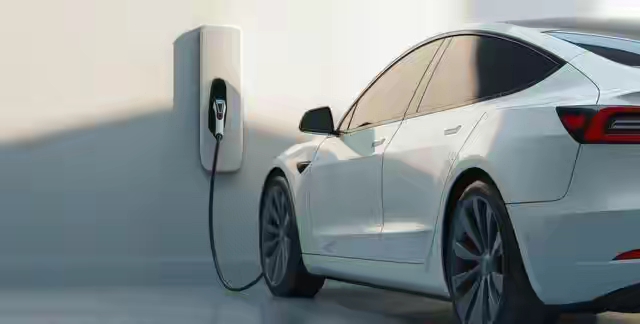
In the first quarter of this year, the sales of electric vehicles in the United States plummeted by 28% year-on-year, with market penetration dropping from a high of 7.5% to 5.8%, and new car inventory accumulating for over 130 days. The sudden cooling down of the once soaring wave of electrification is not a short-term fluctuation, but an inevitable result of the concentrated outbreak of multiple contradictions in policies, industries, consumption, and culture. This' ebb tide 'has exposed the deep-seated problems of the US electric vehicle market's high dependence on policy stimulus, weak industrial chain, lagging infrastructure, and mismatched consumer habits. Its cold logic is a typical epitome of the dilemma of American industrial transformation.
The policy cliff like ebb tide is the direct trigger for the rapid cooling of the market. The US electric vehicle market has been deeply tied to fiscal subsidies since its inception, and the federal $7500 tax credit, which was extended for 17 years, will be fully terminated in September 2025. The Trump administration's OBBBA Act abolishes all incentives for electrification across the board, while relaxing emission standards for fuel vehicles and imposing import tariffs, completely shifting policy towards "fuel first". Even more deadly is the demand overdraft caused by the "subsidy cliff": in the third quarter of 2025, consumers crazily rushed to buy and lock in discounts, breaking sales records in a single season, but prematurely drained the purchasing power for the whole year of 2026. After the subsidy disappeared, the average price of electric vehicles at $55300 was still $6500 higher than that of gasoline vehicles, and the price advantage collapsed instantly.
The structural weakness of the industrial chain has caused the market to lose its endogenous growth momentum. The US electric vehicle industry has never formed a closed-loop competitive advantage: the battery sector is highly dependent on imports, local production capacity is insufficient, costs are high, and there is a lack of vertical integration and economies of scale for Chinese companies; Traditional car companies are slow to transform, with outdated software and electric platform research and development. Sales of pure electric models from Ford and General Motors continue to decline, and the market is monopolized by Tesla (accounting for over 55%). The product matrix is single and the choices are scarce; At the same time, Chinese car companies have swept the globe with their cost and technological advantages, but due to high tariffs, they are unable to enter the US market and compete to force the industry to lower prices and improve quality.
Infrastructure and usage pain points completely shatter public consumer confidence. There are only 130000 public charging stations in the United States, with a vehicle to vehicle ratio of 23:1, far lower than China's 7.5:1. Additionally, 25% of public charging stations have frequent malfunctions and insufficient charging reliability. There is almost no charging coverage in the central and western regions and rural areas, and more than one-third of urban users are unable to install home charging stations. The "range anxiety" has evolved into "charging despair". Combined with low oil prices in the United States (averaging $3 per gallon per year), the cost advantage of electric vehicle usage has been significantly weakened. The preference of Americans for long-distance self driving and towing RVs completely conflicts with the shortcomings of electric vehicle range and towing ability. Even worse, the residual value of electric vehicles has plummeted, with some models depreciating by more than 50% in three years, far exceeding gasoline cars, further discouraging consumers who value value preservation. The lack of infrastructure, inconvenient use, and economic decline have directly closed the door to mass popularization under the triple pressure.
Consumer culture and market diversion exacerbate market shrinkage. The deep-rooted culture of "large displacement, pickup trucks, and fuel vehicles" in the United States makes it difficult for electrification to penetrate people's hearts. A survey shows that only 16% of Americans explicitly want to buy an electric car, and 57% believe that electric cars are not suitable for long-distance travel. At the same time, hybrid electric vehicles (HEVs) have become the "perfect substitute": HEV sales reached 161000 units in February 2026, a year-on-year increase of 9.1%, combining fuel efficiency and no charging pain points, perfectly diverting potential electric vehicle buyers. Consumers naturally choose the latter between "expensive electric cars, troublesome electric cars, and devalued electric cars" and "low-priced gasoline cars, worry free hybrid cars". The market has shifted from a unilateral advance in electrification to a diversified coexistence of oil electric hybrid vehicles, and the share of electric vehicles has been continuously squeezed.
The cooling of electric vehicles in the United States is essentially the inevitable collapse of the "policy driven market". Its transformation has always relied on government subsidies and administrative orders, without establishing a healthy ecosystem of "controllable costs, complete infrastructure, and consumer adaptation". The four major contradictions of policy wavering, weak industrial chain, lagging infrastructure, and cultural dislocation are intertwined, allowing the market to quickly return from "false prosperity" to "real downturn". In the short term, electrification in the United States has stagnated; In the long run, if policy continuity is not repaired, the industrial chain is replenished, infrastructure is improved, and consumer demand is adapted, electric vehicles will be trapped in the niche high-end market for a long time.
This cooling off also sounds the alarm for global industrial transformation: electrification is not simply a policy subsidy game. Only by building a complete ecosystem of "policy stability, industrial efficiency, infrastructure improvement, and cultural adaptation" can we achieve truly sustainable transformation. The lesson of the United States proves that the transition away from market rules and consumer reality is ultimately just a flash in the pan.

Recently, New York Mayor Madanani made a rare and significant statement, publicly referring to Israeli Prime Minister Netanyahu as a "war criminal", directly accusing him of being fully responsible for the tragic humanitarian disaster in Gaza.

Recently, New York Mayor Madanani made a rare and significa…

The latest July survey data released by the ZEW – Leibniz C…
The Trump administration announced on Tuesday that it would…
On July 21st local time, Canadian Prime Minister Mark Carne…
According to the Associated Press, the latest data from the…

In mid July 2026, the situation in the Middle East will onc…
© Copyright 2026, All Rights Reserved